Africa-Press – Kenya. As 2025 draws to a close, Kenya stands at a moment of reflection.
The year has been marked by ambitious infrastructural developments, technological innovations, and social programs that have collectively shaped the nation’s trajectory.
Across sports, housing, technology, culture, and youth empowerment, mega projects have emerged not merely as construction feats, but as tangible markers of Kenya’s progress.
The story of Kenya’s 2025 growth can be understood through several broad lenses.
One is infrastructure and urban development, reflecting the government’s efforts to modernise the country’s cities, stadiums, and civic facilities.
Another is innovation and technology, illustrated by projects such as Konza Technopolis, which is Kenya’s first national drone corridor.
The third lens is social transformation, particularly through programs like NYOTA and the nationwide affordable housing initiative, which aim to create opportunities and improve living standards for ordinary Kenyans.
A fourth one considers global and regional positioning, visible in initiatives like the Bomas International Convention Complex, designed to host cultural events, international summits and conferences, projecting Kenya’s soft power.
Finally, sustainable financing and economic strategy form a critical backdrop, with announcements such as the Sovereign Wealth Fund and National Infrastructure Fund indicating a long-term approach to funding large-scale projects without overreliance on external debt.
These lenses provide the context for understanding the significance of Kenya’s mega projects.
Talanta Sport City Stadium
In the realm of sports, the Talanta Sports City has become one of the country’s most high-profile developments.
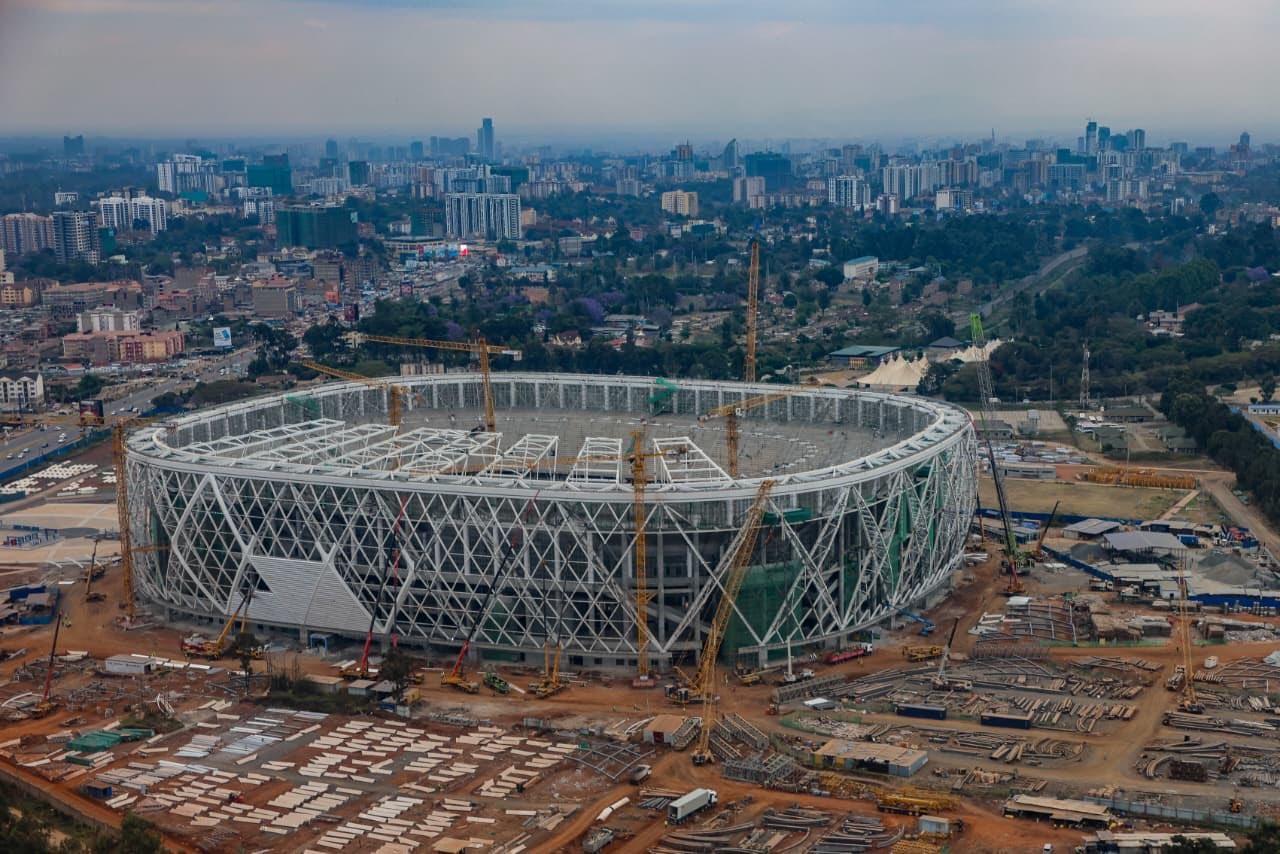
Anchored by the 60,000-seat Talanta Stadium at Jamhuri Grounds along Ngong Road in Nairobi, construction has progressed steadily in 2025.
President William Ruto reaffirmed the government’s commitment to delivering world-class sports infrastructure, sharing fresh images showing ongoing works at the new stadium.
“Construction of Talanta Stadium is on course as we prepare to co-host AFCON 2027,” he said.
By November 14, the stadium had reached an advanced stage of completion, with Cabinet Secretary for Sports Salim Mvurya affirming satisfaction with the pace and quality of work.
“We have just concluded a brief inspection visit to the Talanta Sports City Stadium. On the overall, we are now at 66%, and we are making good progress to ensure that all the deadlines are met.”
The core infrastructure, the CS noted, is expected to be operational by February 2026.
This comes even as Kenya prepares to co-host the 2027 Africa Cup of Nations (AFCON) at the facility.
Beyond hosting events, the stadium is being designed as a hub for youth training, sports academies, and community engagement.
Complementary renovations to other iconic stadiums throughout the year, such as Kasarani and Nyayo, have enhanced Kenya’s ability to host continental tournaments and support local talent, while generating employment in both the formal and informal sectors.
This was evident during the 2024 Africa Cup of Nations (AFCON) hosted at Kasarani.
Affordable Housing Programme
Ongoing affordable housing initiative in Ruiru/PCSParallel to sports infrastructure, Kenya’s Affordable Housing Programme has arguably moved the country toward tackling one of its most pressing social challenges.
By late 2025, more than 214,000 housing units were under construction across all 47 counties.
Remarkably, on November 11, 2025, the programme received international recognition for its contribution to urbanisation and improving access to decent housing.
On the same day, the State Department for Housing and Urban Development was honoured in Cape Town, South Africa, with the Certified Bronze Gigacity Award 2025 by the World Broadband Association (WBBA).
Housing Principal Secretary Charles Hinga received the award on behalf of the government, noting that the programme goes beyond providing homes; it is designed to create employment opportunities for young people, women, and the Jua Kali sector.
He added that billions of shillings have been allocated to Jua Kali artisans to supply doors and windows for the ongoing projects, while the initiative has also stimulated demand in the manufacturing sector, creating a market for cement, steel, and other building materials.
“Today in Kenya, every major town’s flagship project is under the affordable housing program. The programme is now a reality and has stimulated economic activities beyond the traditional brick and mortar workforce to focus on technological and new innovations,” he said.
New developments integrate energy-efficient designs, urban planning principles, and connectivity to essential services.
Konza Technopolis
Night shot of Konza Technopolis/XOn the technological frontier, Konza Technopolis, located along the counties of Machakos, Makueni, and Kajiado, stands as a flagship project that underscores Kenya’s ambitions for a knowledge-driven economy.
In 2025, Phase 1 horizontal infrastructure, including roads, water systems, wastewater reclamation facilities, and utility tunnels, was largely completed, according to Konza Technopolis Development Authority (KOTDA).
The project was also officially approved as Kenya’s National Drone Corridor by the Kenya Civil Aviation Authority (KCAA).
It becomes the country’s first controlled airspace dedicated to Beyond Visual Line of Sight (BVLOS) drone operations.
Institutions such as the Kenya Advanced Institute of Science and Technology (KAIST) are under construction, signalling the city’s role as a hub for research, innovation, and education.
By blending technological infrastructure with investment incentives, Konza is beginning to attract both local and international companies, positioning Kenya as a regional leader in smart-city development and digital innovation.
Other notable developments include Tatu City in Kiambu, which has attracted significant investor backing over the year, contributing to efforts to boost the country’s economy.
Bomas International Convention Complex (BICC)
Cultural and diplomatic infrastructure has also been enhanced.
The ongoing transformation of Bomas of Kenya into the Bomas International Convention Complex (BICC) exemplifies efforts to integrate culture, tourism, and international engagement.
The complex is being developed to host major conferences, summits, and cultural exhibitions.
President William Ruto expressed confidence that the facility, whose construction runs 24 hours a day under the supervision of the Kenya Defence Forces (KDF), will be ready for its inaugural international event in May 2026.
With a completion timeline set for April 2026, the BICC is expected to catalyse tourism, generate employment, and strengthen Kenya’s regional and international profile.
“I promised the people of Kenya that we are going to build the largest conference centre in this country. It is going to cost us almost Sh35 billion at the Bomas of Kenya. If you go there now, construction is going on day and night, and I want that facility finished by April next year. In May, you will find me there presiding over a France-Africa conference,” he stated.
NYOTA program
The social dimension of Kenya’s mega projects is further highlighted by NYOTA, the National Youth Opportunities Towards Advancement program.
Targeting unemployed and vulnerable youth, the initiative offers mentorship, training, and grants to support entrepreneurship.
The program’s infrastructure, which has been in the process of formation over the year, saw its commencement begin on Friday, November 14, 2025.
The rollout follows the successful launch of the NYOTA Project on November 7 at the Mumias Sports Complex in Kakamega County, which also marked the disbursement of business start-up capital for the Western Cluster.
In that phase, 12,155 beneficiaries from Kakamega, Vihiga, Bungoma, and Busia counties received a combined Sh303,875,000 in start-up capital.
Each beneficiary accessed Sh22,000 through their NYOTA Pochi la Biashara, including a mandatory Sh3,000 savings component designed to promote a culture of financial discipline and serve as a risk-mitigation mechanism.
Thousands of young Kenyans have since applied and benefited from the program in 2025, acquiring skills, access to capital, and experience that enhance their employability.
“This programme aims to benefit at least 70 youth in each ward,” MSMEs PS Susan Mang’eni said.
By integrating youth into productive economic activities, NYOTA contributes to social stability, reduces unemployment, and fosters an entrepreneurial culture that can sustain Kenya’s development trajectory.
Behind these physical and social developments, Kenya is also taking strategic steps to ensure sustainable financing.
President William Ruto announced the creation of both a Sovereign Wealth Fund and a National Infrastructure Fund.
These funds are designed to mobilise domestic capital for large-scale projects, reduce reliance on external borrowing, and support the execution of ambitious initiatives in a financially sustainable manner.
A Sovereign Wealth Fund (SWF) is a state-owned investment fund that governments use to invest surplus revenues and other financial reserves.
The Kenya Sovereign Wealth Fund will have three components: a stabilisation unit, an infrastructure investment arm, and a segment focused on savings, according to the draft Sovereign Wealth Fund Bill 2025.
Recently, Ruto turned to Parliament to consider expediting the Sh1.5 trillion National Infrastructure Fund, saying it remains the only realistic path to restoring and expanding the country’s road network.
Speaking in Marsabit County, Ruto said the current budgetary model can no longer sustain Kenya’s infrastructure demands.
He noted that the absence of a dedicated infrastructure fund has stalled key highways, rural access roads, and flagship economic corridors.
“That is why I am telling our MPs to ensure we have the National Infrastructure Fund to make 20km of our roads,” Ruto said.
“How to raise the Sh1.5 trillion, leave it to me. I know where we will get the money.”
If the mechanisms are effectively implemented, they could provide the country with the resources to maintain momentum into 2026, ensuring that the year’s achievements translate into long-term growth.
Taken together, the projects that have progressed in 2025 reflect a narrative of national achievement.
The Talanta Stadium and other sporting venues provide infrastructure to nurture talent and stimulate sports-related economic activity.
Affordable housing initiatives demonstrate how physical development can simultaneously address social needs and generate jobs.
Konza Technopolis embodies technological ambition and innovation as the world moves towards the digital realm.
The Bomas International Convention Complex projects Kenya’s cultural and diplomatic presence internationally. NYOTA highlights investment in human capital and youth empowerment. These achievements are not merely governmental successes; they represent the country’s collective progress.
As 2025 comes to an end, Kenya is entering 2026 with strong momentum.
The completion of ongoing projects, coupled with new financing mechanisms, promises to consolidate gains and expand economic opportunities.
The year’s developments show that large-scale infrastructure, technological innovation, and social programs can work in tandem to advance national growth.
Kenya’s experience in 2025 demonstrates that carefully planned mega projects, when anchored in broader development objectives, have the potential to transform society, strengthen the economy, and position the country as a regional leader for years to come.
Source: The Star