What You Need to Know
Vihiga Senator Godfrey Osotsi has dismissed claims linking his recent attack to a love triangle, calling it misleading propaganda. He emphasized that the incident was politically motivated and criticized the rapid spread of misinformation online. Osotsi recounted his severe injuries and praised the medical care he received, while urging authorities to investigate the attack’s true motives.
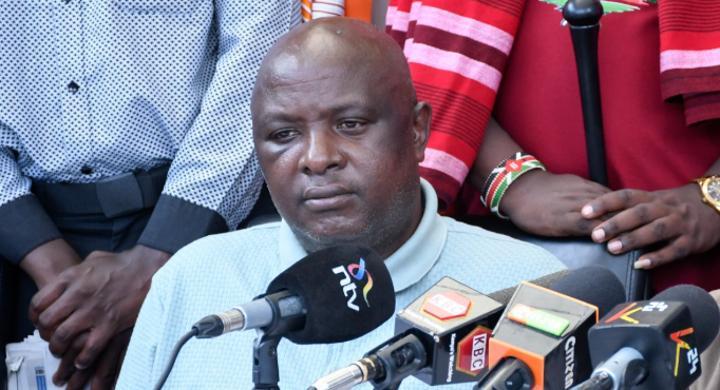
Africa-Press – Kenya. Vihiga Senator Godfrey Osotsi has strongly dismissed claims that his recent attack was linked to a love triangle, terming the narrative as misleading state propaganda and insisting the incident was politically motivated.
Osotsi said attempts to sensationalise the attack were aimed at diverting attention from the real issues behind the assault.
“It was not a love triangle; I have a beautiful wife. Even if I wanted to do love, I cannot do it in the open,” he said in a press conference after recovery.
“It is unfortunate that when a leader in Kenya is attacked, the narrative quickly shifts to personal matters instead of focusing on the truth.”
The senator expressed concern over the speed at which alternative versions of events emerged online, even before official communication or media reports.
“Within 10 minutes of the attack, bloggers were already out giving their version of events. They seemed to know what had happened even before my own media team,” he said.
Osotsi recounted the severity of his injuries, revealing that he was in critical condition following the incident.
“My whole face was swollen. I could not be recognised. My right hand was paralysed, and I had a serious injury on my knee,” he said.
“One of the attackers wanted to remove a gun,” he added.
He was first rushed to Aga Khan Hospital, where initial emergency care was administered.
The senator credited Siaya Governor James Orengo and Nairobi Senator Edwin Sifuna for coordinating efforts that ensured he received further treatment in Nairobi.
“James Orengo was in town and quickly came in. Together with Senator Sifuna and other leaders, they coordinated with the police and Parliament to facilitate my transfer,” Osotsi said.
He was later admitted to Karen Hospital, where he says he received specialised care that significantly aided his recovery.
“Karen Hospital is a wonderful facility. They gave me personalised care, and within a short time, I was able to recover. I thought I would stay longer, but I am now healed and ready to resume my duties,” he said.
The incident has since sparked renewed debate over the safety of political leaders and the spread of misinformation in the wake of such attacks.
Osotsi urged authorities to focus on investigating the perpetrators and ensuring accountability rather than allowing speculation to dominate public discourse.
“I am alive, I have healed, and I am ready to go,” he declared, signalling his return to active political engagement even as questions linger over the motives behind the attack.
Political violence in Kenya has a complex history, often intertwined with ethnic tensions and electoral disputes. Leaders have faced threats and attacks, raising concerns about their safety and the political climate. The rise of social media has further complicated narratives, allowing misinformation to spread rapidly, often overshadowing the facts surrounding such incidents. This situation highlights the need for accountability and thorough investigations into political violence, as well as the importance of responsible media reporting.