
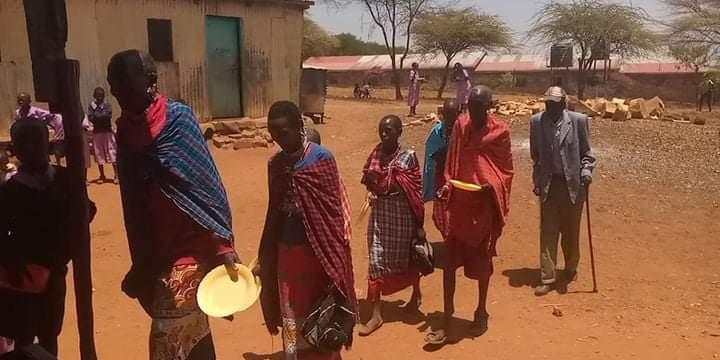
Africa-Press – Kenya. Kajiado, Laikipia and Nyeri recorded 475,363 livestock deaths due to the ongoing drought, the National Drought Management Authority report has said. NDMA said 270,354 cattle, 141,620 sheep and 63,983 goats died.
The report said the livestock mortality was driven by starvation, dehydration and disease as a result of the drought. High staple food prices, the report said, persist driven by the below-average harvests in the country and across the East Africa region.
“In addition to rising prices in the regional surplus-producing countries of Uganda, Tanzania, and Ethiopia, where the ASALs source for supplies when their stocks diminish,” the report said.
The survey was conducted in 23 arid and semi-arid counties. The assessment was carried out by the Kenya Food Security Steering Group in collaboration with the respective county steering groups.
The KFSSG is a multi-agency body comprised of government departments, United Nations agencies, and Non-governmental organizations concerned with food and nutrition security.
The multi-agency body is chaired by the NDMA and co-chaired by the World Food Programme. The report said food security in the country is highly dependent on rainfall.
“Given that the rainfall seasons in Kenya are largely bimodal, the assessments are conducted bi-annually, after the short rains of October to December and after the long rains of March to May,” it said. The 2022 short rains assessment survey was conducted between January 11 and February 10.
Given the protracted drought, the report said, the assessment was expanded to include additional nine ASAL counties of Kiambu, Murang’a, Kirinyaga, Migori, Homabay, Siaya, Nakuru, Machakos, and Elgeyo Marakwet, which had significant areas considered semi-arid.
The main objective of the assessment was to determine the impacts of the 2022 short rains on food and nutrition security in 32 counties. The report said maize and bean prices generally remained significantly higher than in 2021 and the five-year average due to the high costs of production and marketing such as fuel and fertilizer brought about by the Russia and Ukraine conflict.
Conflict and insecurity banditry attacks, the report said, were reported in Baringo, Laikipia and West Pokot counties resulting in fatalities, injuries and livestock loss.
The report said Kirima and Laikipia North subcounties experienced insecurities occasioned by cattle rustling while Laikipia West and Laikipia East experienced both human-wildlife conflicts and resource-based conflicts.
Incidences of resource-based conflicts have been reported between in-migrating herders and local farmers in Kitui, Meru and Makueni counties which so far have resulted in approximately 10 human fatalities. Similar incidences were also reported along the borders of Meru National Park and Makueni where there were migrating cattle from Kajiado.
In Kilifi, similar cases were reported in Ganze, Magarini and Kaloleni and parts of Malindi due influx of cattle and camels from Garissa, with similar incidences reported in areas of Pangani, Lumshi, Witu and Mkunumbi in Lamu and the areas of Mackinnon Road, Samburu/Chengoni, Mwavumbo, Mwereni and Puma Ward in Kwale.
In addition to these incidences, the reports said, security operations in Lamu have adversely affected market operations and livelihood activities driving significant price increases.
“Human-wildlife conflicts were reported in Meru North where more than 247 acres of crops were estimated to have been destroyed by wild animals and over 300 farms were destroyed by elephants in Kitui where livestock owners also lost over 61 heads of livestock to predation by hyenas and wild dogs,” the report said.
Human-wildlife conflicts were equally reported in Lamu and Kilifi in areas bordering the Tsavo National Park. Crop pests and disease infestations of fall armyworms occurred in maize in Makueni and Kitui affecting about 2,000 acres of maize crop during the vegetative stages and driving poor crop performance.
The report said the food security situation has deteriorated across ASAL counties. The population facing acute food insecurity and consequently requiring humanitarian assistance increased significantly to 4.4 million who are classified in crisis and emergency phases.
The increase from 3.5 million people identified during the 2022 long rains assessment denotes an overall deterioration in the food security situation across the 23 ASAL counties and is projected to further worsen during the long rains season owing to the forecasted below-normal rains.
The report predicts that populations facing acute food insecurity are likely to hit 5.4 million by June 2023. The pastoral and agro-pastoral counties reported deterioration in both environmental and productive indicators.
Pasture and browse are at an all-time low with most pastoral counties recording severe to extreme vegetation deficit except parts of Turkana, Garissa and Tana River counties that had fair to poor forage conditions.
The available pasture is expected to last for less than 1 month with the warmer-than-normal conditions and overconcentration of livestock escalating the depreciation.
The report said return trekking distances increased to 15-35 km compared to the average of 2-10 km further impacting negatively on productivity in both pastoral and agro-pastoral livelihood zones.
Over 90 per cent of surface water sources have dried up following poor recharge across all counties. The watering frequency for all species decreased with cattle, sheep and goats watered 2 – 3 days a week across the livelihood zones compared to 4-7 days a week normally.
Camels, the report says, were watered once per week compared to 2-3 days a week normally. Livestock body condition for cattle and sheep is poor to very poor while that of goats and camel is fair to poor across the counties.
For More News And Analysis About Kenya Follow Africa-Press