What You Need to Know
Transport on the Mwea-Embu Highway was halted after a fatal hit-and-run incident involving a miraa vehicle led to protests by residents and boda boda riders. The angry locals blocked the road for hours, demanding action against reckless driving, which they claim has resulted in multiple fatalities. Eyewitnesses reported chaotic scenes as residents expressed their frustration over the lack of speed
Africa-Press – Kenya. Transport along the busy Mwea-Embu Highway ground to a halt after a fatal hit-and-run involving a miraa vehicle sparked outrage, pushing residents and boda boda riders to block the road in protest.
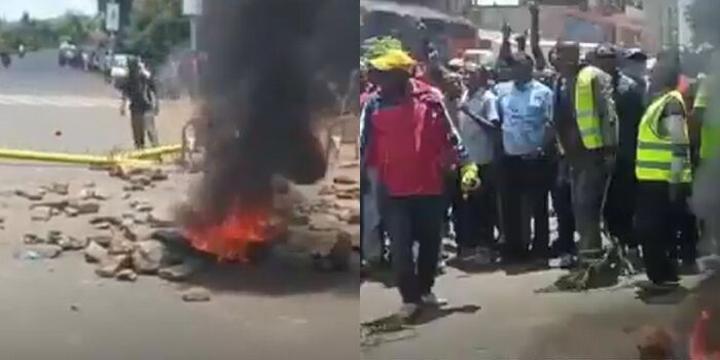
The disruption unfolded at Ngurubani Town, where angry locals barricaded the Makutano–Embu Highway for hours, bringing movement of vehicles and people to a complete standstill as tensions quickly escalated across the area.
The protests were led largely by boda boda riders, who accused miraa drivers of persistent reckless behavior, including overspeeding, that has led to multiple losses of lives.
According to reports, the victim died on the spot after being struck by a speeding Probox ferrying miraa, with the driver fleeing immediately.
Eyewitnesses described a chaotic scene as residents poured onto the highway, lighting fires and placing obstacles on the road, effectively cutting off transport and forcing motorists to seek alternative routes for several hours.
Tensions intensified as residents openly warned miraa drivers against speeding through the area again, with one stating, “This is the second time in a row that they are killing someone, and the more they kill, the more we will block this road.”
Another resident added, “ We are issuing a stern warning to these drivers, that whoever attempts to pass in this road at that kind of speed will be stopped and blocked immediately.”
At the centre of the anger is the long-standing issue of miraa vehicles operating without speed governors, despite being subject to traffic regulations that are meant to enhance safety on public roads across the country.
The nature of miraa as a highly perishable crop means drivers often prioritise speed to preserve freshness and value, racing against time to deliver to markets in Nairobi and Mombasa before quality declines.
These vehicles are also heavily modified for speed and endurance, with reinforced suspension systems and experienced drivers who know the routes well, making enforcement difficult as economic pressure often outweighs safety considerations.
The latest incident adds to a growing list of accidents involving miraa vehicles, including one on April 3, 2026, at Samson Corner, Embu County, where a Probox driver died after a head-on collision with a Canter lorry.
On the other hand, earlier on February 1, 2026, another fatal accident occurred at Njuri area along the Embu-Meru Highway, where a speeding Probox carrying muguka collided head-on with a lorry, killing two people instantly.
The National Transport and Safety Authority (NTSA) has already raised concern, reporting over 1,100 road deaths in early 2026, warning that regions heavily affected by miraa transport continue to record alarming accident rates.
The Mwea-Embu Highway has been a critical transport route in Kenya, facilitating the movement of goods and people. However, it has also been the site of numerous accidents, particularly involving miraa vehicles, which are often driven recklessly due to the perishable nature of their cargo. The ongoing issue of road safety has prompted calls for stricter enforcement of traffic regulations, especially concerning speed limits and vehicle modifications.
In recent years, the rise in accidents has raised alarms among authorities, with the National Transport and Safety Authority (NTSA) reporting a significant number of fatalities linked to miraa transport. The community’s frustration reflects a cl