Africa-Press – Kenya. President William Ruto has urged African countries to fast-track the adoption of locally manufactured health products. He warned that the continent’s heavy reliance on imported medicines is undermining health security, straining national budgets and exposing citizens to unsafe products.
Ruto said Africa must urgently reposition itself from a consumer to a producer in the global health economy. “For far too long, Africa has remained at the periphery of the global health economy largely as a net consumer of health commodities produced elsewhere,” the President said.
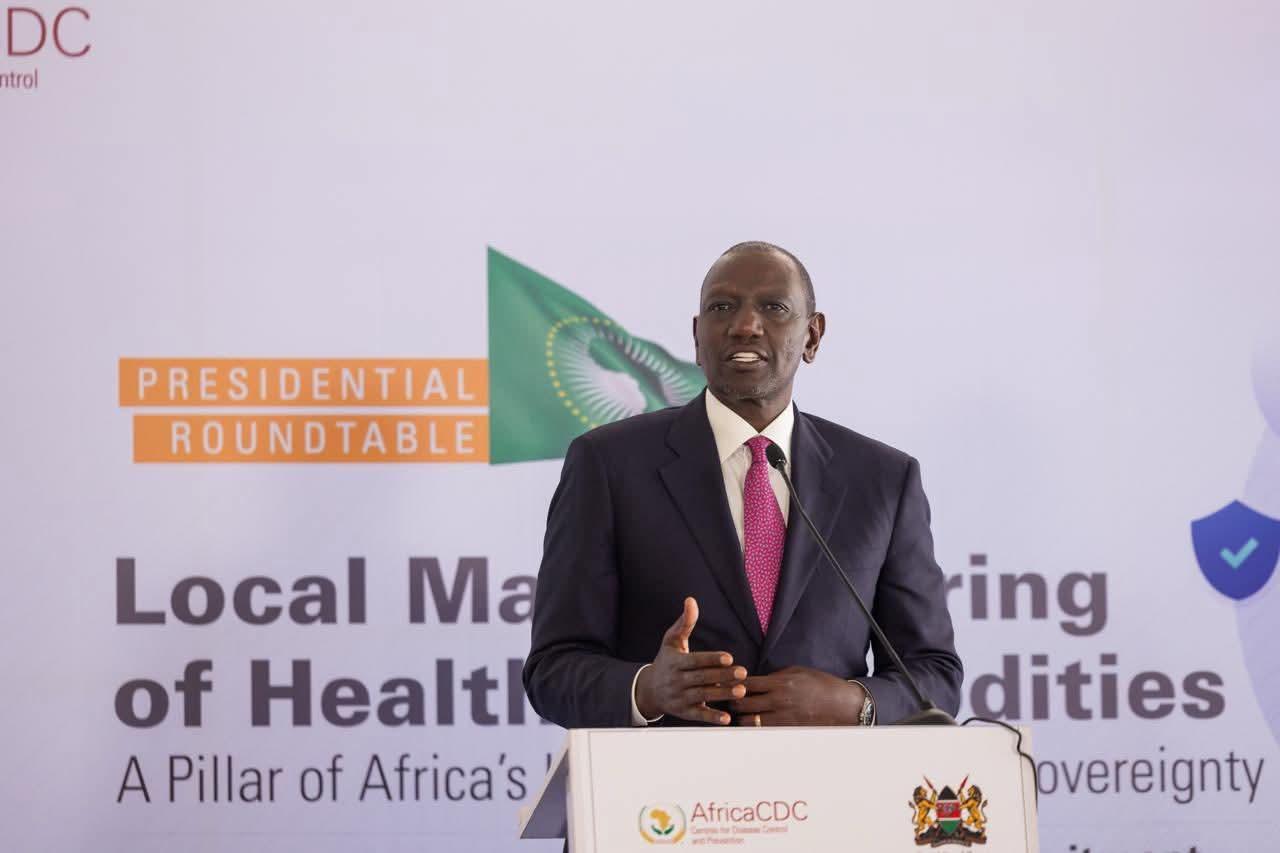
He was speaking during a side event on local manufacturing of health commodities co-hosted by the Government of Kenya and the Africa Centres for Disease Control and Prevention (Africa CDC) on the margins of the 39th Ordinary Session of the African Union Assembly.
“Local manufacturing of health products is no longer a goal we can postpone; it is an urgent priority,” he stated.
He noted that the continent’s reliance on imports has come at a high cost to national health systems and household incomes, with many citizens forced to pay directly for care.
“Across many of our countries, nearly 60 per cent of health expenditure is paid out of pocket by citizens, and millions obtain essential medicines through informal markets where the risk of sub-standard or falsified products is high,” Ruto said.
The President said strengthening local production would not only protect lives but also reduce economic losses caused by import dependence. Africa’s pharmaceutical market, valued at about $36 billion in 2023, is projected to exceed $122 billion by 2032.
“If we manufactured even half of the products we currently import, we could save between $30 billion and $50 billion annually, resources that could be redirected toward infrastructure, social protection and innovation,” he said.
Ruto emphasised that Africa has the demographic and market advantages needed to build a competitive pharmaceutical industry, citing the continent’s youthful workforce and the African Continental Free Trade Area (AfCFTA), which creates a single market of 1.4 billion people. However, he warned that fragmented procurement systems continue to weaken local manufacturers by creating unpredictable demand.
“Without predictable and aggregated markets, local manufacturers cannot scale or remain viable. Pooled procurement is therefore not optional; it is necessary,” he said, calling on AU member states to subscribe to the African Pooled Procurement Mechanism launched through Africa CDC.
The President noted that progress is already being made, with more than 570 registered health product manufacturers across the continent and over 27 vaccine manufacturing initiatives underway.
He added that regulatory systems are improving, with nine national authorities now meeting the World Health Organisation’s Maturity Level 3 standards, while the African Medicines Agency has become operational.
To support long-term growth, Ruto stressed the need for skills development, investment in research and development, and the creation of regional manufacturing value chains.
“Africa must move away from exporting raw materials and importing finished products. Through regional value chains and harmonised standards, we can manufacture competitively for our continental market,” he said.
He also called for stronger policy and infrastructure support, including reliable energy, efficient logistics and access to affordable financing, urging continental financial institutions such as the African Development Bank and Afreximbank to translate commitments into bankable projects.
Ruto cautioned that without strong local production, the AfCFTA risks becoming a conduit for imports rather than a driver of African industrialisation.
“The African Continental Free Trade Area must be powered by African production,” he said.
To accelerate progress, the President proposed that the African Union convene an Extraordinary Summit on Local Manufacturing in April 2026 to review implementation and mobilise partnerships.
The summit, he said, would help the continent move toward its target of producing at least 60 per cent of its health products locally by 2040, a milestone he described as critical to Africa’s health sovereignty and economic transformation.