Africa-Press – Kenya. Geopolitical rivalries and armed conflicts placed growing strain on the global maritime order in 2025, disrupting key shipping routes, raising costs and reshaping trade patterns, maritime experts and international organizations say.
Heightened tensions continued to disrupt navigation across multiple maritime regions, including the Red Sea and the Caribbean, while risks of disruption also emerged around the Strait of Hormuz, a critical artery for global oil trade, UN Trade and Development (UNCTAD) said in its Review of Maritime Transport 2025 report.
Global shipping, which carries more than 80% of world trade, came under mounting pressure as fragile growth, rising costs and uncertainty weighed on the sector, the report said.
The report also highlighted that after a modest 2.2% growth in 2024, maritime trade is expected to slow to just 0.5% in 2025, warning that political tensions, shifting trading patterns and reconfigured shipping lanes are reshaping the geography of maritime trade.
“It was a very difficult year for all global maritime operations – not just shipping – but all commercial operations on the world’s oceans,” Elisabeth Braw, a senior fellow with the Atlantic Council’s Transatlantic Security Initiative in the Scowcroft Center for Strategy and Security, told Anadolu.
Red Sea forces global rerouting
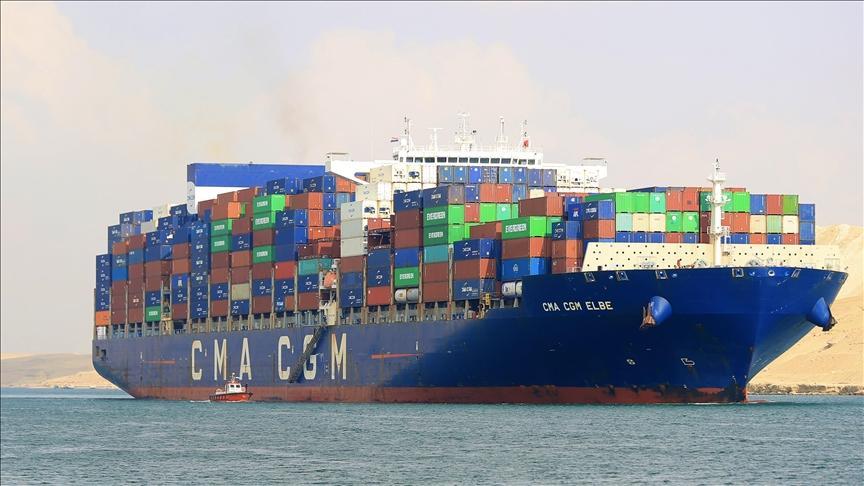
The Red Sea, a vital corridor linking Europe and Asia via the Suez Canal, was among the hardest hit as conflicts disrupted global shipping.
Following Israel’s war in Gaza in October 2023, Yemen’s Houthi group targeted commercial vessels linked to Israel, the United States and the United Kingdom, affecting container ships as well as oil, liquefied natural gas (LNG) and grain carriers.
According to the UNCTAD, vessels that once transited the Red Sea in days were forced to reroute for weeks around the Cape of Good Hope off South Africa.
The prolonged diversions drove freight rates higher and increased volatility, leaving supply chains more fragile and port disruptions more chronic.
Rerouting pushed shipping ton-miles to a record 6% in 2024, nearly three times faster than trade volume growth, according to UNCTAD.
Traffic through the Suez Canal fell sharply, operating at around 70% below average tonnage levels recorded in 2023, the report added.
A brief conflict between Iran and Israel in June 2025 heightened concerns about disruptions at maritime chokepoints, with particular attention on the Strait of Hormuz, which handles about 11% of global maritime trade and one-third of global seaborne oil exports, the report said.
Braw said global shipping adapted to the new reality.
“The western-linked global shipping has adjusted to not going through the Red Sea anymore and the Suez Canal, and instead they go around the Cape of Good Hope,” she said, adding that the longer route means more fuel, more costs and more carbon emissions.
The shift also delivered a financial blow to Egypt, she added.
“The Suez Canal Authority and Egypt have lost massive amounts of revenue because of the traffic through the Red Sea and the Suez Canal has plunged,” Braw said.
While Houthi attacks eased following a Gaza ceasefire, Braw expressed skepticism about a full return of traffic.
“Some vessels may return to the Suez Canal, but we are not going to see the same amount of traffic we saw before the attacks began – not anytime soon,” she said.
Caribbean Sea
In the Caribbean Sea, US actions against Venezuelan-linked vessels have raised alarms among maritime experts.
US President Donald Trump declared a “total and complete blockade” of sanctioned oil tankers entering or leaving Venezuela, with tensions escalating on Dec. 10, when US forces seized a sanctioned tanker near the Venezuelan coast. Venezuela condemned the move as “international piracy.”
Braw said that while Pentagon lawyers may have approved the operations, legal justification does not necessarily translate into strategic wisdom.
“The attacks on Venezuelan fishing boats and then Venezuelan shadow tankers, they are really risky from a global maritime order perspective,” she said. “It signals that if you’re a powerful country, or if you’re a country that has the power in a particular body, you can behave in a way that is not helpful to the global maritime order.”
She also highlighted the risk of retaliatory attacks on US-flagged vessels.
Black Sea remains a danger zone
Maritime insecurity also intensified in the Black Sea, a key corridor for grain, oil and petroleum products shared by many countries, including Russia and Ukraine.
The Russia-Ukraine war continued to disrupt shipping, with Ukrainian attacks on Russian-linked vessels and energy assets, while Russia targeted Ukrainian port infrastructure, damaging commercial vessels and hindering operations.
Analysts warn that the growing use of shadow fleets – aging vessels with opaque ownership and insurance – poses an additional risk.
According to data from Kpler, a real-time data firm that tracks global shipping and commodities, around 3,240 vessels now operate as part of the shadow fleet. A 2024 report found such activity surged by 2,800% since 2022, growing from a fringe practice to account for up to 13% of global tanker capacity.
“Every shadow vessel that sails on the world’s oceans poses the risk of an oil spill, or in the case of oil tankers… they pose a risk of accidents, because they disguise their movements and are obviously old,” Braw said.
She said Ukraine’s recent attacks on Russian-linked shadow tankers aimed to curb Moscow’s oil revenues, but described the development as dangerous for the global maritime order.
Erosion of maritime norms
Braw said 2025 saw declining adherence to global maritime norms.
“The only way in which we can have functioning global shipping and other commercial activities on the world’s oceans, including the seabed, is if we have rules that countries and companies sign up to and then adhere to,” she said.
She pointed to weakening compliance with the United Nations Convention on the Law of the Sea (UNCLOS), citing “continued maritime harassment by China in the South China Sea,” and a US decision to permit deep-sea mining in international waters.
“This could have really negative consequences because other countries can then say, well in that case, we are not going to adhere to UNCLOS either, and without UNCLOS, the world’s oceans will just become very perilous,” she said.
While international bodies can take limited steps, Braw said the global maritime system ultimately depends on states honoring their commitments.
“Because for the global maritime order to work, countries just have to show their commitment to it,” she said. “There is no global maritime police, there is no global enforcement body.”
Looking ahead, she said she expects the new year to be even more “turbulent.”
Source: Anadolu Ajansı