
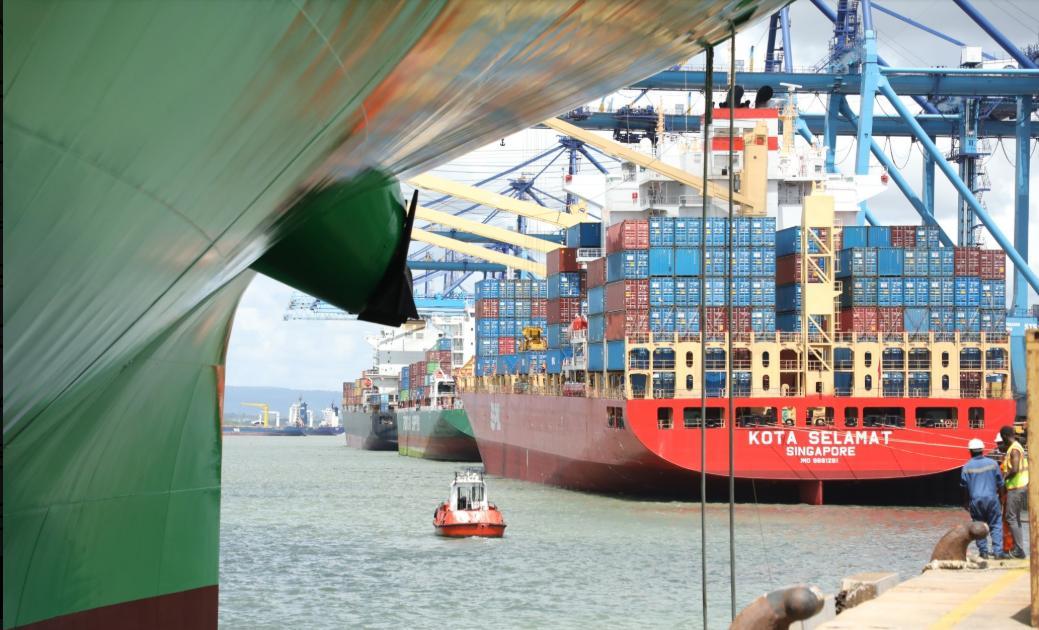
Africa-Press – Kenya. SHIPPING lines now want Kenya to speedily address continued vessel delays and container hold up at the Port of Mombasa, saying it is costing them millions.
Through their local agents, the shippers said that while increase global trade has increased actives at the port the delays threaten Kenya’s pole position as a regional maritime hub.
Shipping lines say congestion at the port is locking up assets worth millions of dollars, with vessels forced to wait offshore as yards and inland depots choke with cargo.
According to the Kenya Ships Agents Association (KSAA), a single ship delayed outside Mombasa costs operators about $60,000 (Sh7.74 million) per day, while each container trapped in the system represents an opportunity cost of $100 (Sh12,900) per day.
“These are not small numbers. These are existential threats to the viability of our shipping routes,” said KSAA chief executive Elijah Mbaru.
The concerns come even as the Kenya Ports Authority (KPA) posts strong performance.
Cargo throughput at the Port of Mombasa reached a record 45.45 million metric tonnes in 2025, up from 40.99 million tonnes in 2024, a 10.9 per cent increase. Container traffic also rose to 2.11 million TEUs, a 5.5 per cent growth year-on-year.
Speaking during a recent media briefing on the port’s 2025 performance outlook, KPA managing director William Ruto said transit cargo grew sharply to 15.88 million tonnes, up from 13.29 million tonnes in 2024, reflecting Kenya’s expanding role as a gateway to the region.
However, ship agents argue that global shipping conditions have become unforgiving.
Overcapacity, trade tensions between the US and China, stricter International Maritime Organization decarbonisation rules and mounting financial losses among shipping lines mean every idle day now cuts deep.
“There is too much tonnage chasing too little cargo. Every day a ship spends idle at our port is a day the operator bleeds cash,” Mbaru said.
During a high-level consultative meeting with Energy and Transport Cabinet Secretary Davis Chirchir, senior officials from KPA, the Kenya Revenue Authority, and other stakeholders last week, KSAA laid out a series of proposals to decongest Mombasa.
On Monday, the association reiterated that the Kenyan government must implement measures with tangible results, noting the port, Inland Container Depots (ICDs) and empty container yards all full.
They want more cargo shifted to Container Freight Stations. Hinterland cargo should move to Nairobi ICD, while transit cargo should be routed to Naivasha.
To create long-term breathing space, the association is urging KPA to establish an ICD outside the port, modelled on Tanzania’s approach at the Port of Dar es Salaam.
“All physical interventions should happen outside the port. Only focal point personnel should be inside,” Mbaru said, “This single idea could radically transform the port from a chaotic warehouse into a streamlined gateway.”
The agents have also questioned uneven investment in equipment. “We cannot have world-class cranes on the water if we don’t have enough terminal tractors on shore,” Mbaru noted.
Beyond Mombasa, shipping lines want urgent upgrades at Lamu Port, including quay and yard equipment, backed by road and rail links.
They also see opportunity in the Dongo Kundu project, arguing the multipurpose port must be fully equipped from day one to handle vehicles, bulk cargo, containers and passengers.
KSAA is further pushing for deeper digitisation through a fully integrated port community system—a “super single window” linking KPA, KRA and all other agencies.
“This is not a luxury; it is a necessity to eliminate human delays that cost millions,” Mbaru said.
As cargo volumes climb, ship agents warned of ta damage to Mombasa Port’s reputation
“If Mombasa becomes known as a port where ships lose $60,000 a day waiting, the lines will vote with their rudders and go elsewhere,” Mbaru cautioned.
KPA has been implementing a number of projects and equipment upgrade in recent months to meet the rising demand, key being the expansion of berths and yard space including berth 19B, 23 and 24 that will create an additional capacity of 1.4 million TEUs.
According to MD Ruto, KPA is ALSO upgrading the Terminal Operating System currently at 40 per cent completion and gates automation which have attained a 60 per cent completion rate for gates 23 and 24.
“Acquisition and modernisation of Equipment is also at an advanced stage of implementation, even as the authority enhances collaboration with the industry players to streamline services,” Ruto said.