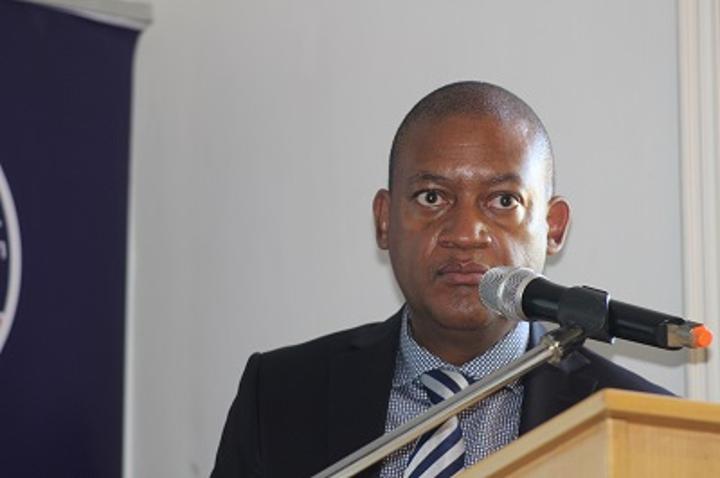
Africa-Press – Lesotho. Lesotho Revenue Authority (LRA) Commissioner-General Thabo Khasipe said for the trade bloc to be competitive, the creation of a high-value industry is key, saying it is time that Member States start selling
intellectual property. This he said during the Southern African Customs Union (SACU) investment roundtable that was held recently in Gaborone, Botswana.
The two-day hybrid event was held under the theme, ‘Positioning SACU as an industrial, investment, manufacturing and innovation hub for the African continent and beyond’.
He also challenged the Member States to explore competitive avenues amongst themselves. Khasipe underscored the need to enhance trade facilitation mechanisms.
The LRA Commissioner-General also mentioned that the Member States need to capacitate and put more investment in their human capital. He expressed a need for SACU bloc to efficiently exploit the African
Continental Free Trade Area (AfCFTA). AfCFTA is a continental free trade area that came into operation on January 1, 2021. It “create[s] a single market for goods, services, facilitated by
movement of persons in order to deepen the economic integration of the African continent and in accordance with the Pan African Vision of “An integrated,
prosperous and peaceful Africa” enshrined in Agenda 2063”. Meanwhile, AfCFTA is said to be one of the SACU priority areas. “The issue of human capital is at the core,” said Khasipe.
About how the trade bloc can position itself well to compete globally, he argued that there is a “lot to catch up” and that the bloc needs to “up” its
game. As revenue services, Khasipe said they need to expand their bases to provide their governments with funding that has been hit hard due to the COVID
-19 pandemic sponsored revenues decline. He said LRA is now moving towards becoming as “facilitative” as possible,
adding that they are now moving towards automatic tax compliance. The LRA Commissioner-General says they want the cross-border traders’ experience to be
“seamless and less intrusive as possible”. For his part, Lesotho Minister of Trade and Industry Dr Thabiso Molapo
said the roundtable could not have come at an opportune time, as it will provide “direction for the region towards the recovery trajectory”. “I believe that this roundtable will highlight the investment
opportunities that exist within the SACU region which our private sector will take full advantage of, to boost trade and investment flows thereby achieving
economic gains. Such opportunities should serve as enablers for private sector participation in various value chains leading to industrialisation in our
respective countries,” he said. Dr Molapo further highlighted that the prioritised sectors by SACU resonate with Lesotho’s economic and development agenda as indicated in the
National Strategic Development Plan II (NDSP II). The implementation of the SACU work programme will see the country achieving her targets as stipulated in the NDSP II.
He added: “It, therefore, goes without saying how critical the success of this work programme is to Lesotho. We should therefore remain resolute in our pursuit to achieve the objectives we have set, and ultimately reach deeper
SACU integration propelled by clear Industrial and Investment Strategies. ” His Botswana counterpart, Hon Mmusi Kgafela, the Minister of Investment, Trade and Industry said the uniform connectivity system is pertinent.
He said where the trade bloc lacks capacity, it should engage the private sector. “We need to upskill our human capital to make it easy for our trade women and trade men to trade.
We should not be shy to readily admit when there are inefficiencies,” he submitted. The representative of the Road Freight Association Gavin Kelly said
there is a need to drive the information sharing amongst the trade bloc’s members. Kelly challenged the Member States to automate their systems for synchronisation.
This he argued would counter the trade impediments. “We need collaboration and trust. We need to foster innovation,” he said. He said there is a need for the adoption of what he referred to as three
principles digitisation, customer-driven business and purpose-driven organisation. SACU revenues had in the previous years declined and the decline was
also necessitated by the outbreak of the COVID-19 pandemic that had hurt the economy as the trade flow amongst member states was minimal. Lesotho continues
to feel the pinch of this decline in revenue collections as this revenue contributes hugely to the country’s national budget. The Executive-Secretary of SACU Paulina Mbala Elago highlighted that the
policy issues that had been identified as impediments to trade need to be addressed “seriously”. The Executive-Secretary also told the delegates that SACU is working to
mount technological infrastructure facilities to accommodate cross-border facilitation between member states. Eswatini Minister of Commerce, Industry and Trade Hon Mangaliso Khumalo
highlighted that SACU’s success is dependent on the collective effort of the Member States. The SACU Member States are Lesotho, Botswana, Eswatini, Namibia and
South Africa. According to Article 2 of the 2002 SACU Agreement, one of the objectives of this five-member body is to ease the facilitation of the cross-border movement of goods between the boundaries of the Member States.
For More News And Analysis About Lesotho Follow Africa-Press