Africa-Press – Lesotho. There is a saying that ‘all that glitter is not gold’ wand this applies to experiences of some of the Basotho when they come home for Christmas and New Year’s Holidays from South Africa where they work in various sectors.
With the ongoing economic meltdown, a significant number of Basotho find themselves migrating to South Africa where they get employed as construction, factory, farm and domestic workers.
In the past a large number of people who formed part of labour migration from Lesotho to South Africa were men. However, in recent years, women are seen at the forefront. Some leave their children with their elderly mothers, others with family members while others on their own in order to make a living.
Closure of several mines in South Africa where a large number of Basotho men used to be employed has reportedly resulted in illegal mining operations where young men are recruited. Some of these men leave their wives and children for months without coming home, consequently the wives decide to follow them and secure jobs.
Loss of jobs when some of the factories in Lesotho, which employed the majority of young women closed shop, has added to the large number of women from Lesotho working in South Africa as domestic workers. Majority prefer it there as they say it is better paying than in Lesotho.
A legal pay rate for the domestic worker in Lesotho is M872.00 per month while in South Africa it is about R5,610.00. However the practical payment for domestic workers ranges from M1,000.00 being the minimum wage, depending on the size of a house and number of children one looks after. Reports have showm that domestic workers in South Africa get from R2,000.00 and R3,000.00 as the large number of them are illegal immigrants.
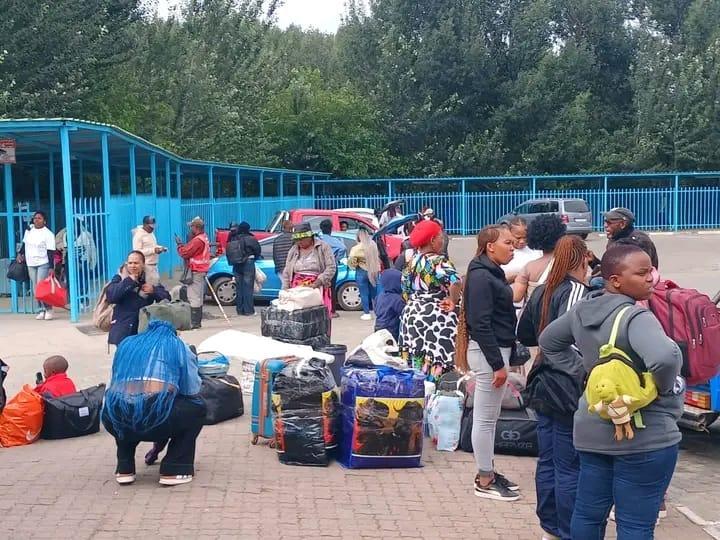
It is a norm that the Basotho who work in South Africa come home during the Christmas and New Year’s holidays as well as Easter which are major holidays. When they cross the borders and enter the country with happy faces, huge luggages and fancy cars, for those who managed to secure good paying jobs, one expects nothing but joy, wealth and good health. This is despite the fact that they have been exposed to long journeys, several road blocks where they are searched and those without valid travelling documents are atrested. Their appearances make some of their admirers wish they had their lives.
The high expectations from family members and the community push one to work hard so that they have something to show and share when they come home. They come to share their succesees, experiences, good food and company. They are welcomed with love, warmth and respect. They often bring along gifts and goodies for families and friends. They find their children anxiously waiting for them to reveal what they have for them.
While coming home is a good time for many, the expectations and the process itself exert a lot of pressure on others because things did not go as planned as some go for months without jobd or there is nothing pleasant waiting for them at home. Others are filled with shame for abondoning their families all in the name of seeking jobs in the neighbouring country.
To some, coming home is a nightmare which is unfortunately inevitable.They come to empty and abandoned houses as their parents and/or siblings are no more and there are no relatives to look after the houses while they are away, trying to make a living in South Africa. In such cases, one is surrounded by misery as they clean such houses which have become habours of spider webs and dust. The good memories they used to share in their homes are
overshadowed by renewed grief, misery and tears.
Speaking in an interview with Miss Sebueng Mokhaboli of Setibing, a rural area in Maseru, about 61 kilometres from the city center, she stated that having lost her mother in 2020 who was her only parent, coming home is never pleasant. She indicated that she had to find a job as a domestic worker at the age of 20 because she could not further her studies because of financial constraints after her mother’s passing.
“I came home to an empty house where I used to stay with my mother”, she said adding that her home was a place where she used to share laughter with her mother during her lifetime. She further added that everytime she was away from home she always looked forward to coming back because of the love and care she knew awaited her.
She pointed out that she now gets to spend time with her aunties and cousins as well as old friends when they are available. She said that is however not the same as when her mother was still alive.
Also speaking in an interview Ms. ‘ Masechaba Moleko of Koro- Koro in the outskirts of Maseru, she state that her coming home with her siblings, all who work in South Africa, after burying their father a month ago felt weird. She however said she atleast had her siblings for company as their mother died five years ago. She indicated that they shared all the good memories of the times they had with their parents.
According to a 68-year-old ‘Malillo Lekhetho, her daughter’s coming home does not make much of a difference.
“With three little mouths to feed, what she brings home is never enough. It would be better if she did not come at all and keep sending money. It is more efficient than when she incurs expenses on travelling. However, she has to come home for the wellbeing of her children whom I am taking care of while she is away”, she said.
She pointed out that the children are always happy to see their mother adding that she too gets relieved that her daughter is well. She however remarked that although the holidays are time for families, things have changed and one has to be economically efficient.
There are some of Basotho who come home in the rural areas to find that development remains a challenge. They still have to use damaged gravel roads, rellying on a single bus which is the only public transport available in their area. Some still have to walk long distances to access health services and vital documents. There are those who still relly on rivers and wells for drinking, cooking and washing. Others have to go to town to buy some things which the local shops in the villages do not offer or are out of stock and will take days before they are available.
According to Lireko Mosenene who is employed as a factory worker in South Africa, it is not easy to move from the fast life in South Africa where almost everything is easy to access, to the life in the rural areas of Lesotho. She stated that the development in South Africa, compared to that in Lesotho, is unmatched. She said Lesotho still has a long way to go, to improve the lives of the rural communities.
She pointed out that when she came home she had to make sure that she is in the Maseru city by 12:00 midday and done with everything so that when a bus leaving to her village at the rural area of Ha Rampoetsi leaves the main busstop, she is not left behind. She indicated that being left behind would mean waiting for the next day to get home as that is the only public transport available. She pointed out that it would mean seeking accomodation, causing more inconveniences and extra costs. She said even going to a relative’s house would mean taking a taxi to and from and also bringing something for that family which was never planned for.
Although coming home has its frustrationd for women due to their responsibilities especially the motherly duties, men too have their share.
According to Mr. Sello Letlatsa, coming home as a man who works in South Africa, a lot is expected from you. He indicated that families and the society expect to have their share of what one brings. He stated not being able to meet the expectations of others leaves one classified as a failure.
There are Basotho men working in South Africa who are fugitives of the law. They have partheard criminal cases awaiting them back home together with warrants of arrest therefore one has to come home under disguise if they are not willing to surrender themselves. There are those who are key witnesses in murder cases and such cases have been held in abeyance because they were not available as they work in South Africa and can only be available during the holidays.
The courts of Lesotho have been suffering a major blow with murder cases having to be indefinately postponed because witnesses who work in South Africa are not available. Other cases are postponed because accused persons who are on bail go back to their work places in South Africa in the midle of their trials thus evading the hands of justice. Some even do so at the stage where the court has to deliver a judgment. This does not only add to the backlog of cases which the judiciary is trying to reduce, but also leaves victims and the public with no trust in the justice system because caeses are not finalised on time.
While coming home is most challenging for some people in the rural areas, there are also challenges in the urban areas. Others come to find an increase in crime rates. They discover that certain streets are no longer safe either during the day or at night.
Others learned the hard way that drunk driving is no longet taken lightly by the police. Others find it difficult to adapt to regulations put in place under community policing. In some instances, night movements are regulated by members of crime prevention comittees and one has to identify themselves and state where they are going.
Job creation as well as relaxed financing of small bussineses could come a long way in reducing labour migration. Those without academic experiences and qualifications must be equiped with skills to create jobs for themselves and others. When they are closer to home the young Basotho who go to South Africa will be able to efficiently contribute to the development of the country and ensure economic circulation within the country.
This could reduce the burden from elderly women having to take care of grandchildren while their parents are away in South Africa. This can also keep families together as no wives will be forced to follow their husbands to South Africa.
While they are mocked for unusual hairstyles, makeups and accent among others, the Basotho who work in South Africa bring life into their respective homes and villages when they are home.