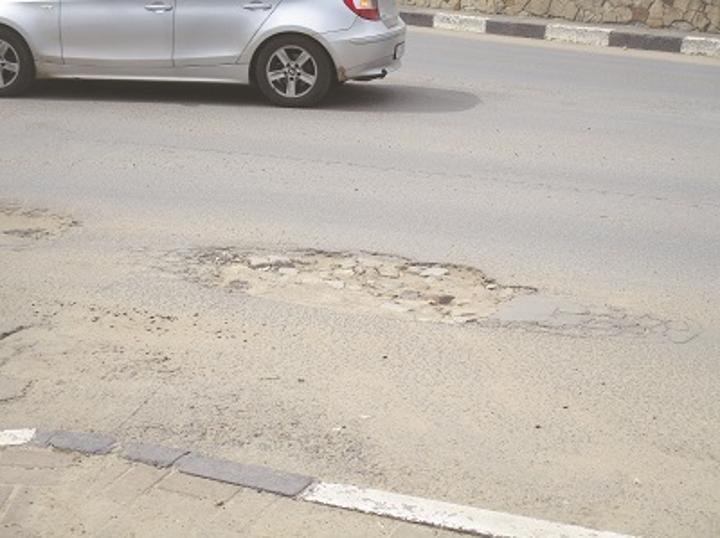
Africa-Press – Lesotho. Lesotho has recorded a high number of traffic related deaths and injuries, logging 584 deaths mainly caused by road traffic accidents according to the World Health
Organization (WHO) data published in 2018. The primary source of these road accidents is usually attributed to poor road infrastructure that has gone unrecognized for the past years.
Due to the recent heavy rains in Lesotho, bridges have been washed away and the water has left farrows and pounds in the roads. The state of gravels and tarred
roads is generally poor therefore seeking more attention and development. However, development of road infrastructure is not prioritized and extreme weather
conditions make it hard for Basotho to survive. More often than not roads in Maseru are the most damaged and the most left unattended, especially around villages
such as Ha Tšosane, Ha Tsolo and Tšenola. In an exclusive interview with this reporter, an ordinary driver ‘Matšepang Leferefere stated that the damaged roads call for disappointment.
She said they cannot even ride their cars comfortably as the next pothole might tarnish their tyres. “We are hoping that the next ruling party will include roads
infrastructure in their plans as they seem to be an unrecognized matter. The only thing to do is to be extra careful when driving to avoid accidents,” she
said. She said it is disconsolate how much the government has not said anything about refurbishing roads in Maseru as they seem to be the most damaged.
She acknowledged local residents in the villages around Maseru, who have devoted their time and effort in levelling the gravels and patching the potholes to
ease traffic flow. Leferefere added that even though people still make means to repair roads in their own capacity, it is only temporary. On the other hand, Keketso Molapo said these unrepaired
roads and potholes often cause fights between drivers who tend to be impatient with each other along the roads. The United Nations (UN) had in 2011 launched a Decade of Action for Road
Safety. It was an action that lasted for eight years. The Action was to cover for critical areas for action, enhance roads and vehicles to improve the behaviour of drivers.
It had found that sometimes road accidents are caused by drunk drivers and long traffic congestion. Although it was an eight year project, it was not fixated on the construction
of roads in Lesotho but it did leave a positive impact of focusing on road traffic accidents as they are the major but neglected public health problems in
Lesotho. According to the budget speech for the fiscal year 2022/23, the capital expenditure is M6.8 billion, which will focus on the development of roads, bridges and buildings
among others. A larger portion of the budget is for continuation of Transport and Connectivity Infrastructure projects such as construction of eight footbridges which were delayed due to Covid-19 in Mafeteng, Leribe and Quthing.
During the 2022/23 fiscal year, the government will construct 11 additional footbridges at Lepeli to Thakeli road and Maliehe to Mpeli road in Maseru.
In Mohale’s hoek, the bridges will connect Mokhasi to Luka, Ramosokothoana to Ralimpe, Sefateng to Baruting, Ntlhasinye to Makhetheng, Ntja to Jobo as well
as Thabantšo to Moiketsi. In Thaba-Tseka, construction will start at Kou to Motau while in Mokhotlong it will be from Nyokololi to Tiping and lastly at Pali to Leihloana in Quthing.
The Minister
of Finance Thabo Sophonea had mentioned that in recent years, the government had engaged contractors for routine maintenance of roads, he however, said the
country’s current economic status warrants a reconsideration of the approach. He said the government will reinstitute labour-based system for routine maintenance.
He said the upgrading of Mpilo 7km road will commence this financial year. The 2003 case study on ‘Integrating gender into the Ireland aid financed rural
roads and access program’ indicates that the road network of Lesotho is remarkably simple, particularly compared with Lesotho’s only neighbour South Africa (SA).
It further estimates that “Lesotho’s road network extends over about 7,000 km, most of which are located in the lowlands. The highest concentration of roads per unit of land is in urban
areas, a contrast reflecting the urban-based nature of development efforts since independence”. Moreover, the case study shows that there are four national agencies responsible for road
network in Lesotho; Roads Branch, Department of Rural Roads (DRR), Ministry of Local Government and Maseru City Council (MCC) are responsible for parts of
Lesotho’s road network. The Roads Branch is responsible for primary roads (Code A) linking major towns and district centres as well as main border posts.
The same entity is responsible for secondary roads (Code B) connecting districts and linking local centres to the primary roads. The Ministry of Local
Government is responsible for part of the Code B roads and tertiary roads connecting local centres within districts. DRR is responsible for access roads
linking one or more villages in the rural areas. According to MCC Public Relations Officer (PRO) ‘Makatleho Mosala, the damaged roads are said to be effects of natural disasters as 90% of roads have been damaged due
to heavy rains. She said they have not been allocated the capital they needed to construct and maintain roads that they had find necessary for upgrading
immediately. Ministry of Local Government Public Relations Officer (PRO) ‘Makena Setho highlighted that Lesotho’s roads are constructed, maintained and fixed according to the
agreement between councils. “As the Ministry of Local Government oversees road maintenance at the central level, this does not mean that Local Government is
responsible for such roads, but councils make planning according to the number of roads that they see fit to be maintained, for instance, if Tšosane and Tšenola roads are not included in the plan then it means they will not be fixed that financial year,” she noted. Despite the possibilities, 90% of the roads in Lesotho require serious attention.
For More News And Analysis About Lesotho Follow Africa-Press