
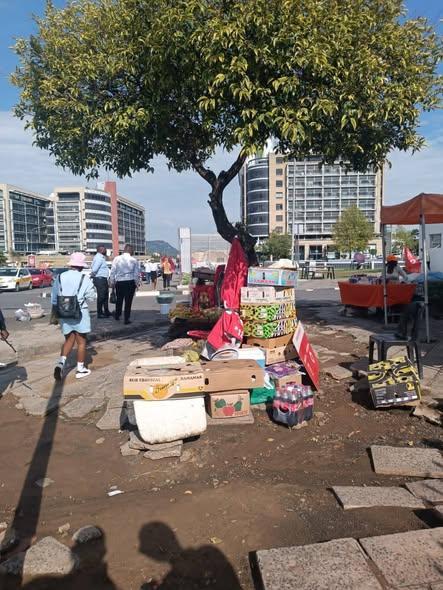
Maseru, Feb. 10 — Unsafe working conditions presented by continued harsh weather often characterised by storms and extreme heat together with rising unemployment rate and the unstable economy, continue to make life difficult for informal traders operating in the streets of Maseru where there is no shelter.
The impact is felt more by women who travel to the city each day to provide for their families. Majority are forced to walk as they cannot afford transport fare. There are those who carry children on their backs while others hold them by hand so they can drop them off at school before the hustle begins.
For some of these women, hawking, which they do the moment they step out of their respective homes, on their way to the city, is a favourable choice. This is due to their inability to afford a monthly fee required by the Maseru City Council (MCC) for informal traders to operate on the city’s streets. Those who opt to ignore the requirement by the municipality and operate on the pavements, sometimes pay the price as they are chased by the MCC officers and their goods confiscated at times.
Various efforts by the authorities to remove informal traders from the pavements, and alleging to develop the town, make it clean and welcoming, have not deterred the unemployed, less educated and single parenting women from taking their different spots along the streets of Maseru. This they do with the main target which is to ensure that there is a loaf of bread on the table at the end of each day.
Some do it unaware that they are breaking the law as section 85 (1) (a) of Road Traffic Act, 1981 prohibits trading on the public road.
It states, ‘Except on or in premises licensed by competent authority, no person shall sell, display, offer for sale or deliver pursuant to a sale, any goods on any public road or any traffic signs denoting a blind corner or rise thereon’.
Speaking to one of the young women who are seen each day maneuvering the traffic trying to make sales, ‘Maneo Morapeli who could not finish her high school education due to financial constraints admits that the practice is dangerous.
She however says she is not aware that it is also unlawful. She indicates that although it obstructs the traffic and confuses motorists, while also putting her life in danger she will continue to do it. She says if she does not take the risk, she will go hungry with her family.
She also indicates that the city is congested with informal traders adding that there is no decent work space. She remarks that one cannot rent a room in one of the city’s buildings just to sell fruits.
“The streets are our only answer,” she exclaims.
Miss Lineo Pule, one of the women operating on a pavement along one of the busiest parts of the town, Ha Mafafa, told the Lesotho News Agency (LENA) that there was a time when they would be chased daily by the MCC officers. She says one had to ensure that they get away with their properties still intact. She points out that in that rush, there would not be any guarantee for safety as they risked tripping and falling as well as being hit by moving vehicles while they try to evade law enforcement.
She however vows to go on operating in that area until there are more affordable places with shelter where informal traders are accommodated. She highlights that informal trading is her only means of life.
Another trader operating near the Makoanyane Square along Kingsway Road Mrs. ‘Makananelo Thetsane informs the Agency that selling fruits in 2012 was the best choice one could make when venturing into informal trading. She says after she lost her job when a factory she worked for closed shop, she thus went for informal trading and sold fruits.
“There were not many of us who sold fruits along the Kingsway Road. Business was good until COVID-19 happened,” she says, adding that since the pandemic the sector has been suffering.
She remarks that competition is high adding that they do not make proper sales. She indicates that whenever a factory closes down, people resort to informal trading. She further says there is no sufficient space to accommodate everyone.
Mrs. Thetsane uses an umbrella as shelter from the scorching sun but the same umbrella is useless when it is rainy or windy. She says the places under the MCC where there is shelter are all full.
She stores her properties at a nearby building for safety when she goes home. She and other traders who use the same building for storage used to pay security guards to guarantee the safety of their properties but were told to discontinue as the guards earn a salary. She tells the Agency that since then, their properties get stolen.
Mrs. Thetsane suggests that movable stalls could help ease their burden by cutting costs and improving their livelihoods.
Another trader Ms. ‘Maboitumelo Ramokhele who has been selling roasted maize since 2016 was forced to take two jobs, she serves her formal employer in the morning, then goes to the streets to continue with her infomal trading.
She states that this is the route she selected when life was difficult for her. She indicates that her salary is not enough to cover her personal needs and those of her family members as she is the only bread winner.
Ms. Ramokhele points out that when she first started informal trading, business was good, adding that she used to make a lot of money. She said now things have changed for the worse adding that her customers are unable to buy from her because money is scarce.
“I have lost some of my loyal customers. I sometimes go home without having made any sales,” she lamentes, adding that at times she makes so little that she cannot afford to buy a maize meal.
She points out that she is struggling to put together money for her son who just finished high school to register for university entry. She adds that she could not even give him money for transport fare to attend a career expo which was held in Maseru last week. She emphasises that her son missed an opportunity which could have had a significant impact in shaping his future.
Ms. Ramokhele whose majority of customers are government employees says her customers are now unable to buy from her because of poor salaries. She therefore appeals to the Government of Lesotho to intervene and improve the salaries of government employees. She indicates that with better salaries, they will be able to afford a living and support informal traders.
She further appeals to the government to attract investors and open factories as well as prevent further closure of the few that are still operational in the country. She states that factory workers spend money locally, adding that they are the loyal customers to the informal traders.
She too complains about lack of shelter which leaves traders vulnerable to unfavourable weather conditions. She adds that there is no place for them to store their equipment.
“We cover and leave them on the streets when we go home and they get stolen. They also get destroyed when it is raining,” she says, adding that the loss they suffer does not only affects them financially but also emotionally as it was not easy to secure the merchandise.
Another informal trader, Ms. Karabo Makotoane has been trying to make a living in the city for 8 years now selling food. She chose not to be employed because she could not wait until the end of the month to have money.
She reveals that business in informal trading is at its lowest. She indicates that money is scarce, adding that providing lunch for workers is no longer as lucrative as it used to be when she started.
She raises a concern that lack of safe and protected workspace makes her incur extra costs as she also has to pay for special transport to take her goods to and from home each day. She points out that it is more difficult for someone who sells food to operate when it is dusty or rainy. She adds that there are times when she has to stay home and not work for a full day because of bad weather conditions.
Ms. Makotoane says shelter would make informal trading easy, enjoyable and profitable. She suggests that sponsors should be allowed to provide shelters for the traders when the government does not have the capacity to do so.
President of the Lesotho Federation of Informal Traders Association, Mr. Ts’olo Lebitsa says that secure work space and conditions can only be achieved if traders are united. He adds that collaboration between the MCC and the informal traders is essential for efficiently addressing issues affecting the traders.
He stresses that it is not by choice that traders are operating from pavements. He says shortage of work space has been an issue even before the informal trading sector got saturated, and overcrowded. He insists that traders will only pay for services that they get therefore a fee required by the MCC for them to operate within the city will only be paid when they have been allocated with work space.
Mr. Lebitsa advises the MCC that removal of informal traders from the streets and confiscation of their goods is not an answer to the current unemployment rate which resulted from closure of factories.
By the time of publication, efforts to secure a comment from the MCC were still not successful.
A ruling in a case between South African Informal Traders and others against City of Johannesburg and others (2014) emphasises that urban management should ‘balance regulations with constitutional rights of vulnerable workers’.
The Constitutional Court ruled that ‘the city’s mass eviction of informal traders without following proper bylaw procedures was unlawful’. It directed the city to ‘allow verified traders to return to their stalls, affirming that livelihoods cannot be arbitrarily’.
This was after the City of Johannesburg evicted over 500 informal traders during the ‘Operation Clean Sweep’ in 2013, accusing them of illegal operation.
Reports show that ‘women are heavily concentrated in vulnerable, low-paid and insecure jobs facing higher gender gaps and limited access to resources’.
Statistics show that almost 60 percent of employed women in the world work in the informal economy and in low-income countries there are about 90 percent of them.
According to UN Women, in South Asia there are about 95 percent of women in informal employment while in Sub-Saharan Africa there are 89 percent of them and 59 percent in Latin America and the Caribbean.
Ends/SM/tl