
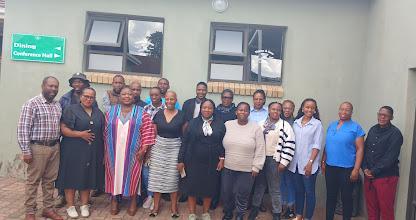
Qacha’s Nek, Jan. 28 — The Ministry of Agriculture, Food Security and Nutrition (MAFSN) District Agricultural Officer (DAO) Nyakallo Pokocho has expressed concern over persistently low food production in Qacha’s Nek, warning that inadequate farming at both household and field level is worsening malnutrition and food insecurity in the district.
Pokocho made the remarks on Wednesday during a Nutrition-Sensitive Platform meeting, where she questioned the limited presence of household gardens and fruit trees in many villages.
“In some families you hardly find fruit trees or food crops, which makes one wonder what our communities are surviving on. We must work together to change this district for the better in our lifetime, not only for ourselves but for future generations, particularly to reduce stunting and food insecurity” she said.
She revealed that Qacha’s Nek currently has the highest stunting rate in the country at 48 percent, followed by Thaba-Tseka at 46 percent and Mohale’s Hoek at 45 percent, according to the Lesotho Demographic and Health Survey (LDHS) 2023–24.
Pokocho further cited findings from the Lesotho Vulnerability Assessment Committee (LVAC), which indicate that 40.9 percent of households in Qacha’sNek are food insecure, the highest rate nationwide.
“This is deeply worrying, during public gatherings we hold regularly, villagers openly say they survive on pap and salt, and some even feed children pap with sheep fat,” she said.
Despite the challenges, Pokocho said progress is possible through collective effort.
“If we work together, we can win this fight, we need to come up with new strategies and work harder,” she said.
She noted that last year’s Nutrition-Sensitive Platform interventions yielded some results, with increased crop production in fields. However, she said farmers remain behind due to reliance on recycled seeds from previous harvests rather than certified inputs.
“The major problem remains at the household level, we must improve food production at all levels,” she said.
Meanwhile, ’Makamohelo Semuli, Director of Nutrition and Home Economics at MAFSN headquarters, recommended that the Nutrition-Sensitive Platform be convened quarterly to better address nutrition-related challenges in the district.
“Our rural communities need support from all stakeholders. The high levels of stunting and poverty are largely linked to lifestyle and dietary habits,” she said.
Deputy Principal Secretary in the Ministry of Education and Training, Refiloe Kepa, echoed the call for collaboration.
“All hands must be on deck if we are to develop Lesotho. With cooperation, we can achieve meaningful change for future generations,” she said.
On behalf of the Nutrition Manager, ’Masekete Motsetsero, Project Field Officer for the Smallholder Agriculture Development Project Phase II (SADP II) in Butha-Buthe, thanked stakeholders for their engagement.
“The reports presented show that work is being done on the ground, although the desired goal has not yet been reached, there is clear progress,” she said.
Motsetsero expressed optimism that lasting improvements would be achieved, particularly if nutrition education is introduced early.
“There is hope for long-term positive change, especially when nutrition education begins at Early Childhood Care and Development (ECCD) level, I commend Qacha’s Nek for its commitment to turning the situation around,” she said.
As alarming statistics continue to place Qacha’s Nek at the centre of Lesotho’s nutrition crisis, stakeholders say sustained collaboration, household-level food production and early nutrition education will be key to reversing the trend and securing a healthier future for the district.
Ends/MM/tl