
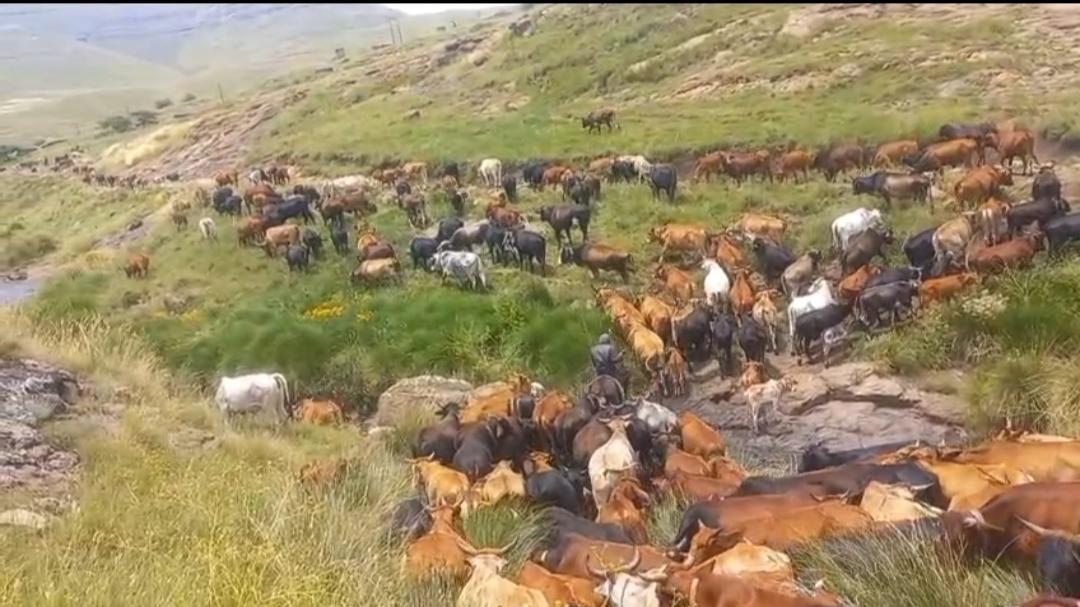
Despite ongoing land rehabilitation efforts in some areas, rangelands vandalism continues to pose a challenge to the farming community of Jorodane in the Berea district.
This was revealed by Jorodane Electoral Division Community Councillor, Mr. Kamo Kamo, on Monday. He said more than 250 head of cattle were impounded over the weekend after being found grazing in areas where grazing is prohibited.
Mr. Kamo explained that communities in the foothills normally develop grazing plans which designate certain rangelands as out of bounds for specific periods to allow natural vegetation to recover.
However, he said their efforts are undermined by some farmers and herders from the lowlands, with or without grazing permits, who deliberately encroach on protected areas, including wetlands earmarked for development.
He noted that most of the impounded cattle were found grazing in rangelands near residential areas such as Maqholo, which are usually reserved for winter grazing as communities try to escape extreme cold. Others were captured grazing in wetlands currently under rehabilitation projects.
Mr. Kamo stressed that grazing livestock in areas allocated for development negatively affects the country’s economy, as significant financial resources are invested in such projects.
“As a result, we cannot show mercy to farmers who deliberately undermine these efforts,” he said.
The councillor further indicated that in some instances, community members tasked with impounding livestock are confronted, threatened, or even attacked with weapons by some farmers.
He appealed to farmers, particularly those from the lowlands, to consult local communities about areas where grazing is permitted and those that are restricted, urging them to respect rules and regulations set by other villages.
Commenting on the matter, a local farmer, Mr. Setofolo Lilochane, said although rangelands are communal assets, their utilisation requires collective responsibility and respect for the law.
Mr. Lilochane said the invasion of protected rangelands by herders from distant areas is a serious issue that negatively affects local communities.
He added that both livestock farming and crop production are the main sources of livelihood in Jorodane, and when cattle stray into agricultural fields, food security is severely compromised.
He emphasised the importance of obtaining grazing permits instead of destroying community development projects.
Meanwhile, according to Jorodane Electoral Division regulations, a cow found grazing in an area allocated for development or where grazing is prohibited is charged M10.00 if it has a valid highland grazing permit, while those without permits are charged M20.00.
Jorodane is located in the foothills of the Berea district, with most of its land covered by rangelands, while a smaller portion is used for crop production.
Ends/RM/BM