Africa-Press – Lesotho. On December 2021, the sun-like star, known as ASASSN-21qj, located 1,800 light-years from Earth, began to flicker, perplexing astronomers. This unusual event led to groundbreaking discoveries, offering a rare opportunity to observe the creation of a new planet and understand the mysteries of planetary formation.
Astronomers recently reported their findings, suggesting that the two sets of observations may be linked to a catastrophic planetary collision, commonly referred to as a giant impact. Such events are believed to be pivotal in the final stages of planetary formation, influencing planetary sizes, compositions, and orbital configurations.
In our solar system, giant impacts are thought to have shaped Uranus’s tilt, Mercury’s high density, and the Moon’s existence.
The collision between the two planets must have released more energy in its initial hours than the star itself emits. The impact would have resulted in superheated, melted, or vaporized materials from the colliding bodies, forming a hot, glowing mass many times larger than the original planets.
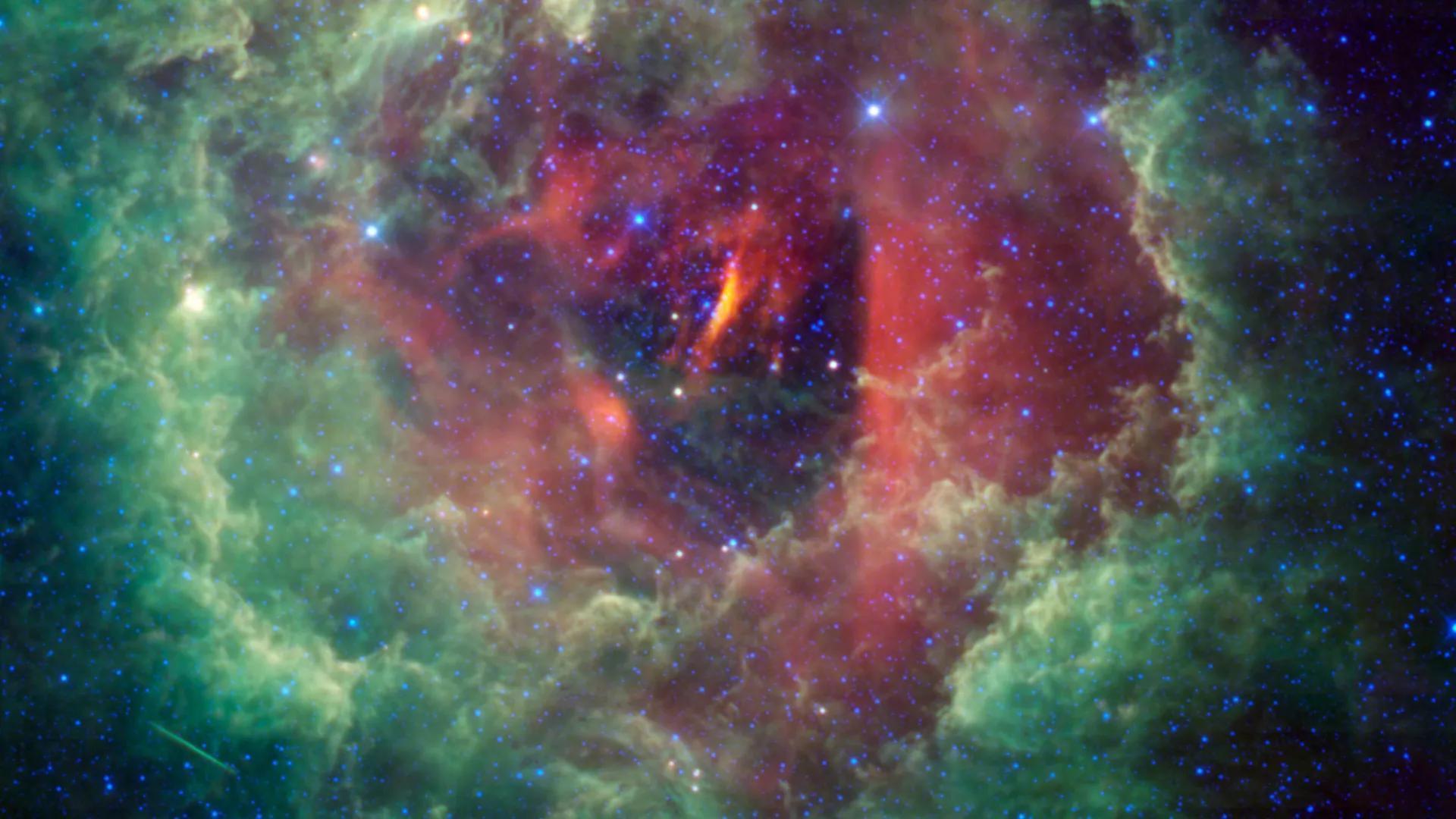
Nasa’s WISE space telescope captured the infrared brightening of ASASSN-21qj, although it likely missed the initial flash of light from the impact due to infrequent observations. This “post-impact body” may take millions of years to cool and shrink into a recognizable new planet.
The collision also ejected clouds of debris into various orbits around the star. Some of this debris was vaporized, later forming clouds of tiny ice and rock crystals, blocking out visible light from the star and causing erratic dimming.
The observations suggest that the collision involved planets several times the mass of Earth, possibly akin to the “ice giant” planets Uranus and Neptune. The temperature of the post-impact body, estimated at around 700°C, indicates that these planets contained elements with low boiling points, such as water.
The time delay between the emission of infrared light and the observation of debris crossing the star indicates that the collision occurred at a considerable distance from the star, resembling our solar system’s configuration with ice giants positioned far from the star.
Researchers are excited about the prospects of continuing to monitor this system for decades, using telescopes like Nasa’s JWST to determine debris cloud compositions, post-impact body properties, and the cooling process. These observations promise to revolutionize our understanding of planetary formation, offering an unprecedented real-time glimpse into the birth of a new planet and the impact of giant collisions in shaping planetary systems beyond our solar system.
For More News And Analysis About Lesotho Follow Africa-Press