Africa-Press – Liberia. Imagine a country rich with arable land, yet suffering from severe hunger.
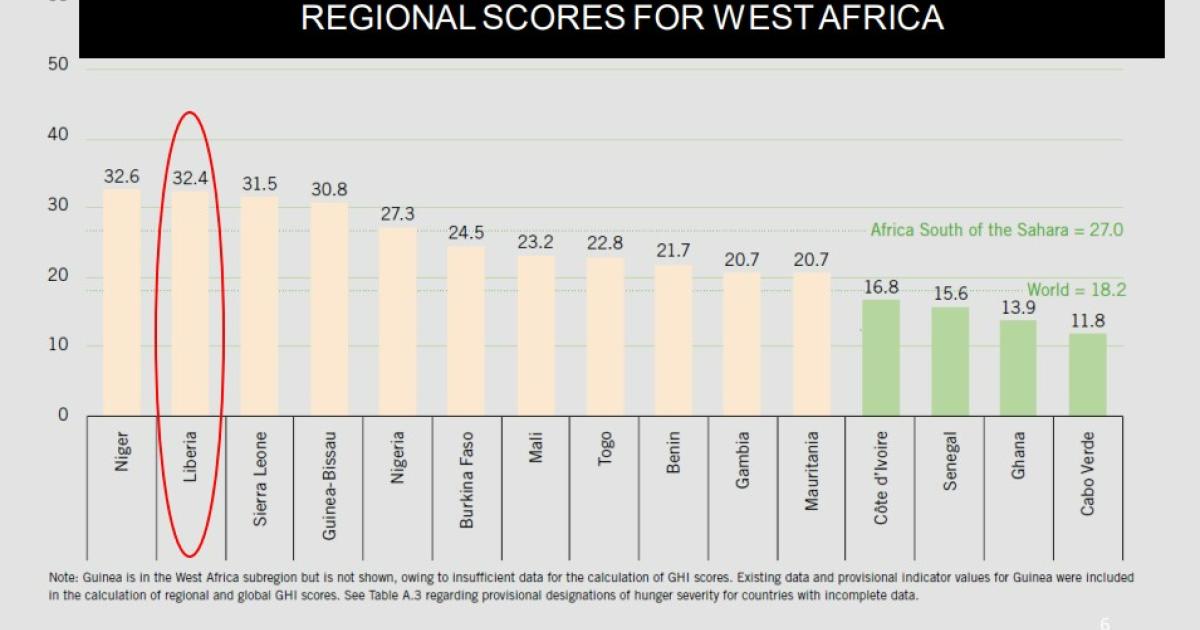
This is the situation of Liberia, a country with a population of 5.2 million people but suffers from a serious level of hunger which is the second highest in the ECOWAS region behind crisis-hit Niger, according to the 2022 Global Hunger Index report published by Concern Worldwide and Welthungerhilfe.
The hunger score for Liberia is 32.4, which is higher than the average hunger score of Africa, which stands at 18 percent, and Africa South of the Sahara, which stands at 27 percent.
And in Africa South of the Sahara, only Niger performs worse than Liberia, which is the world region with the second-highest hunger index score, slightly below that of South Asia.
“In the 2022 Global Hunger Index, Liberia ranks 113th out of the 121 countries and, with a score of 32.4, Liberia has a level of hunger that is serious,” the report noted. “Liberia scores 32.4 out of 100 points according to the ranking matrix, [means] hunger level is still high, even though progress has been made in some areas.”
“Africa South of the Sahara and South Asia are the regions with the highest hunger levels and are most vulnerable to future shocks and crises. Like other world regions, progress against hunger in these regions has stagnated, which is particularly troubling given their desperate need for improvement,” the report said.
Hunger in Liberia, according to experts, is primarily driven by low local agricultural productivity and limited availability of agricultural inputs, mechanized equipment, financial capital, and extension services. Experts also point to the country’s high importation of rice, which is the country’s staple food, and limited nutritional diversity of local production — a problem which is heightened by underdeveloped local markets for high nutritional value products.
Also, the issue of poverty, according to poverty, is a major problem as the World Bank estimates that 50 percent of Liberians live below the poverty line (US$1.90/day) and are unable to access sufficient food on a daily basis.
According to data from the World Food Programme, Liberia continues to face significant levels of hunger and food insecurity. In 2021, it was estimated that 32 percent of the population (1.7 million people) were experiencing acute food insecurity, meaning they did not have enough food to meet their basic needs. The situation is particularly dire in rural areas, where poverty and limited access to basic services exacerbate food insecurity, experts say.
“This year’s Global Hunger Index (GHI) brings us face to face with a grim reality. The toxic cocktail of conflict, and climate change had already left millions exposed to food price shocks and vulnerable to further crises,” Mathias Mogge, Secretary General Welthungerhilfe and Dominic MacSorley, Chief Executive Officer Concern Worldwide wrote in the forward of the report.
The index, according to Mogge and MacSorley, shows that progress in tackling hunger has largely halted and the impacts are now playing out across Africa South of the Sahara, South Asia, Central and South America, and beyond.
The 2022 Index report shows that after decades of global hunger reduction, progress has nearly come to a halt as the score for the world is 18.2, considered moderate, down slightly from the 2014 score of 19.1.
This considerable slowdown compared with previous periods and that as many as 828 million people were undernourished in 2021, representing a reversal of more than a decade of progress in tackling hunger.
The report also noted that progress in tackling hunger is stagnating in South Asia and Africa South of the Sahara, the world regions with the highest hunger levels score of 27.4 and 27.0, respectively.
The hunger levels in both regions are considered serious, and that they are dangerously off track in terms of the progress needed to achieve the second Sustainable Development Goal of “Zero Hunger” by 2030, it adds.
For More News And Analysis About Liberia Follow Africa-Press