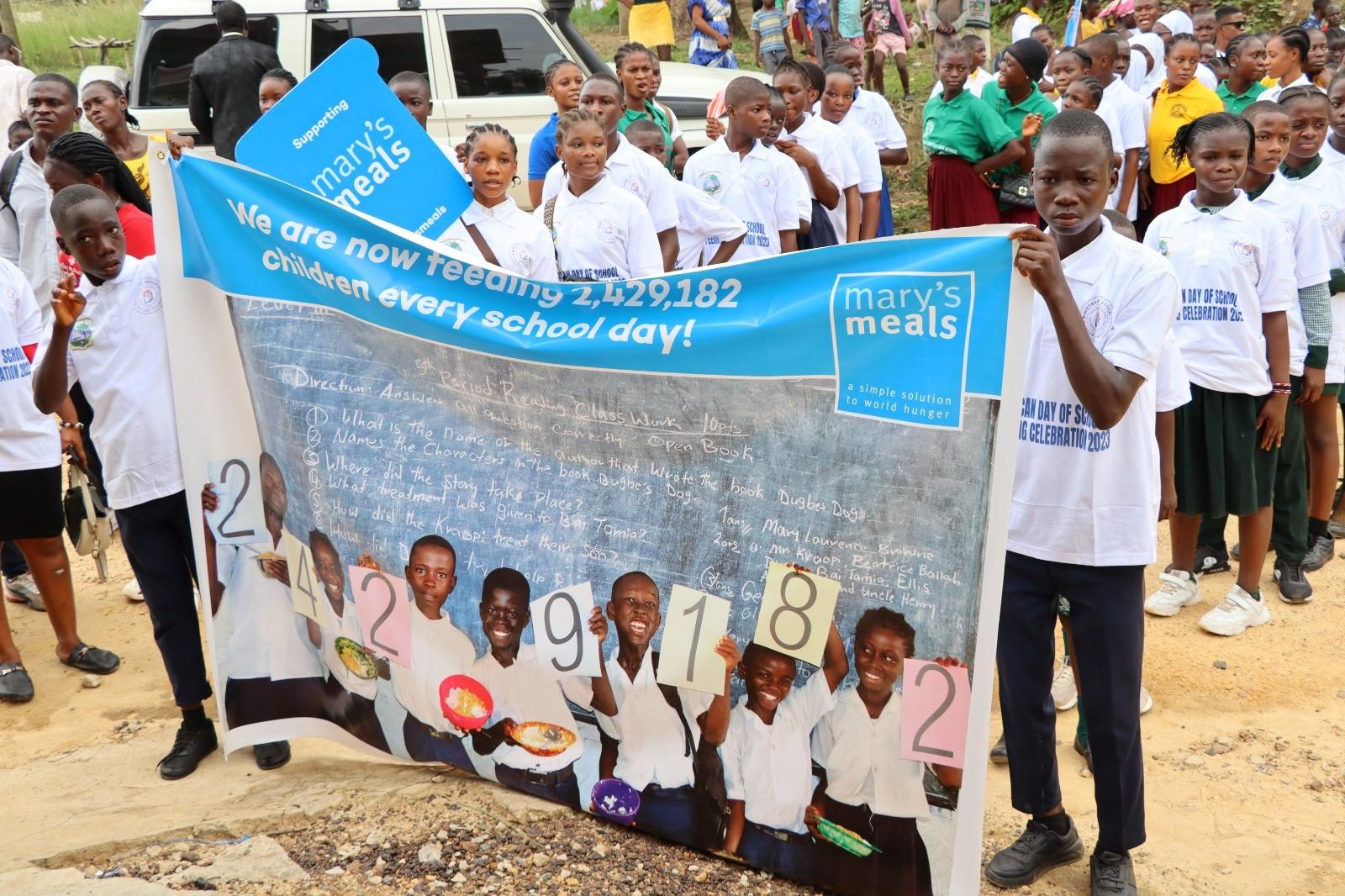
Africa-Press – Liberia. The head of Programmes of Mary’s Meals Liberia, Lusungu Ngulube, has pledged the institution’s commitment to continue supporting the school feeding program in the country. Ngulube made the statement at the commemoration of the eighth Africa Day of School Feeding (ADSF).
ADSF, celebrated every March 1st, is a key tool in realizing the effort to get every girl and boy in school by reducing poverty-related disparities. This year’s edition is celebrated under the continental theme: “Local Food Procurement Systems and Regional Value Chains in the Context of AFCFTA for Sustained Homegrown School Feeding Programmes and Improved Learning.”
Addressing the occasion, Ngulube said the institution’s objective is to ensure vulnerable children receive a vital meal in their place of education. “This commitment both meets children’s immediate need for food and helps to address another key driver of poverty -which is a lack of education- by encouraging them into the classroom where they can learn and grow.”
According to the head of Programmes, Mary’s Meals serves more than 150,000 school children in over 600 schools across five counties, mainly Bomi, Grand Cape Mount, Gbarpolu, Montserrado, and Bong County, where they are the sole provider of school feeding. He acknowledged donors, especially the United States Agency for International Development (USAID), for their generous support in helping to further address the immediate needs of hungry children, contribute to the long-term development of communities, and highlight the issue of food insecurity in Liberia.
“We work hard on how to source our food, aiming to use ingredients that are produced locally and available all year round, when and where this is possible. Our most important consideration must always be consistent, high-quality produce delivered at a scale that allows us to keep our promise to all the children we support,” Ngulube said.
“We try to support smallholder farmers through our procurement where this is possible and have a strong desire to support Liberia’s economic growth.”
Making a brief remark, USAID Education Office Director Anh Pham said school feeding programs provide students with the assurance of a nutritious meal every school day and the incentive to enroll and regularly attend school. “School feeding provides critically needed social safety nets for Liberia’s poorest families, especially during this challenging era of rapid increases in food prices and global food shortages,” she said.
Pham revealed that the US government, through USAID, will continue to partner with Mary’s Meals in providing daily nutritious meals to school-going children across the five counties. He disclosed that USAID is planning to expand its support to reach more students, stressing that Liberia needs the assistance. According to him, food insecurity problems are getting worse as a recent assessment conducted by the government of Liberia and the UN World Food Programme showed that over 2 million people, or 47% of households, are food insecure. He added, “Many Liberian students are unable to get enough food to meet their daily nutritional needs.”
Pham emphasized that without sufficient nutrition, children have difficulty concentrating, learning, and developing to their full potential. Therefore, Liberia is one of eight new target countries under the United States Government’s Feed the Future Initiative. The initiative will support Liberia in developing its agriculture sector and breaking the vicious cycle of poverty and hunger. The best solution to food insecurity in Liberia is a developed and productive agriculture and a private sector free from corruption. This will also propel home-grown school feeding.
Pham called for a collective effort to ensure Liberia takes advantage of these resources to increase agricultural productivity, food security, and nutrition. She further urged the government to fund the Ministry of Education to provide resources to support Liberia’s children and their future. She said, “For Liberia to reach its potential, all resources need to be maximized and used for their intended purpose of improving education for Liberia’s children.” She added, “We don’t want families to choose between food for survival and an education that can provide a pathway out of poverty for their children.”
Reading the proclamation of the Africa Day of School Feeding, Stephanie Makarvee Nabieu, an eighth-grade student of the Divine Daycare Primary and Junior High School, highlighted the importance of increasing the consumption of locally produced food items, including the promotion of innovative school feeding programs that use food items sourced from the local farming community (a home-grown component of school feeding).
She said the aim was to improve the nutritional status and eliminate infant undernutrition in Africa to bring down stunting to 10% and underweight to 5% by 2025. She indicated that NEPAD is a key partner in moving forward the agenda, which is similar to the Africa Union Department of Social Affairs (DSA), which has been working to promote an enabling environment and build capacity for school feeding and nutrition in Eastern Africa.
She indicated that the idea to establish the African Day of School Feeding was a brainchild of Heads of State and Government of the African Union (AU) who passed the decision in the Assembly in January 2016, acknowledging school feeding’s contribution to human resources development in Africa, adding value to the realization of Agenda 2063, CESA 16-25, and the efforts to reap demographic dividends.
She said, “In recognizing the particular value of the Home Grown School Feeding (HGSF), the Heads of State called for a general study on the relevance and impact of school feeding in Member States; urged the establishment of a multi-disciplinary technical committee for school feeding; and established the 1st of March as the African Day of School Feeding (ADSF).”
For More News And Analysis About Liberia Follow Africa-Press