TINA S. MEHNPAINE
Africa-Press – Liberia. For years, James Sackie, a father of three, has depended on charcoal production as his primary source of income, but the health risks associated with the trade have begun to worry him.
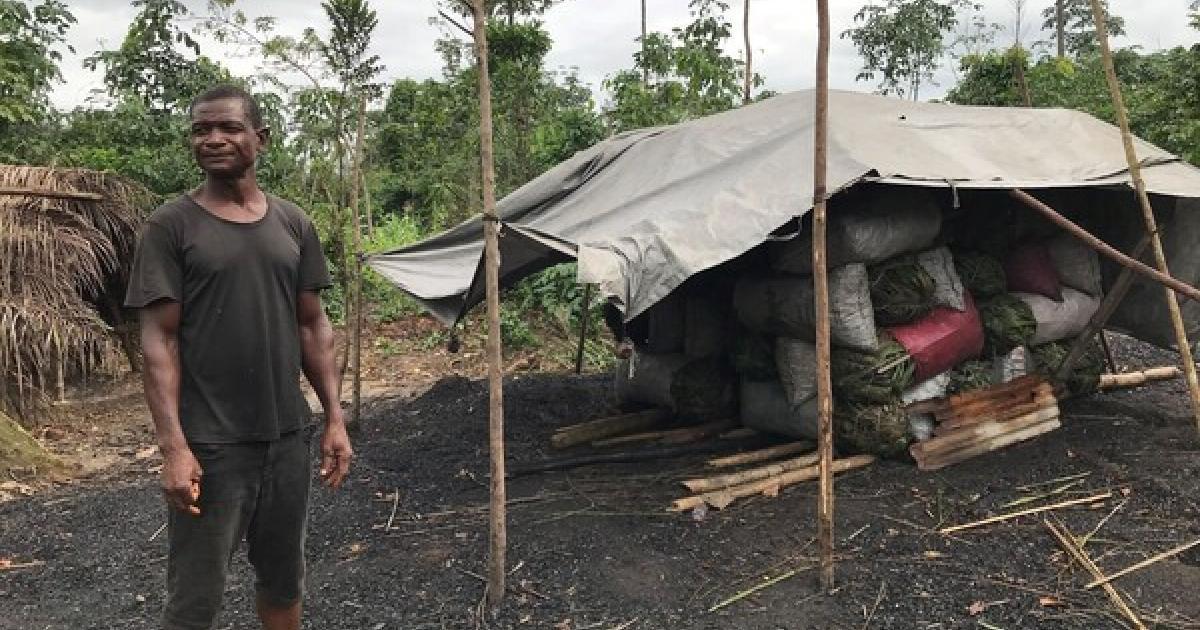
The 48-year-old, who lives in one of the poorest districts in Montserrado County, had spent the last three months spending hours inhaling smoke, which is often toxic when producing charcoal.
“I have spent years producing charcoal for a living,” says Sackie, as his hands bear a bundle of freshly made charcoal, his voice tinged with desperation. “But it is the health risk that worries me.
“This is against the background of the lower profit margin despite the risk involved for charcoal producers. Life is getting harder, and I’m worried about what the future holds for me and my family.”
Charcoal, which is the most used cooking fuel in Liberia, is not just a vital economic activity for Sackie, who lives in Barh Town, Todee District, but for thousands of Liberians as well, including his workmate Joseph Ford.
Todee, which is one of the oldest and poorest rural districts in Montserrado County, is notorious for its limited economic opportunities, forcing many into the charcoal trade, whose entire production line is fraught with hazards and health risks.
The smoke emitted during the carbonization process contains toxic chemicals and particulate matter that can cause respiratory problems, eye irritation, and long-term health issues.
Workers often lack protective equipment, such as masks or gloves, exacerbating their exposure to harmful fumes and increasing the risk of injuries from handling burning wood.
But the quest for survival keeps Sackie and many others, who are worried about their health, in business. According to a 2019 World Bank report, about 337,000 metric tons of charcoal — worth US$46 million — was sold in 2018.
Montserrado, the report noted, consumed the bulk of the 337,000 metric tons that year — accounting for over 65 percent of total demand, more than ten times greater than any other county.
The charcoal industry, according to the World Bank, also saw significant demand in Margibi, Bong, Nimba, Grand Bassa, and Bomi counties, respectively. The industry overall is expected to keep growing as the population has a strong desire for charcoal, which is cheaper than other imported fuels.
The nature of the industry, despite its health and environmental risks, has pushed Sackie and workmate Ford to spend L$30,000 — nearly twice what they used to spend before to produce 169 bags of charcoal — which may bring in about L$50,700 when all is sold.
A bag of Sackie’s and Ford’s charcoal will be sold for L$300 in Barh Town. However, when it is transported to the nation’s capital, Monrovia, and its environs, the price ranges from L$700 to L$900, depending on the location.
The lucrativeness of the industries also comes with health risks for many of the impoverished Librarians who are involved in the production of charcoal.
“The toll on the health of charcoal producers is grave,” experts say. “The toxic fumes emitted during the combustion of wood in open-air kilns contain harmful substances that can cause irreversible health damage and even premature death.
“The long-term exposure to these pollutants can lead to chronic respiratory diseases, heart problems, and even developmental issues in children. The health risks are not only confined to those who engage in the production but also extend to their families and communities.
The situation in Barh Town, which relies heavily on charcoal production for economic activities, is exacerbated by the lack of protective equipment.
Many charcoal producers toil without proper masks or ventilation, leaving them highly vulnerable to the harmful particulate matter and gasses released during the process.
Charcoal workers, who are predominantly men and women from impoverished rural communities, have to spend hours cutting down trees; splitting them into firewood, and stacking them in makeshift kilns.
The kilns are then carefully covered with mud to trap heat — allowing the wood to burn partially and transforming it into that dark, chalky charcoal.
The stacked kilns must be constantly monitored in the process and maintained during the burning process — which can take up to several weeks. This involves Sackie and Ford sometimes being exposed to the elements while trying to ensure the quality and protection of their product.
For Ford, the health risk is the price they have to pay for living in a poor and neglected community. He says while he and many others are aware that the smoke during the charcoal production period is dangerous, they have no choice but to survive.
“What can we do? This is our only means of survival,” Ford noted as he gazed at the vast expanse of charcoal that now dominates the Barh Town landscape.
“Life itself is hard but in Todee, it is four times harder and there is limited opportunity to get out of the shackles of poverty.
“This is not what many of us here in Todee dream of, but our hands are tied to do the odd jobs for survival,” Ford says. “We cannot sit down and do nothing.”
The transition to safer practices isn’t without challenges as charcoal producers like Tomas Kennedy, who has been in the business for seven years, lack the cash to buy protective equipment which is needed to reduce his exposure to industry health risks.
Kennedy, like many others who produce the charcoal, does not make much money from the trade as the wholesale buyer who have the liberty to sell at any price of their choice in urban markets, where the demand for the product is perpetually high.
“We are not begging for handouts but alternative livelihood opportunities so we can break from the cycle of destruction,” says Kennedy, whose view is echoed by many in Barh Town.
“We’re faced with a stark reality — but this is our only means of survival. It’s a challenging path, but we are committed to finding sustainable solutions.
“We need training, alternative income sources, and incentives to help us shift to safer methods,” Kennedy added. “Or else, we will continue to be exposed to smoke.”
However, the head of the National Charcoal Union of Liberia, Richard Dorbor, has slammed calls for alternative livelihood.
Dorbor noted that while the Union supports sustainable charcoal production, it cannot call on Liberians, many of whom are poor, to abandon charcoal production.
“We are not stopping anyone from seeking alternatives but what we are mainly focusing on is sustainable charcoal production for our people,” he said. “Our people deserve to live and survive and Charcoal production is one of the mediums.”
Beyond the physical strain and health risks, charcoal production also poses significant environmental concerns.
Liberia’s forests, spanning more than 3 million hectares, is also a global diversity hotspot, albeit at risk in part due to charcoal production.
The 2018-2019 National Forest Inventory estimates that Liberia’s forest makes up more than two-thirds of the country’s land area and covers 6.69 million hectares, equivalent to twice the size of Belgium.
“As you burn charcoal, you have CO2 going into the atmosphere, which causes the earth to get warmer,” says Dr. Eugene Shannon, former Minister of Lands, Mines, and Energy, now President of the Natural Resources Development Corporation.
“We are trying to keep the temperature at 1.5 degrees census. Charcoal goes along with deforestation but people do so to take care of themselves, send their children to school, and, in the process, they do not consider the environmental effect,” Shannon says.
Experts have cautioned that if charcoal production continues on its current trend, the country may lose most of its forest in the process. This would happen despite Liberia being a signatory to the 2021 United Nations Conference of Parties (COP), Declaration on Forests and Land Use — pledging to “halt and reverse forest loss and land degradation” by 2030.
Liberia and the rest of the 127 signatories account for about 90% of global tree cover and 85% of the world’s primary tropical forests, including the nine top countries in terms of forest area.
But two years later, trees are still being cut down in Liberia as poverty remains seriously high among Liberians. The World Bank estimates that 50 percent of Liberians live below the poverty line and a sizable number live in extreme poverty.
This puts Sackie and many others in Barh Town at a crossroads — looking at the weight of poverty and the challenge of forging a sustainable path ahead.
For More News And Analysis About Liberia Follow Africa-Press