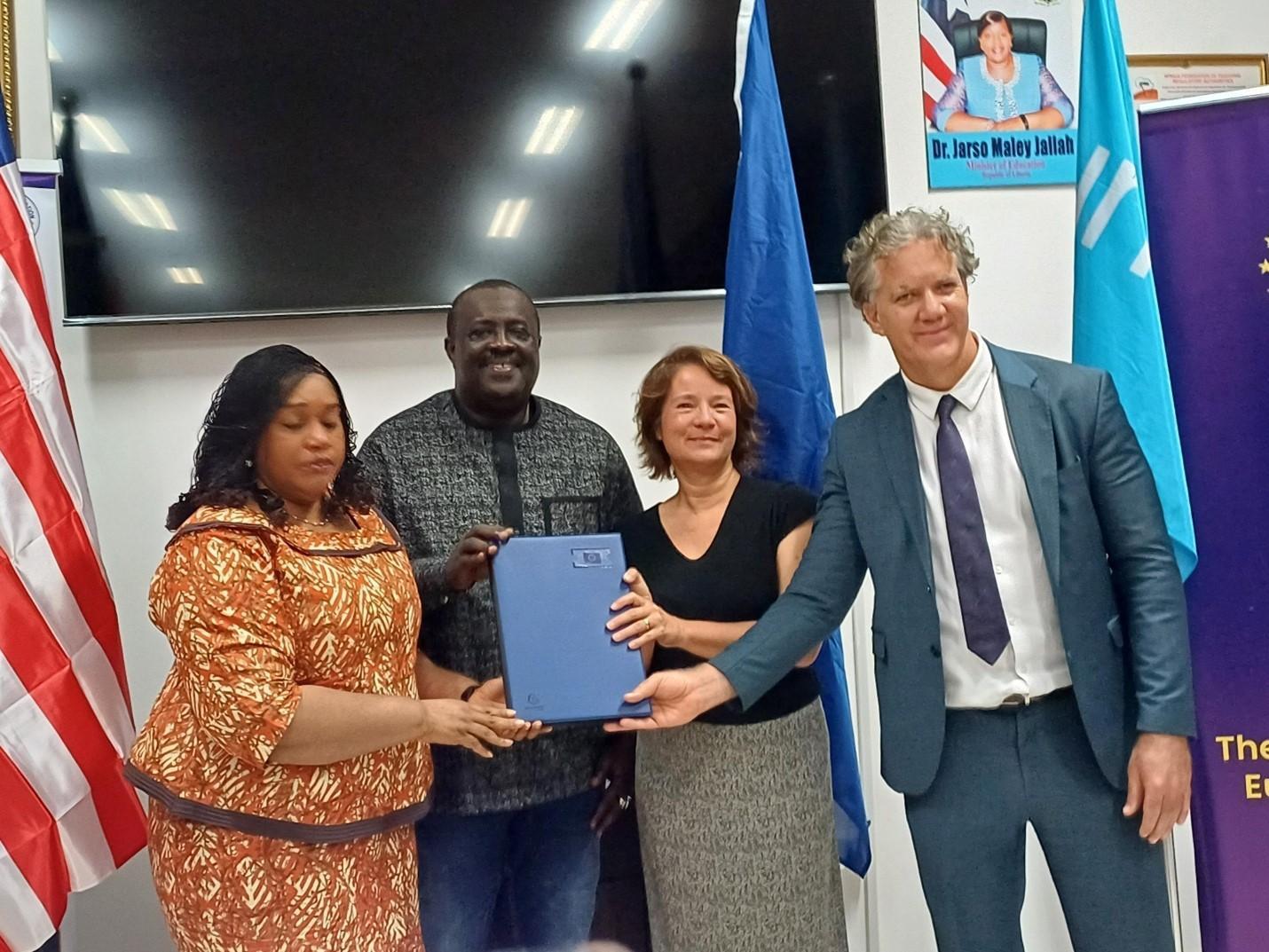
Africa-Press – Liberia. The Ministry of Education (MOE) has signed a $2 million grant agreement with the European Union (EU) and UNICEF to strengthen the country’s Education Management Information System (EMIS).
This agreement aims to enhance data-driven decision-making and implement sustainable reforms in education. It will establish robust systems for capturing data on enrollment, completion, employment outcomes, and resource allocation across Technical and Vocational Education and Training (TVET) institutions.
In addressing the Minister of Education, Jarso Jallah emphasized that the agreement highlights a shared commitment to improving the education system and data management through EMIS, stressing that the $2 million grant represents more than just a financial transaction.
She reaffirmed the importance that partners place on evidence-based policymaking, which relies on data to provide a clear picture of the state of Liberia’s schools, teachers, staff, and administrators. This information is essential for driving data-informed decisions and solutions.
Jallah stated, “This funding will directly support the MOE’s Management Information System division and the Ministry of Youth and Sports. Together, we will enhance our national capacity to collect, analyze, and use data to improve planning and accountability, and most importantly, student outcomes. A critical component of this support is the emphasis on technical vocational education and training.”
She noted that the TVET sector has long been underrepresented in national data systems. “TVET offers a pathway to opportunity for thousands of young people in Liberia. We need to first understand where the needs are, where the gaps lie, and how we can invest wisely and strategically.”
Jallah praised the EU and UNICEF for their belief in Liberia’s potential and for helping to build a future where every educational decision is backed by evidence and focused on impact. This partnership will foster collaboration between ministries to ensure that education and youth development progress together.
“Let me say this: when we invest in data, we invest in better decisions; and when we make better decisions, our children and youth benefit the most,” Jallah stated.
The EU Ambassador to Liberia, Nona Deprez, expressed pride in the EU’s longstanding commitment to Liberia’s education sector. She revealed that over the past several years, the EU has invested more than €50 million in TVET.
“We’re not just investing in infrastructure and students; we’re also prioritizing teacher training and school management. Partnering with UNICEF to support the Ministry of Education in strengthening EMIS is a natural next step. It enables us to track the real impact of our collective investments,” Ambassador Deprez disclosed.
She added that the EU, through its “Team Europe” approach, which includes contributions from member states, has committed approximately €100 million to support Liberia’s TVET sector. This partnership with UNICEF will ensure that quality data is available to guide future policies and priorities.
UNICEF Country Representative in Liberia, Andy Brooks, stressed that data and evidence are essential tools for driving lasting change.
“If you have reliable data, you have authority, credibility, and objectivity—and ultimately, the power to influence change,” Brooks said. “What we currently lack in the sector is consistent, credible information to help us tell a convincing story about what’s working and what’s not.”
Brooks noted that the persistent challenges facing Liberia’s education sector, such as out-of-school children, gender disparities, and overage enrollment, could be addressed with a robust EMIS that allows policymakers and development partners to measure progress and allocate resources effectively.
“This initiative is not just about tracking TVET,” he stated. “It’s about creating a data system that follows children from their first day of school through secondary education and into vocational training—helping us understand what interventions make a real difference at every step.”
Brooks commended the MOE’s new leadership role under the African Union’s African Agenda for Industrial Development (AAID) in guiding the Human Capital Pillar, calling it a fitting recognition of the ministry’s central role in national development.
“Liberia has endured too much loss—war, Ebola, COVID. Now, the World Bank tells us that only one in three children will reach their full potential. That’s unacceptable,” Brooks declared. “This investment in EMIS is a step toward changing that narrative so we can finally measure—and, more importantly, achieve—real progress.”
For More News And Analysis About Liberia Follow Africa-Press