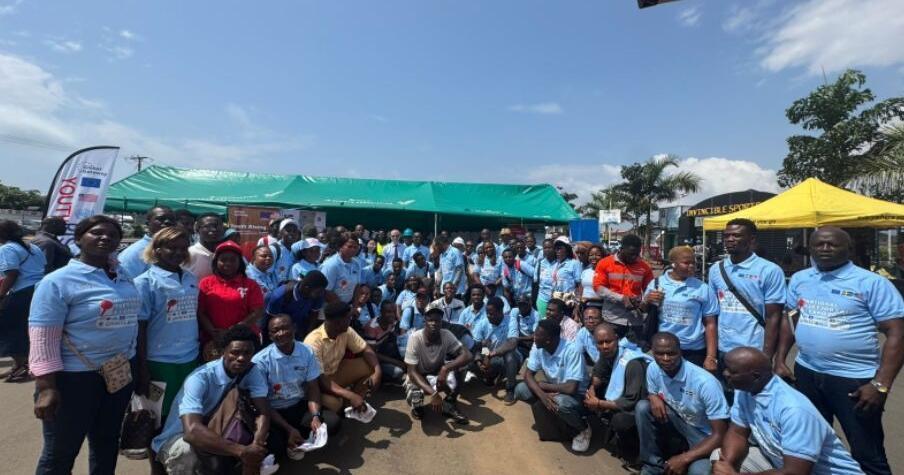
Africa-Press – Liberia. The Government of Liberia, through the Ministry of Education and the Ministry of Youth and Sports, in collaboration with the United Nations Industrial Development Organization (UNIDO) and the European Union (EU), on Thursday officially opened the Second Annual National Technical, Vocational Education and Training (TVET) Job Fair and Expo 2025 at the Invincible Sports Park in Monrovia, reaffirming national and international commitment to youth employment, skills development and private sector growth.
Held under the theme “Bridge” – Connecting Skilled Youth with Liberia’s Private Sector, the job fair forms part of the Youth Rising Project, which is designed to strengthen Liberia’s TVET sector to deliver high-quality, demand-driven training that improves youth employability and entrepreneurship.
The initiative is funded by the European Union and the Government of Sweden and implemented by UNIDO. Other partners supporting the event include the Embassies of France, Germany, Sweden and Ireland, as well as Lonestar Cell Mobile Money, among others.
Delivering the official opening remarks on behalf of Education Minister Dr. Jarso Jallah, Assistant Minister for Technical, Vocational Education and Training, Nathaniel K. Cisco Jr., described the job fair as a major national platform linking education directly to employment opportunities. “Today’s job fair is more than a gathering. It is a bridge — a bridge between the skills we deliver and the opportunities of our young people,” Minister Cisco said.
He explained that Minister Jallah was unavoidably absent due to pressing national engagements but extended her full support and best wishes for the success of the event.
Minister Cisco said the Youth Rising Project has empowered thousands of Liberians with marketable skills as a result of strong international cooperation. “Through the Youth Rising Project, hundreds of thousands of Liberians have been empowered with marketable skills thanks to the steadfast support of the European Union and the Swedish Government. We remain sincerely grateful for this partnership,” he said. He also acknowledged the French Government for its continuous support to TVET in Liberia.
However, he warned that training alone is not enough to transform Liberia’s economy if employment is not guaranteed. “We must face a key truth — training without empowerment cannot transform our economy. Skills must align with industrial needs, and industry must open pathways to our skilled youth. That is why today matters,” he emphasized.
He called on employers to see young people not merely as job seekers but as partners in innovation and national development. Turning to the students, he urged them to walk forward with confidence. “Your skills are needed now more than ever. Together, let us build a TVET system where training leads to productivity, dignity and national growth,” he said.
Earlier, Director for TVET at the Ministry of Education, Patrick Anderson, delivering the welcome remarks on behalf of Minister Jallah, lauded UNIDO, the European Union and all development partners for their pivotal role in implementing the 2025 Youth Rising Project and supporting skills development across Liberia.
French Ambassador to Liberia, Madame Isabelle Le Guellec, reaffirmed France’s strong engagement in Liberia’s TVET sector, disclosing that her country is supporting multiple initiatives including the STRIVE Project funded through the French Development Agency, a scholarship program and the placement of an international technical expert at the Ministry of Youth and Sports.
She said France is also supporting TVET through its private sector presence in Liberia, including companies such as Orange, AGL, Bureau Veritas, CMA-CGM, Renault, Ecobank and SUNU Insurance.
Ambassador Le Guellec outlined four major challenges confronting the TVET sector, beginning with the quality of training and the need for harmonized curricula across all trades.
“There is a need for harmonized and aligned curricula in each trade. The entrepreneurship curriculum has just been validated, and curricula in masonry, hospitality and agriculture are also ready. But these must be rolled out in all TVET centers across Liberia’s 15 counties,” she stressed. She identified sustainability as the sector’s greatest challenge, saying government must gradually assume responsibility for funding TVET centers, teacher salaries, equipment and maintenance. “TVET is essential to economic growth, entrepreneurship and job creation. Therefore, the national budget must allocate enough resources to make the sector sustainable,” she emphasized.
On private sector engagement, she pointed out that President Joseph Nyuma Boakai had recently told French investors that Liberia intends to add value to its raw materials through local manufacturing.
“TVET must ensure that the skills taught are those needed in the labor market and for future manufacturing development,” she said. She also called for the establishment of a national coordination authority to regulate and harmonize the sector, noting that discussions on the proposed LITCOM Commission are currently before the Legislature.
Swedish Ambassador to Liberia, Karl Backéus, described the job fair as a vital pathway to sustainable economic growth, warning that Liberia can no longer rely mainly on government employment. “Historically, there has been an over-reliance on government jobs. But Liberia’s future lies in strong private sector growth — and that requires skilled labor,” he said.
He disclosed that Sweden has invested nearly eight million United States dollars in Liberia’s TVET sector since 2018, working primarily through UNIDO, with a strong focus on Lofa County. He praised the Voinjama Multilateral High School as a model of what strong partnerships, committed teachers and motivated students can achieve.
European Union Ambassador to Liberia, Nona Deprez, said 27 companies were present at the fair, offering at least 85 job vacancies. “This is not just a job fair — it is also a free platform where young people can learn how to develop CVs, face interviews and navigate the labor market,” she said.
She announced that the top three winners of the TVET Expo and Innovation Showcase would each receive one thousand United States dollars as seed funding to support their business ideas. “Make contacts with employers, promote your CVs and leave here today more confident in your skills and your future,” she urged the youth.
Representing the UN Resident Coordinator, Chie Matsumoto of UNIDO Headquarters summarized the job fair around three pillars: skills, strength and success. She described the event as a celebration of young people’s talents and innovations, with platforms for job matching, career guidance, CV writing, interview coaching and business pitching.
She said the fair was made possible through support from the European Union, Sweden, France, Finland, Iceland, Norway and the Government of Liberia. “Together, we are investing in people, strengthening institutions and fostering innovation for Liberia’s future,” she stated.
Speaking on behalf of job-seeking students, Jerralyn B. Kou, an electrical installation and maintenance student at Zwedru Multilateral High School, told the gathering that the Youth Rising Project has transformed the lives of young Liberians.
“Through the Youth Rising Project, young people like myself have gained access to quality training, equipment and an environment that encourages excellence, innovation and positivity,” she said.
She described the job fair as a powerful bridge between education and employment that creates pathways for decent work, entrepreneurship and national development. She encouraged young people across Liberia to embrace TVET as a respected and viable career pathway and called on graduates to remain persistent and committed to lifelong learning.
The Second National TVET Job Fair and Expo has been widely praised as one of Liberia’s most strategic platforms for transforming education into employment, strengthening the private sector and reducing youth unemployment through practical, market-driven skills development.
For More News And Analysis About Liberia Follow Africa-Press