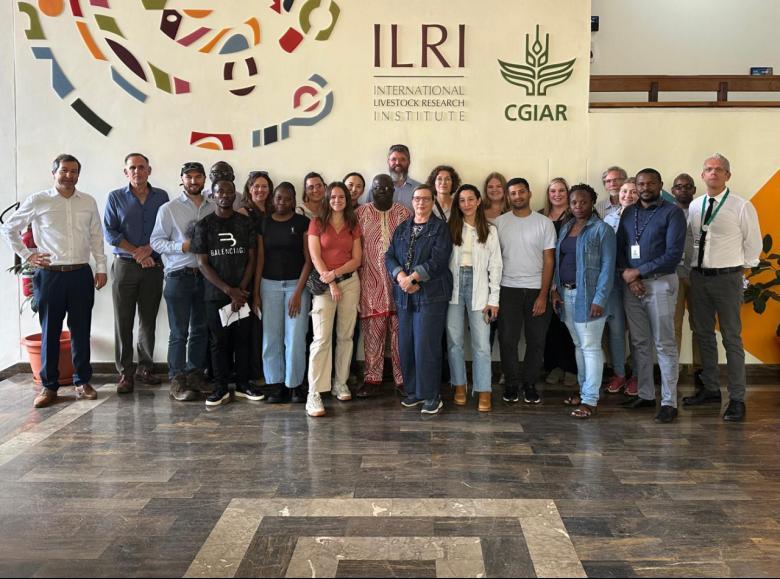
Africa-Press – Liberia. At the International Livestock Research Institute (ILRI) campus in Nairobi, a diverse mix of journalists from Africa, Europe, Asia, and the Americas gathered for a rare inside look into the world’s most influential agricultural research network, the Consultative Group on International Agricultural Research (CGIAR). The gathering itself reflected CGIAR’s global reach, stretching from dryland agriculture in North Africa to maize hybrids in Mexico and livestock systems across sub-Saharan Africa. For many visiting reporters, it was a chance to step directly into the laboratories, fields, and innovation hubs where some of the most impactful agricultural breakthroughs of the last half-century have been born.
Michael Victor, ILRI’s Head of Communications, welcomed the group with a broad overview of CGIAR’s mission and the evolving challenges shaping its work today. CGIAR, he explained, is a network of thirteen research centers operating in more than eighty countries, each specializing in different agricultural commodities, ecosystems, or development priorities. Institutions such as International Center for Agricultural Research in the Dry Areas (ICARDA) in North Africa and International Maize and Wheat Improvement Center (CIMMY) in Mexico are global leaders in crop improvement, climate resilience, and regional food systems. ILRI, however, stands out as the only center dedicated entirely to livestock, cattle, sheep, goats, pigs, camels, poultry, milk, meat, and eggs.
Victor noted that ILRI’s work is no longer focused solely on boosting production. The institute now helps shape sustainable food systems that protect the environment, strengthen human and animal health, and support the smallholder farmers who rely on livestock for income and food security. Over its fifty-year history, CGIAR has broadened its approach from the yield-focused mindset of the Green Revolution to integrated solutions that address climate change, gender equity, markets, and One Health systems. Today, the consortium’s research responds not just to food shortages, but to the broader social and environmental pressures shaping global agriculture.
He also underscored the importance of journalism in tackling misinformation, whether rumors about livestock vaccines or political distortions of scientific findings, which increasingly threaten agricultural progress. Evidence-based reporting, Victor said, is essential for strengthening public trust and guiding policy decisions rooted in science.
Following the briefing, ILRI research technician Collins Mutai outlined the tour of ILRI’s research facilities and quarantine station. Journalists would also meet scientists from CGIAR sister centers based at ILRI, including the Alliance of Bioversity International, the International Center for Tropical Agriculture, and the International Potato Center. After putting on lab coats for a quick group photo, the team set off to explore the science and partnerships shaping CGIAR’s global impact.
ILRI’s Mazingira Centre: Climate-Smart Livestock with Scientist Sonja Leitner
At ILRI’s Mazingira Centre, Sonja Leitner, Scientist for Soils and manure nutrient cycling offered insight into the institute’s work on climate-smart livestock research tailored to African realities. Most global methane and manure research focuses on high-tech dairy systems in Europe and North America, systems that rely on liquid manure handling, automated feeding, and large-scale mechanization. “These interventions simply don’t fit the realities of African smallholders,” she said. “We need low-cost, low-tech solutions that farmers can actually use.”
To achieve this, ILRI co-designs interventions with farmer groups such as the Women Farmers Association of Kenya and Regenerate Africa. Farmer input guides every stage of research. “If you design something in a lab and only later discover it’s unusable in the field, it’s a failure,” she explained.
Policy engagement is equally important. In many countries, manure falls between ministries, Health treats it as waste, Agriculture sees it as fertilizer, and livestock departments often overlook it entirely. ILRI is working with Kenya and Uganda to clarify responsibility and integrate improved manure practices into extension programs and agricultural training.
Africa needs more research centers like Mazingira, Leitner noted. “We have one Mazingira Centre here. For Africa’s scale, we need at least twenty. Climate change isn’t waiting for us to expand.”
One challenge is limited farmer knowledge about greenhouse gases. Some pastoralists worry that methane from cows may be dangerous to them personally. Leitner clarified that emissions do not threaten individual farmers directly. The real issue is systemic: livestock numbers in the Global South are rising quickly while productivity remains low. In Europe, a cow may produce forty to sixty liters of milk per day. In pastoralist areas of Kenya, the same animal may produce only two liters. “The Global South needs to increase output per animal so that herds don’t expand endlessly just to meet food demand,” she said.
Communication is central to ILRI’s work with communities. Since ILRI is not a development agency, it depends on local partners, translators, and simplified materials to reach pastoralist communities in regions such as Kajiado, Machakos, and northern Kenya.
Leitner also demonstrated ILRI’s systems for measuring methane emissions. Animals are placed for twenty-four hours in a transparent respiration chamber that precisely captures methane, produced mostly through burping, not flatulence. For field settings, ILRI uses the SF6 tracer technique, where cattle wear harnesses that collect breath samples as they graze. This work is among the first of its kind in the region.
Research on low-methane forages is also advancing. Certain legumes contain tannins that naturally reduce methane formation in the rumen and shift nitrogen excretion from urine to dung, lowering emissions from both the animal and its manure. ILRI works with institutions such as the Alliance of Bioversity & International Center for Tropical Agriculture (CIAT) and International Center for Agricultural Research in the Dry Areas ( ICARDA), using gene bank materials to identify promising forages through laboratory screening and feeding trials.
International Potato Center (CIP): Innovation for a Changing Global South
At the exhibition area, Mukani Moyo, Head of Urban Food Systems at CIP welcomed journalists to the International Potato Center (CIP) booth. Headquartered in Lima, Peru, CIP operates across Africa, Asia, and Latin America, with a research agenda anchored in biodiversity, crop improvement, regenerative agriculture, and food systems.
Under its biodiversity program, CIP conserves and distributes germplasm for potatoes, sweet potatoes, and other root and tuber crops, ensuring that decades of breeding progress are secured for future generations.
The crop improvement pillar focuses on varieties that respond to farmer needs, nutrition demands, and market preferences. Moyo highlighted orange-fleshed sweet potatoes rich in vitamin A and purple-fleshed varieties packed with antioxidants, both already released across Kenya and multiple African countries.
CIP’s regenerative agriculture work integrates climate adaptation, soil health, and environmentally friendly farming methods. Every technology, Moyo emphasized, must strengthen farmers’ resilience to climate risks.
Leading CIP’s food systems pillar, Moyo showcased value-added products such as sweet potato flakes, flour, biscuits, and the popular orange-fleshed sweet potato purée. The purée is steamed and shelf-stable for up to two years without refrigeration, offering a nutritious, cost-effective alternative to wheat in baked goods. By replacing a portion of wheat with sweet potato, households can improve nutrition at lower cost.
Moyo also presented a “Healthy Baby Tool Kit” for caregivers, which includes a spoon for checking food consistency and markings that guide appropriate portion sizes for children aged six to twenty-four months, with additional guidance for maternal nutrition.
In Lab 7, CIP scientist Mary demonstrated biotechnology research focused on combating late blight, a disease that causes up to seventy percent yield loss in Kenya. CIP has introduced resistance genes from wild potato relatives into farmer-preferred varieties such as Shangi. Trials in Kenya, Nigeria, and Rwanda show complete resistance, promising to reduce farmer losses and lower fungicide use. CIP is also exploring solutions for bacterial wilt and investigating gene-editing approaches targeting Potato Virus Y to improve seed quality and yields.
IITA: Scaling Proven Technologies Across Africa
Rachel Zozo, Country Representative for the International Institute of Tropical Agriculture (IITA) in Kenya, outlined IITA’s mission to reduce poverty and improve food security through actionable, validated research. Headquartered in Nigeria, IITA operates in twenty-eight African countries organized into hubs across Central, West, Sahel, Southern, and Eastern Africa.
In Kenya, IITA’s work centers on biotechnology, plant and soil health, nematology, and digital agriculture tools that equip farmers with real-time decision support. A central initiative is the Technologies for African Agricultural Transformation (TAAT) program, implemented with the African Development Bank. TAAT brings together CGIAR centers, governments, and private-sector actors to scale proven technologies from research to farmer fields.
Governments play an essential role because they hold the networks, extension structures, and resources needed to move innovations into rural communities. IITA’s long-term goals include lifting eleven million farmers out of poverty, reducing child malnutrition by thirty percent, and restoring seven and a half million hectares of degraded land. The institute also invests heavily in training, including its long-running partnership with UC Davis that supports African plant breeders through the Christopher Course.
ILRI Poultry Genetics: Safeguarding Africa’s Indigenous Breeds
ILRI’s Collins Mutai concluded the visit with a presentation on poultry genetics research conducted in partnership with the Roslin Institute in Scotland. Across Western Kenya and many other regions, indigenous chicken breeds remain important to rural culture, nutrition, and income. However, growing demand for commercial breeds threatens the survival of these native lines.
ILRI scientists collect primordial germ cells from fertilized indigenous chicken eggs and store them in liquid nitrogen at minus 196 degrees Celsius. This genetic archive enables ILRI and national partners such as Kenya Agricultural and Livestock Research Organization (KALRO) to conserve indigenous breeds and reconstitute them if disease outbreaks or market pressures cause decline.
The program works closely with research institutions in Kenya and Uganda and is gaining interest from countries like Zimbabwe. A major constraint is low productivity, some indigenous birds lay as few as fifteen eggs per year, compared to more than three hundred in commercial layers. To address this, ILRI is testing a surrogate-hen system in which genetic material from indigenous breeds is inserted into high-producing commercial birds. These surrogate hens can then generate large numbers of indigenous chicks, preserving diversity while offering higher productivity.
Mutai added that ILRI is now extending these technologies to cattle, with the goal of conserving African breeds that require less feed and possess natural tolerance to heat stress and local diseases, traits critically important under climate change.
From rice fields in Kenya’s coastal belt to methane chambers in Nairobi and sweet potato purée in food processing labs, CGIAR’s research ecosystem is pushing forward new scientific solutions for a rapidly changing world. For the journalists walking through ILRI’s corridors, the visit offered a glimpse into how global partnerships, local expertise, and decades of rigorous science are shaping the future of food in Africa and beyond.
For More News And Analysis About Liberia Follow Africa-Press