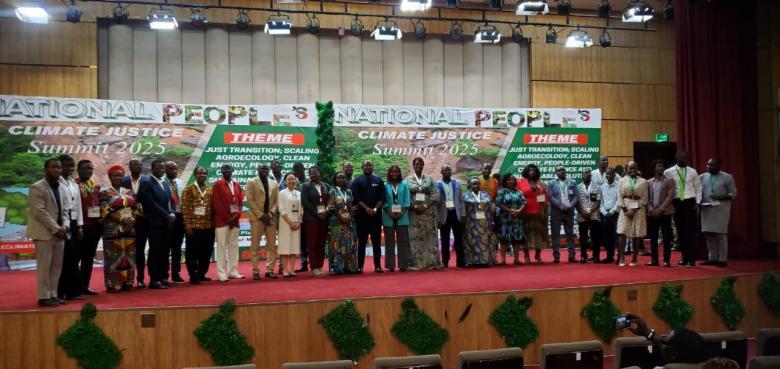
Africa-Press – Liberia. About 1,000 participants drawn from across Liberia and the West African region have converged in Monrovia for a two-day Second National People’s Climate Justice Summit, aimed at advancing inclusive and people-centered climate action.
The summit, organized by ActionAid Liberia in collaboration with national and regional partners, is being held at the Ellen Johnson Sirleaf Ministerial Complex in Congo Town under the theme: “Climate Financing for Agroecology and Renewable Energy.”
Participants include climate justice activists, academics, human rights defenders, farmers, renewable energy practitioners, environmentalists, government officials, civil society actors, local and international NGOs, and community representatives, including women, men, and youth.
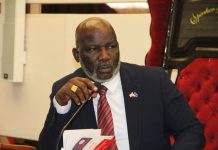
Delivering the keynote address, Deputy Minister for Administration at the Ministry of Finance and Development Planning (MFDP), Bill McGill Jones, described the summit as a critical national platform for policy dialogue, institutional collaboration, and movement-building, with women and young people at the center of climate justice actions in Liberia, Africa, and beyond.
“The theme could not be more timely, because climate change is no longer just an environmental concern; it is a macro-fiscal, developmental, and social imperative,” Deputy Minister Jones said. He noted that climate change directly affects revenue generation, infrastructure, agricultural productivity, and the achievement of Liberia’s ARREST Agenda for Inclusive Development.
According to him, the MFDP has recognized the urgency of integrating climate action into national planning, leading to the establishment of the Climate Integration and Financing Office (CIFO). The office is tasked with mainstreaming climate considerations into national development planning and budgeting while mobilizing resources for climate-resilient interventions.
“This unit underscores the Ministry’s belief that climate financing is not optional; it is essential for national stability and sustainable development,” he emphasized.
Deputy Minister Jones further highlighted Liberia’s strong international partnerships, naming the World Bank Group, International Monetary Fund (IMF), African Development Bank (AfDB), the United Nations system including UNDP and UNICEF, as well as other institutions, for their continued support in embedding climate resilience into fiscal policy, agriculture, and energy transformation.
“Beyond these, Liberia continues to benefit from the contributions of many development partners, NGOs such as ActionAid, and bilateral friends whose support strengthens our national capacity to confront climate risks and pursue a greener, more just future,” he added.
Also speaking, ActionAid Liberia Country Director, Madam Elizabeth Gbah Johnson, said the summit seeks to confront inequality and demand a just transition where policies, finance, and technology deliver dignity, resilience, and opportunity to those who bear the greatest burden of the climate crisis.
She recalled that the inaugural summit called for scaling up agroecology, accelerating renewable
energy, and advancing people-driven climate finance—an agenda that has since sparked stronger engagement between civil society and government institutions, including commitments to strengthen domestic resource mobilization and review extractive sector concessions.
“We are equally clear-eyed about the distance ahead,” Madam Johnson noted. “Communities from West Point to the St. Paul River watershed continue to face flooding, coastal erosion, and displacement. Farmers in Bong, Gbarpolu, and Montserrado report erratic rainfall, degraded soils, and rising input costs that trap them in debt. Energy poverty persists, and climate finance remains too slow, too top-down, and too distant from the priorities of our people.”
She stressed that ActionAid’s position is that climate justice is social justice, anchored in power, participation, accountability, and community-led, gender-responsive, and rights-based solutions rooted in feminist and human rights principles.
Meanwhile, Chairperson of the National Civil Society Council of Liberia (NCSCL), Madam Loretta Alethea Pope-Kai, described the summit as timely and necessary, providing a platform to amplify the voices of communities, women’s groups, youth, and persons with disabilities most affected by climate change.
“Across our regions, climate impacts are not abstract future threats; they are present realities disrupting livelihoods, deepening inequality, and undermining human rights,” Madam Pope-Kai said. “Climate justice demands that those who contributed the least to the crisis are not made to bear its greatest burdens.”
She called for people-centered climate action that prioritizes vulnerable communities, indigenous knowledge, women, youth, and persons with disabilities in both decision-making and implementation, stressing that climate change remains a major development and sustainability challenge for Liberia.
For More News And Analysis About Liberia Follow Africa-Press