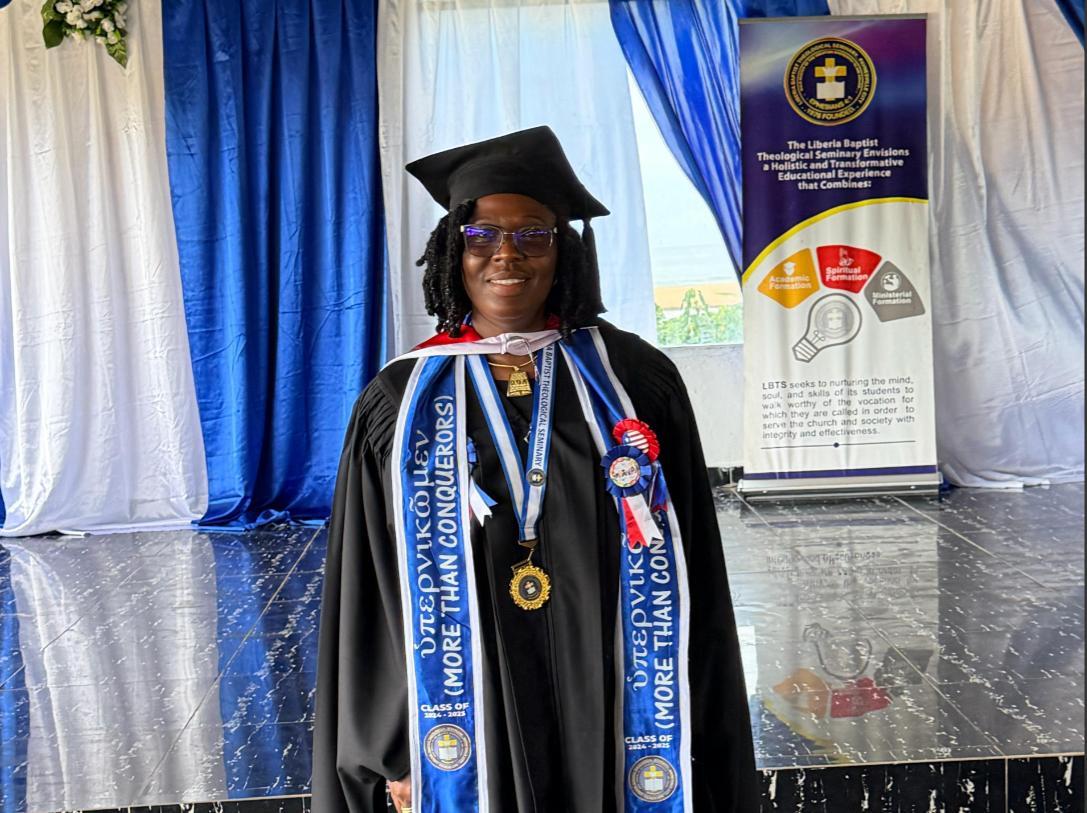
Africa-Press – Liberia. Rev. Mrs. Dialokai Golanyon-Kemayah has set a new academic benchmark at the Liberia Baptist Theological Seminary, graduating over the weekend with a cumulative grade point average of 3.82, the highest recorded in the institution’s nearly 50-year history.
Dialokai Golanyon-Kemayah, who led the Class of 2025 as valedictorian, earned a Master of Divinity in Leadership from the Bradley D. Brown Graduate School of Theology of the Liberia Baptist Theological Seminary. Seminary administrators said no previous graduate has attained a GPA at that level since the school was founded in 1976.
The seminary’s president, Rev. Dr. Momolu A. Massaquoi, confirmed the record during the commencement ceremony, saying institutional archives were reviewed before the announcement was made.
“After checking our academic records from the beginning of the seminary, we found no graduate who has achieved a cumulative GPA of 3.82,” Massaquoi said. “This is the highest academic result the seminary has recorded.”
Founded by former President William R. Tolbert Jr., who also led the World Baptist Alliance, the Liberia Baptist Theological Seminary is regarded as the oldest theological institution in West Africa. For decades, it has trained clergy and church leaders serving across Liberia and the wider region.
Dialokai Golanyon-Kemayah graduated summa cum laude, the highest academic honor awarded by the seminary. Faculty members described her academic performance as exceptional in both consistency and depth across the program.
While the ceremony marked a personal milestone, Dialokai Golanyon-Kemayah used her valedictory address to shift attention to broader social concerns, focusing on Liberia’s growing drug abuse crisis and the limited availability of rehabilitation services.
“There is urgency in the condition of our youth,” she said. “Drug addiction is steadily stripping away hope and dignity, and the response so far has not matched the scale of the problem.”
Speaking on the theme “Prophesying Life to the Streets: A Mandate for Rehabilitation,” she urged churches and policymakers to engage more directly with the realities facing young people affected by substance abuse.
Dialokai Golanyon-Kemayah noted that while theological training often centers on scripture, language and doctrine, the country’s streets tell a different story.
“We have spent years studying theology in classrooms,” she said. “Outside these walls, a generation is struggling for survival.”
She drew on the biblical account in Ezekiel 37, describing Liberia as a “valley of dry bones” and likening drug-dependent youth to lives written off by society.
“These young people are labeled and pushed aside,” she said. “But they are not lost causes. They are lives that have been neglected.”
Dialokai Golanyon-Kemayah noted that approaches focused largely on law enforcement have had limited impact, emphasizing that arrests without treatment are unlikely to address the roots of drug addiction.
“Detention without rehabilitation does not solve addiction,” she said. “It only delays the damage.”
She called for a coordinated national approach that combines medical treatment, counseling, skills training and community reintegration, saying recovery must extend beyond sobriety to restoring purpose and opportunity.
During her remarks, Dialokai Golanyon-Kemayah also acknowledged the personal support she received during her studies, thanking her husband, Ambassador Dee-Maxwell Saah Kemayah Sr., former minister of foreign affairs, for what she described as consistent encouragement throughout her academic journey. She mentioned that he has been her “mentor, best friend, and strength,” and crediting his support as central to her academic success.
For More News And Analysis About Liberia Follow Africa-Press