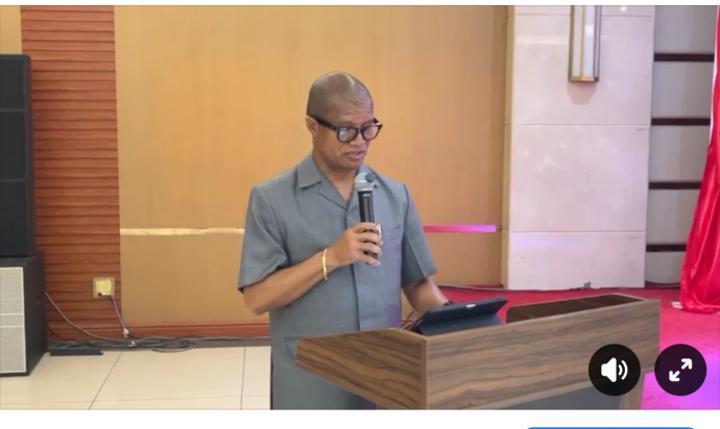
Africa-Press – Liberia. Senior Pastor of the historic Providence Baptist Church and President of the Liberia Council of Churches, Rev. Dr. Samuel B. Reeves Jr., on Thursday delivered a powerful call for national healing, urging Liberians at home and abroad to confront the country’s painful past as a prerequisite for rebuilding a peaceful and just future.
Dr. Reeves was delivering the keynote address at the Liberia Diaspora Annual Return Conference 2025, held on December 18 in Monrovia under the theme “Our Liberia: One People.” His address, titled “Healing Liberia’s Wounds: Confronting the Past, Rebuilding the Future,” challenged political leaders, faith institutions, and the diaspora to embrace truth, accountability, and ethical renewal.
“We gather today not merely to remember history but to reckon with it,” Reeves said. “A nation cannot outrun its past, and a people cannot flourish while carrying unresolved pain.”
Unresolved Grievance and National Trauma
Drawing on psychology, philosophy, and scripture, Dr. Reeves warned that unaddressed grievances from Liberia’s violent past continue to manifest in mistrust, political suspicion, ethnic tension, and despair among young people.
“Unacknowledged trauma does not disappear; it migrates,” he said, citing trauma psychologist Judith Herman. “When societies fail to process collective harm, it reemerges in new and often destructive forms.”
He noted that Liberia’s civil conflict damaged not only infrastructure but also moral trust and national psychology, arguing that silence and denial have only deepened societal fractures.
Truth, Accountability, and Reconciliation
Reeves stressed that reconciliation without truth is unsustainable, and forgiveness without accountability is hollow.
“Unity without justice is temporary,” he declared.
Referencing Liberia’s Truth and Reconciliation Commission (TRC), he said that despite its imperfections, the process affirmed the importance of acknowledging victims’ pain. He cited experiences from South Africa, Rwanda, and Northern Ireland, noting that societies that engage in structured truth-telling achieve stronger long-term cohesion than those that choose silence.
“Authentic reconciliation is costly,” he added, invoking theologian Dietrich Bonhoeffer’s warning against “cheap reconciliation” that demands nothing and changes nothing.
Faith and Ethical Leadership
As head of Liberia’s largest ecumenical body, Reeves underscored the responsibility of faith leaders to resist tribalism, corruption, and political manipulation.
“Faith is not an escape from responsibility; it is a call to higher accountability,” he said, urging churches and mosques to become spaces for healing rather than political battlegrounds.
He emphasized that faith-based reconciliation must protect victims while demanding accountability from perpetrators and fostering restoration within communities.
Diaspora as Bridge Builders
Addressing Liberians in the diaspora, Reeves said they carry a unique moral responsibility as custodians of memory, resources, and influence.
“You are not detached observers; you are moral stakeholders,” he said, cautioning that diaspora communities can either harden divisions or help heal them.
He urged diaspora Liberians to invest in dialogue, trauma healing, education, and ethical leadership, rather than exporting grievance from afar.
From Blame to Shared Responsibility
Quoting philosopher Hannah Arendt, Reeves distinguished between guilt and responsibility, arguing that while guilt belongs to perpetrators, responsibility belongs to all who inherit the consequences of past violence.
He called for practical national actions, including peace education rooted in Liberian history, community-based trauma healing programs, ethical leadership training, national remembrance initiatives, and economic inclusion to address structural inequality.
A Call to Courage
In a stirring conclusion, Reeves challenged Liberians to reject silence and fear in favor of courage, repentance, and transformation.
“Peace is not passive. Reconciliation is not sentimental. Healing is not automatic,” he said.
He warned that Liberia risks losing another generation to suspicion and silence unless leaders and citizens commit to confronting history honestly.
“Let us refuse the comfort of amnesia and choose the courage of memory,” Reeves urged. “If Liberia is to rise—not only economically but morally—this generation must decide that the past will no longer imprison the future.”
The 2025 Liberia Diaspora Annual Return Conference is taking place in Monrovia this December under the theme “Our Liberia: One People”, marking one of the country’s most ambitious efforts to reintegrate Liberians living abroad into the national development agenda, strengthen unity, and foster economic, social, and cultural ties.
Purpose and Significance
Launched as an expanded national homecoming initiative, the Diaspora Annual Return Conference is designed to reconnect Liberians abroad with their homeland, family, and heritage, promote national unity, reconciliation, and identity beyond tribal, regional, or political divides and encourage investment and collaboration between the diaspora and local stakeholders in key economic sectors.
Officials say the 2025 program is expected to achieve a 30–40% increase in attendance compared to previous years, demonstrating a growing appetite among diaspora Liberians to engage more deeply with national affairs.
Key Themes and Focus Areas
The conference and its associated Annual Return program cover a wide range of national priorities:
Unity and National Identity
The theme “Our Liberia: One People” highlights a collective call to strengthen ties between Liberians at home and abroad, fostering a sense of shared identity and purpose.
Investment and Economic Collaboration
Events such as the Diaspora Investment Summit focus on connecting diaspora professionals and capital with opportunities in agriculture, tourism, health, ICT, infrastructure, and manufacturing, aimed at boosting Liberia’s economic growth and development.
Reconciliation and Social Cohesion
A series of discussions and dialogues emphasize peace, reconciliation, and healing—acknowledging that national development depends not only on economic progress but also on social unity.
For More News And Analysis About Liberia Follow Africa-Press