Africa-Press – Liberia. Liberia’s Senate, on late Thursday evening, December 18, 2025, concurred with the House of Representatives to ratify the Ivanhoe Liberia Concession and Access Agreement, clearing the final legislative hurdle for a deal that formally opens the Yekepa–Buchanan railway and port system to multi-user, independently operated access for the first time in the country’s modern history.
The concurrence was secured by a two-thirds majority following a tense but brief exchange on the Senate floor between Montserrado County Senators Saah H. Joseph and Abraham Darius Dillon over the procedural status of a Joint Committee report on the agreement. Senator Dillon told the plenary that the report circulating under the Joint Committee’s name “could not generate more than three signatures” from a committee comprising more than two dozen members, rendering it procedurally defective.
With the committee report effectively collapsing, Senator Dillon proffered a motion that the Senate concur directly with the version of the Ivanhoe Agreement already passed by the House of Representatives, in its entirety. The motion carried.
The final tally recorded 20 senators voting in favor, four abstentions, and one vote against, surpassing the constitutional threshold required for ratification. With the Senate’s action, the Concession and Access Agreement now stands fully ratified by the National Legislature.
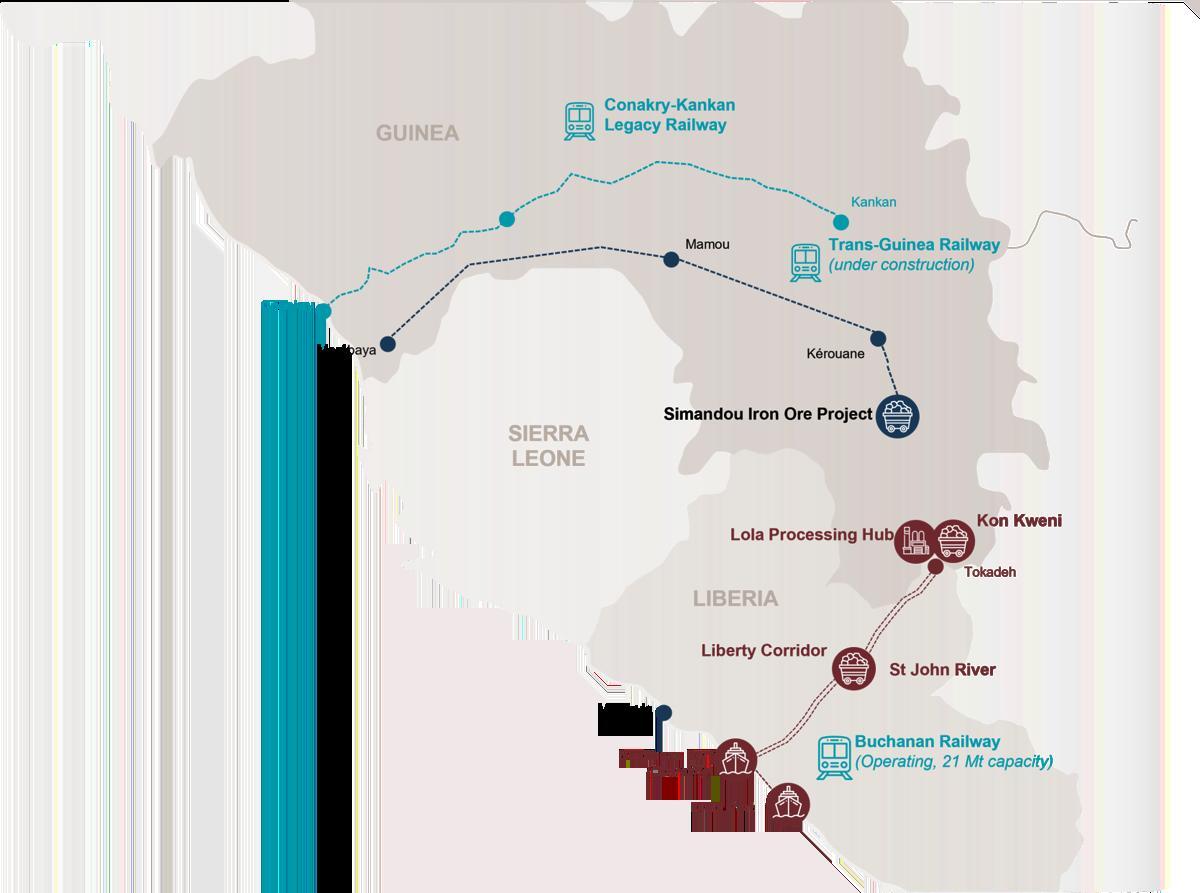
The agreement grants Ivanhoe Liberia Ltd., a subsidiary of U.S.-based Ivanhoe Atlantic Inc., guaranteed development rights and regulated access to Liberia’s government-owned Yekepa–Buchanan heavy rail line and the Port of Buchanan for the transport of ultra-high-grade iron ore from the Kon Kweni project in Guinea’s Nimba region. The Kon Kweni project is part-owned by the Government of Guinea and contains ore grades exceeding 67 percent iron.
The Senate’s concurrence caps a process that began in the House earlier this month, where lawmakers approved the agreement by an overwhelming margin, citing its projected economic, infrastructure, and strategic benefits to Liberia. The deal is anchored in the 2019 Bilateral Implementation Agreement between Liberia and Guinea, ratified by both countries in 2020 and 2021, which established the legal framework for cross-border mineral transport using Liberian infrastructure.
Within minutes of the Senate vote, Ivanhoe Atlantic issued a statement confirming legislative ratification and signaling its readiness to move the project into its execution phase.
“Ivanhoe Atlantic Inc. confirms that its Concession and Access Agreement, granting both development rights and guaranteed access to Liberia’s multi-user rail and port infrastructure, has been ratified by the Liberian Legislature,” the company said.
The company noted that the ratified agreement authorizes the transport of iron ore from Kon Kweni through Liberia to global markets via the Port of Buchanan, using the Yekepa–Buchanan railway. According to Ivanhoe Atlantic, the project is expected to generate approximately US$16.7 billion over its lifecycle for the Government of Guinea through royalties, taxes, and development fund contributions, while Liberia benefits from rail access fees, port revenues, community development funding, employment, and expanded logistics activity.
Ivanhoe Atlantic President and Chief Executive Officer Bronwyn Barnes described the Senate vote as a milestone not only for the company but for Liberia’s national infrastructure policy.
“The ratification of our Agreement by the Liberian legislature is fully in line with President Boakai’s policy to transition existing Liberian rail infrastructure to a multi-user, independently operated system and marks a significant milestone, not just for Ivanhoe Atlantic but for Liberia,” Barnes said.
“This opens up a valuable logistics chain to other users in Liberia and neighboring countries, including U.S.-aligned companies looking to expand into the region. After more than twenty years, Liberia stands to fully benefit from its own infrastructure, laying the foundations for an expanded, independently operated multi-user infrastructure corridor connecting West Africa to the Atlantic Ocean.”
Barnes credited President Joseph Nyuma Boakai, Sr. for what she termed “leadership and deep commitment” to ensuring Liberia derives full economic and social value from its infrastructure. She said the company looks forward to working with the Liberian Government, the soon-to-be-established National Rail Authority, and the independent rail operator once selected.
“These strategic changes to the way that Liberia manages its critical national infrastructure will deliver generational benefits for the people of Liberia and will clearly deliver strong financial benefits from multiple future rail users,” she added.
With legislative approval secured, Ivanhoe Atlantic said it is now focused on advancing its development program. The company confirmed that environmental impact assessments have been submitted in both Guinea and Liberia and are currently under regulatory review, with construction targeted to commence in the first quarter of 2026.
The company outlined its immediate next steps as finalizing environmental approvals in both jurisdictions, continuing engagement with the Government of Guinea through a jointly established technical committee, supporting Liberia’s formation of the National Rail Authority, and finalizing transitional arrangements with the current rail user and operator ahead of the planned move to independent rail operatorship in 2030. Ivanhoe Atlantic also said it will begin hiring key operational personnel and expand partnerships with Liberian service providers to strengthen local content and downstream economic activity.
Beyond the project itself, Thursday evening’s Senate vote carries broader policy significance. The ratification entrenches President Boakai’s commitment to decoupling mining from infrastructure control and repositioning Liberia’s rail corridor as a shared national asset capable of serving mining, agriculture, and industrial freight across borders.
For supporters, the concurrence represents a decisive shift away from concession-specific rail monopolies toward a regulated, competitive model with regional reach. For critics, the focus now turns to implementation, oversight, and the speed with which Liberia operationalizes the National Rail Authority to ensure that the promised independent, multi-user framework moves from statute into practice.
What is clear is that, with the Senate’s late-evening vote, Liberia has crossed a defining threshold—locking in a new chapter for its rail governance and firmly inserting itself into emerging West African and trans-Atlantic mineral supply chains.
For More News And Analysis About Liberia Follow Africa-Press