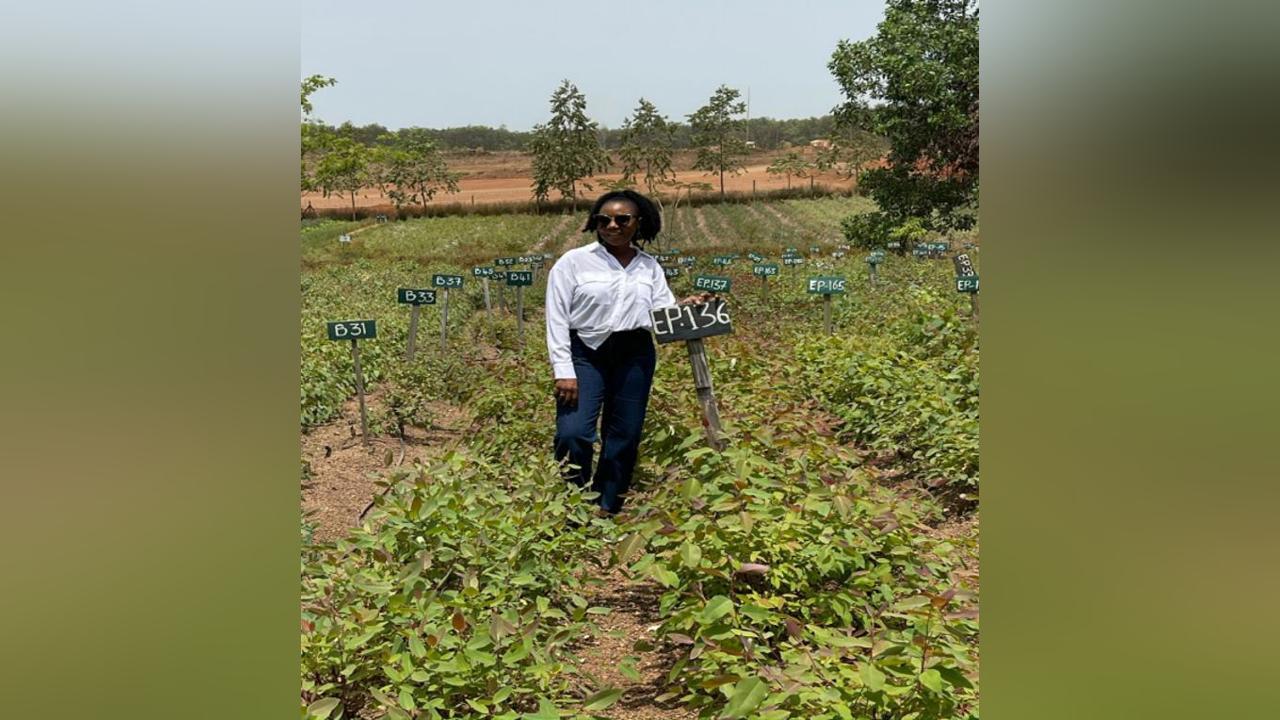
Africa-Press – Liberia. Kargbo and colleagues from the “Freetown the Treetown” team visit Miro Forestry to establish a partnership. The collaboration aims to develop sustainable strategies for the city’s ambitious new goal: planting five million trees while significantly improving sapling survival rates. Credit: Eugenia Kargbo / LinkedIn.
Freetown, Sierra Leone—When Eugenia Kargbo was announced as the nation’s first Chief Heat Officer, she wanted a fixed solution, so she began planting trees and erecting shade canopies in marketplaces to help women adapt to the rising heat temperature caused by climate change.
These combined efforts provide outdoor protection to some of the city’s 1.2 million population who spend hours in the blazing sun, enduring intense heat and unusual rainfall. Solar lights were also installed.
As a Freetown native, Kargbo remembers her city’s vibrant years—a time when it was defined by its livability, peaceful atmosphere, and lush forest cover. Today, however, that natural beauty is vanishing. Rising sea levels, extreme heat, and devastating floods are rapidly stripping away the very environment that once protected the people, leaving them vulnerable. Her mission now is to help citizens adapt to these changes, but she emphasizes that adaptation must begin with a clear understanding of the crisis at hand.
“When I started, it was really very new,” the mother of two said during a Wednesday afternoon interview at her office, located on the 13th floor of the Freetown City Council building on Wallace Johnson Street.
Unlike many familiar titles, such as police officer, immigration officer, or medical officer, hers was relatively new when she took over in 2021, leaving many to ask, “What exactly is your role?” “I explain so it’s really about telling the story of what is really happening and getting people to see exactly how the climate is changing and how that is impacting our environment and the lives of people.”
Kargbo’s work was hit by an early setback in 2023, after a heavy windstorm, another impact of climate change, destroyed the market canopies’ covers. “When we were designing them, we weren’t thinking about windstorms,” she said. ‘And then it just happened.’ ” A new plan is underway to rebuild them,” she says.
“We have an engineering firm in town that is working on constructing the new shade covers, so even if you go to the market, you will see that the older structures have been demolished. They are now putting up new poles.”
Before assuming the role of heat officer, Kargbo previously worked as the city council’s lead for the sanitation sector.
Heat is built up over a period of days and nights in the atmosphere, acting as a risk multiplier that causes a wide range of health and economic crises that affect women, disabled people, and elderly people heavily. Other impacts lead to increased mortality rates and diminished water quality due to severe droughts and wildfires.
Prolonged exposure to extreme heat is physically debilitating, a crisis already straining nations worldwide. Freetown is at the bottom of this crisis with stagnant temperatures that provide almost no cooling relief after sunset. While average temperatures typically fluctuate between 24°C (mid-70s) and 31°C (high-80s), spikes reaching as high as 38°C–43°C (100°F–110°F) are becoming regular occurrences.
But by 2050, the city expects to have temperatures that high almost half the year, according to predictions by Vivid Economics, a London-based consultancy. To date, Kargbo and her team have planted 1.2 million trees across 18 reforestation sites. Each tree is equipped with a tracking device and a unique ID, enabling the monitoring of its growth and maintenance. “Now we are working towards registering for the carbon market, but we are also trying to get a tree protection policy for the city because the level of deforestation is massive, and so we need to ensure that we are not only planting but also protecting the trees by law.”
Kargbo’s vision expands upon the city’s existing public gardens—small sanctuaries of cool air where elders gather for tea beneath the shade of the canopy. Her plan for a more resilient Freetown involves scaling these ‘oases’ by implementing white ‘cool roofs’ to reflect solar radiation, installing public water fountains for hydration, and embarking on an extensive, city-wide reforestation campaign.
Freetown has had its own dark history: civil war and a 2017 landslide on the slopes of the capital that killed more than 1,100 people. Now, drug abuse and extreme poverty, where up to 60 percent of people live in makeshift housing made of corrugated iron roofs and walls that turn the place into an open-air oven most of the year. The country is one of the world’s poorest; few people have air conditioning, and there is not nearly enough money to finance ambitious fixes.
Kargbo’s portfolio as heat officer is part of a broader plan known as “Transform Freetown” that is led by her boss, Mayor Yvonne Aki-Sawyerr, a prominent member of the main opposition party, the All People’s Congress (APC), who is currently vying for the flagbearer (standard bearer) of the party. Kargbo’s position was created and funded by the Adrienne Arsht-Rockefeller Foundation Resilience Center, part of the Washington-based Atlantic Council. She envisions a greener, cooler Freetown—one where the pristine beaches of her youth are preserved rather than lost to illegal sand mining and where the trees that once offered her solace are protected instead of being cleared for urban sprawl.
As of early 2026, the global average temperature has consistently hovered near or above 1.5°C higher than pre-industrial levels. Rising temperatures are primarily driven by a “thickening” of the Earth’s atmosphere with heat-trapping gases. While the planet has natural temperature cycles, the current rapid increase is almost entirely due to human activity. The Earth’s atmosphere acts like a greenhouse. Visible light from the sun hits the Earth and is re-radiated as heat. Naturally, some of this heat escapes into space, but greenhouse gases (GHGs) trap it.
Kargbo emphasizes that heat is a driver of massive inequality. The burden caused by high temperatures is not shared equally, falling most heavily on those in informal settlements, outdoor workers, and elderly women. In Freetown, the built environment often consists of cement and corrugated iron sheets—materials that act as heat traps. For elderly women who spend much of their time indoors in poorly ventilated structures, the impact is physical and immediate: they suffer from dehydration, respiratory stress, and profound discomfort.
Looking ahead, Kargbo is focusing on systemic change. This includes training 500 healthcare workers to recognize heat-related illnesses and developing an early warning system. Despite challenges like a lack of coordination between national and local governments, Kargbo remains driven by her passion for protecting nature and the planet. As the first person to hold this title in Africa, she is turning Freetown into a laboratory for heat resilience, proving that while heat may be invisible, the solutions to it must be tangible and inclusive.
The former banker is one of seven women appointed as chief heat officers by the Arsht-Rockefeller Foundation across four continents. Her work extends beyond Freetown. Now working as a senior heat strategist for Africa for the international NGO, Climate Resilience for All (CRA), working with nations like Liberia to develop policies addressing rising temperatures. Notably, in 2025, she formed part of the launch of the Paynesville City Corporation’s inaugural Climate Action Plan—a landmark initiative that included the appointment of Mosilla Neufville as Liberia’s first-ever Chief Heat Officer (CHO).
“Paynesville’s bold step to launch a climate action plan and appoint a CHO marks a major stride in the right direction,” she said. Having served in this role for several years, I can confidently say that the CHO appointment is transformative. It gives voice to the silent killer, turning that silence into visible, actionable leadership that protects lives and strengthens urban resilience.”
The launch of the Climate Action Plan was supported by a grant provided to help developing cities support science and data analysis essential for heat quantification, planning, policy development, and a community-driven heat awareness campaign. This initiative culminated with Freetown’s first-ever Heat Action Plan.
Through this grant cities, local governments, and community groups will carry out urban heat island (UHI) and vulnerability mapping while designing and delivering community-driven, actionable heat awareness campaigns.
As a consultant working with the city of Freetown, Kargbo’s work and salary depend on foreign money. The World Bank, United Nations agencies, and private partners, like financial institutions, pay for her projects.
Since her appointment in 2021, Kargbo’s work has been widely admired both within Africa and across the globe, earning her international accolades. In 2022, she was named to the Time100 Next list as one of the world’s rising stars. Earlier this year, she and her boss, Mayor Aki-Sawyerr, were also recognized by National Geographic as two of ’33 extraordinary individuals’ making a global impact through their innovative climate action initiatives.
Nathaniel Blama, former head of Liberia’s Environmental Protection Agency (EPA), supports the work of Kargbo and hopes to see its replica in Liberia. “We need green zones. Air conditioning is costly; even if you have air conditioning (AC), you can’t turn it on because there is no power. People need to go outdoors. You have to go out under a shade, under a canopy.”
For More News And Analysis About Liberia Follow Africa-Press