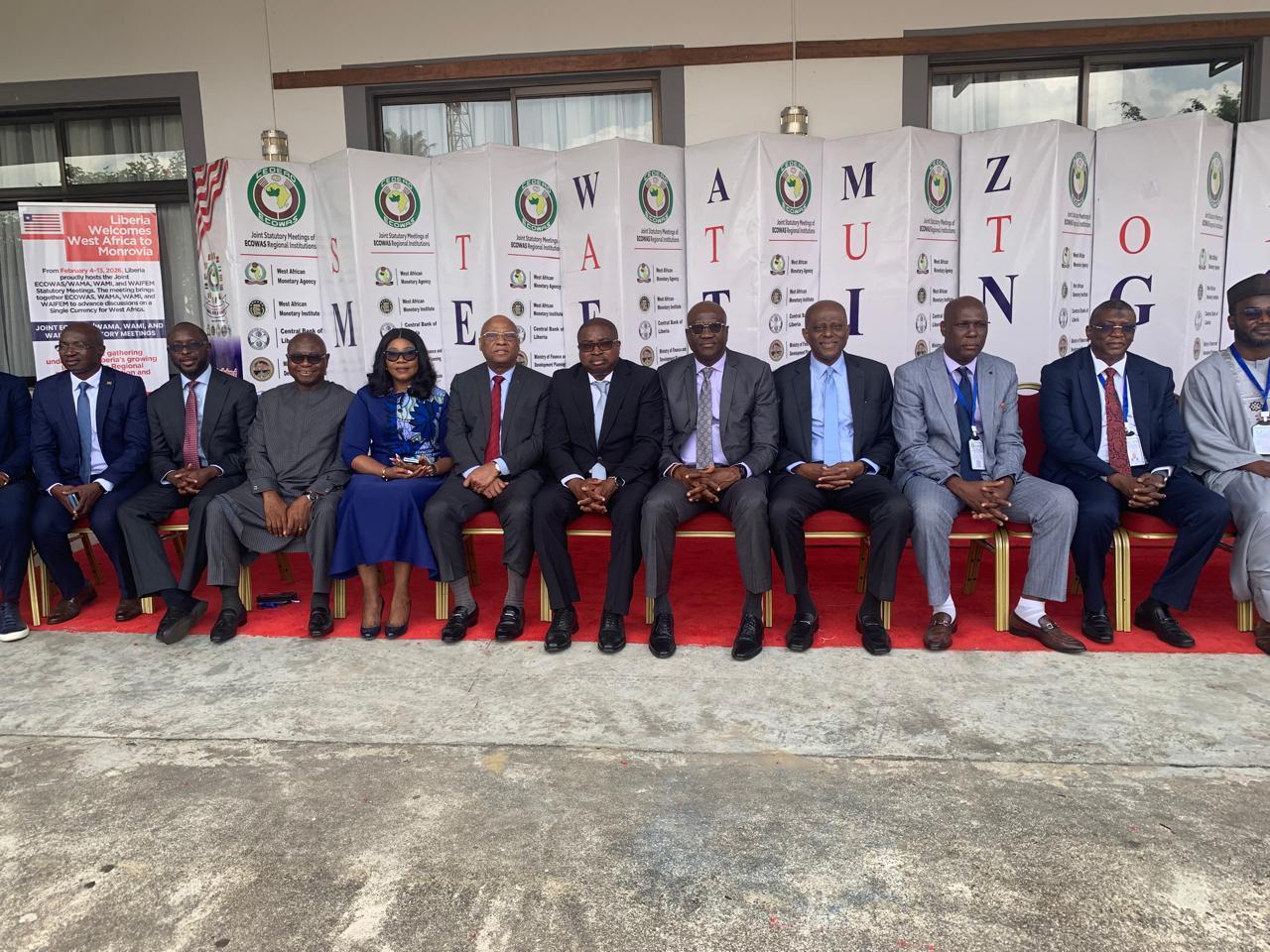
Africa-Press – Liberia. The Executive Governor of the Central Bank of Liberia, Henry F. Saamoi, highlighted significant progress in regional monetary integration at the 67th Ordinary Meeting of the Committee of Governors of Central Banks of ECOWAS Member States, hosted in Liberia.
In his opening address to delegates from WAMA, WAMI, and WAIFEM at the Farmington Hotel in Harbel, Margibi County, Governor Saamoi emphasized the region’s resilience, citing 4.5% economic growth in 2025 and effective inflation containment.
Among the key achievements highlighted were:
– Improved fiscal performance, marked by a narrowed deficit and stronger revenue mobilization
– Enhanced external sector performance, with export growth and increased reserves
– Progress on convergence criteria, with four member states meeting all primary benchmarks
Despite these gains, Governor Saamoi noted that challenges remain, including meeting inflation targets, addressing fiscal deficits, and ensuring debt sustainability. He underscored the meeting’s emphasis on regional cooperation and solidarity as critical to achieving economic integration and stability.
“We gather here not only as technocrats and policymakers, but as custodians of a vision—one that seeks to bind our nations together in prosperity, resilience, and shared destiny as envisaged by our forebears.”
Liberian President Joseph Boakai, in his remarks, affirmed that hosting these landmark meetings is both a privilege and a responsibility. “We stand ready to contribute meaningfully to the discourse and to the decisions that will shape the financial future of our region, recognizing that our collective strength lies not in isolation but in solidarity.”
Governor Saamoi reiterated, “Today, as we gather here in Monrovia, we reaffirm our collective commitment to building a stronger, more resilient, and more integrated West Africa.” He described the meetings as milestones on member states’ shared journey toward monetary cooperation, financial stability, and the long-standing aspiration of a single regional currency. “Our gathering is not merely ceremonial—it is a testament to the enduring vision of our forebears who believed in the power of unity.”
He noted that the regional institutions, WAMA, WAMI, and WAIFEM, remain pillars supporting this vision, providing technical expertise, policy frameworks, and capacity-building initiatives. Their work, he said, is crucial to harmonizing monetary policies, strengthening financial systems, and building capacity across member states, thereby laying the foundation for a common destiny.
The Governor acknowledged that the region convenes at a time of both challenges and opportunities. Global economic uncertainties, climate shocks, and technological disruptions continue to test resilience. Yet, he said, within these challenges lie opportunities to innovate, deepen intra-regional trade, and leverage digital finance for inclusive growth.
“Our dream of a unified monetary zone may be ambitious, but it is achievable if pursued with courage, discipline, and vision. Others have done it; so, too, can we.” He pointed out that global growth remains steady at 3.3 percent in 2025, likely to hold in the medium term—a performance shaped by shifting trade policies, geopolitical tensions, accommodative financing conditions, and increased investments in technology.
Governor Saamoi observed that, while global inflation is declining—from 5.8 percent in 2024 to a projected 4.1 percent in 2025 and 3.8 percent in 2026—significant vulnerabilities persist. Advanced economies face service-sector inflation and wage pressures, while many West African economies continue to grapple with currency depreciation and food price volatility.
He also cautioned that the apparent easing of global financial conditions, including a weaker US dollar, may offer some relief but masks underlying risks of sudden market adjustments that could rapidly destabilize capital flows to the region. Nonetheless, he expressed pride in the region’s resilience: ECOWAS economies grew by 4.5 percent in 2025, up from 4.4 percent in 2024, and are projected to expand by 5.0 percent in 2026.
Governor Saamoi stressed that this impressive performance, especially in comparison to global trends, is no accident. It reflects deliberate policy choices, improved coordination among Central Banks and relevant authorities, and reform efforts undertaken by many member states despite domestic challenges.
For More News And Analysis About Liberia Follow Africa-Press