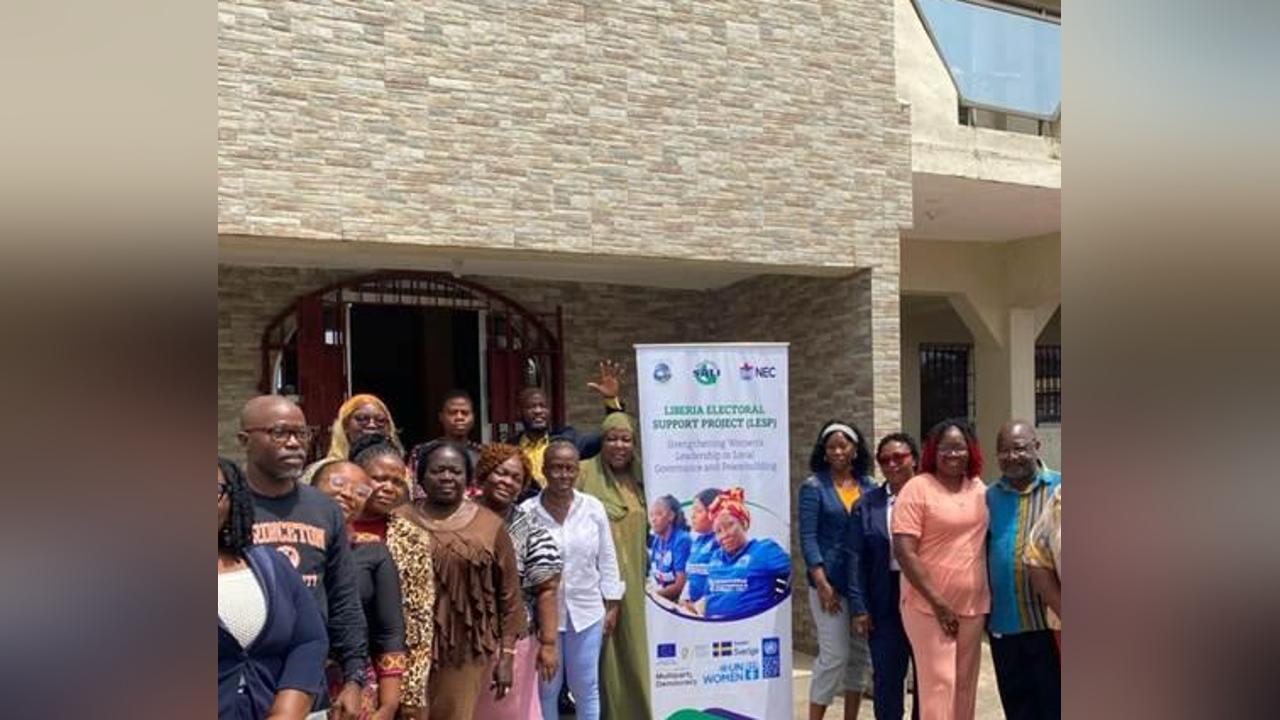
Africa-Press – Liberia. Women leaders from across Liberia’s political spectrum have convened for a pivotal two-day Strategic Planning and Organizational Strengthening Workshop aimed at reinforcing women’s leadership, political participation and peacebuilding efforts ahead of the 2029 Elections.
The high-level engagement, held at the offices of Sister Aid Liberia (SALI) in Panama Lodge, Menitama Junction, ELWA Road, brought together members of the Coalition of Political Parties Women in Liberia (COPPWIL), women’s wings of political parties and representatives of key national and international institutions.
The workshop was supported under the Liberia Electoral Support Project (LESP) and implemented in collaboration with Sister Aid Liberia.
LESP is managed by the United Nations Development Programme (UNDP) in partnership with UN Women, the Netherlands Institute for Multi-Party Democracy (NIMD) and the National Elections Commission (NEC).
The project is co-funded by the European Union, the Government of Ireland, and the Embassy of Sweden.
The initiative falls under the project titled “Strengthening Women’s Leadership in Local Government and Peacebuilding,” which seeks to advance women’s participation in governance and peacebuilding structures to achieve inclusive governance, gender equality and sustainable peace in Liberia.
The project is currently operational in seven counties: Bong, Gbarpolu, Nimba, Lofa, Grand Gedeh, Grand Bassa and Bomi.
By June 2026, the initiative aims to ensure that appointed women leaders and Peace Hut members apply strengthened leadership, mediation, and advocacy skills to influence local decision-making and contribute to peaceful, inclusive and gender-responsive governance.
It also seeks to build a pipeline of women political aspirants prepared to contest the 2029 Elections while advocating for internal reforms within political parties.
Day One of the workshop centered on institutional reflection and constitutional review.
With co-facilitation from Charles G. Tiah and Cllr. Tonieh Wiles, participants conducted a comprehensive SWOT analysis to assess COPPWIL’s strengths, identify gaps, and define its strategic direction for the coming years.
Key areas of focus included: Transformative leadership training for appointed women leaders, Mediation and conflict-resolution capacity building for Peace Hut members.
Mapping and preparing women aspirants for the 2029 Elections. Strengthening women’s auxiliaries within political parties. Founded in May 2003, COPPWIL serves as an umbrella organization for women engaged in Liberia’s political landscape and has played a significant role in advancing women’s political representation.
Among its recent accomplishments, COPPWIL successfully influenced 25 political parties in May 2023 to sign a voluntary Memorandum of Understanding committing to field at least 30 percent women candidates.
In February 2026, the coalition also launched a Leadership Clinic and developed training manuals designed to enhance long-term readiness for women seeking roles in local and national governance.
Delivering the opening remarks, SALI Executive Director Amelia Siah Siaffa described the workshop as a critical opportunity for women’s political groups to reflect, realign, and reposition themselves for the next phase of advocacy and engagement.
“This engagement provides space for open dialogue, constructive engagement, and collective collaboration to strengthen women’s meaningful participation in policy and governance,” she said.
Founder of Sister Aid Liberia, Madam Miatta Germai Darwolor, emphasized the importance of active participation and critical engagement during the constitutional review process. She underscored the need to clearly define and strengthen the role of women within political parties and public life in Liberia.
Madam Rosetta G. Jones, Vice Chair for Operations of COPPWIL, welcomed participants and reaffirmed the coalition’s commitment to developing a robust constitutional framework that promotes women not merely as participants, but as leaders in policy formulation and democratic governance.
She urged participants to engage deeply in the review process to ensure that the constitution reflects the diverse experiences and challenges faced by women across Liberia.
During discussions, concerns were raised regarding the Women Legislative Caucus, with some members expressing that it has not fully upheld the aims and objectives of COPPWIL. Leadership acknowledged
that more work is needed to strengthen coordination, accountability and alignment with the coalition’s broader mission.
Day Two began with a recap of the previous session, followed by an in-depth review of the COPPWIL constitution. Participants proposed several amendments and recommended key changes aimed at improving governance structures, operational clarity, and institutional effectiveness within the coalition.
For More News And Analysis About Liberia Follow Africa-Press