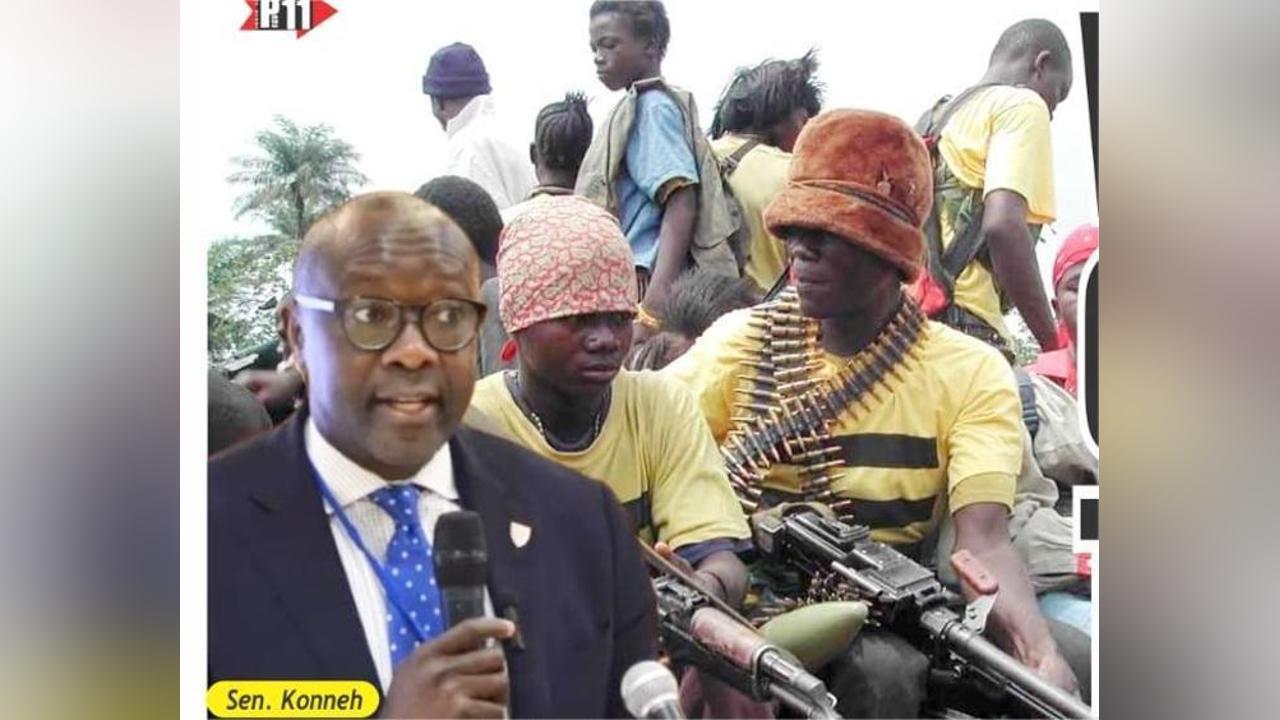
Africa-Press – Liberia. Gbarpolu County Senator Amara M. Konneh has formally urged the Liberian Senate to provide an update on the status of the War and Economic Crimes Court for Liberia (WECC-L), warning that continued delays threaten justice, reconciliation, and sustainable peace.
In a letter dated February 23, 2026, addressed to Senate President Pro Tempore Nyonblee Karnga Lawrence, Senator Konneh referenced the Senate’s landmark April 2024 vote, taken jointly with the House of Representatives, to establish the WECC-L as a mechanism to address atrocities committed during Liberia’s civil wars from 1989 to 2003.
“I extend my compliments and respectfully draw your attention, and that of Plenary, to our overwhelming vote in April 2024 to establish a War and Economic Crimes Court for Liberia (WECC-L),” wrote Senator Konneh, who chairs the Senate Public Accounts Committee.
He also highlighted President Joseph Nyuma Boakai’s executive actions, including the issuance of Executive Order Number 131 in May 2024 and its renewal as Executive Order Number 148 in April 2025. These orders, Konneh noted, aim to secure justice for more than 250,000 Liberians who lost their lives and to ensure accountability for economic crimes that fueled the conflict.
“For decades, victims and survivors have waited for justice,” Senator Konneh emphasized. “Many of us in this Plenary, including myself, continue to carry the scars of that senseless war. The need for accountability is not only historical. It remains urgent and deeply relevant to the present.”
Senator Konneh drew attention to recent national and international assessments showing that 40 to 50 percent of Liberian households include at least one member suffering from long-term trauma, disability, or psychological distress linked to the conflict. He warned that without justice, these families remain trapped in cycles of trauma that undermine national reconciliation and prospects for lasting peace.
While acknowledging progress, Konneh expressed concern over reports that the Office for the Establishment of the War and Economic Crimes Court has submitted a roadmap projecting the launch of an anti-corruption court in 2026 and war crimes trials in 2027. He cautioned that the process’s sustainability remains uncertain without firm legislative action and reliable funding.
He commended Pro Tempore Lawrence for her leadership and praised her efforts to mobilize support for the court, which he said reflects her experience and commitment to justice.
Addressing his colleagues, Konneh stated, “If my urgency appears undue, I ask your indulgence. It is shaped by lived experience, as I am a victim of that war, just as many of you and the people we represent are.”
He warned that the unresolved burdens of Liberia’s turbulent past would continue to undermine peace unless decisive action is taken to establish the court. “Liberia remains one of the most war-traumatized nations in the world. Without justice and accountability, we risk perpetuating cycles of impunity, mistrust, and political manipulation.”
Konneh emphasized that history would judge the Fifty-Fifth Legislature by its actions or inaction, pointing out that even the late Senator Prince Y. Johnson, accused of killing former President Samuel K. Doe, supported the court’s creation.
To strengthen legislative oversight, Senator Konneh requested that Plenary invite Jallah A. Barbu, Executive Director of the Office of the War and Economic Crimes Court, to appear before the Committee of the Whole.
He said the briefing should provide updates on the office’s work, financial and technical support, and diplomatic efforts to address political obstacles—especially in partner countries like the United States—that could delay the court’s establishment.
For More News And Analysis About Liberia Follow Africa-Press