Africa-Press – Liberia. Former President Ellen Johnson Sirleaf has strongly criticized the conduct of social media commentator Justin Oldpa Yeazehn, describing his public statements as disturbing, irresponsible, and detrimental to national cohesion.
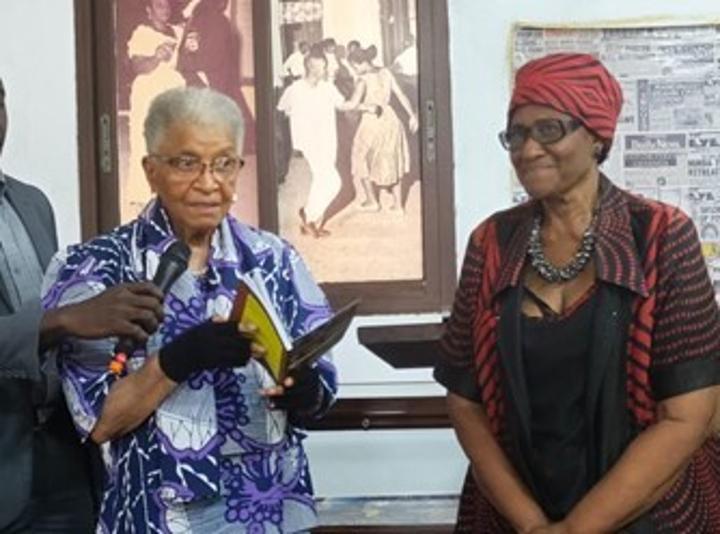
Madam Sirleaf made the remarks on Thursday, February 26, 2026, while appearing on the ELBC program Changing Minds, Changing Attitudes. She condemned what she characterized as false accusations, profanity, and personal attacks associated with Prophet Key’s recent broadcasts.
“Like I said, somebody like that, one has to question his sanity, because you don’t do things like that,” Madam Sirleaf stated. “That’s no way to try to express whatever disagreement or disappointment you have. You don’t express it in that manner.”
Prophet Key, the public persona of Justin Oldpa Yeazehn, is a Liberian online podcaster, preacher, and social media commentator known for his outspoken and often controversial commentary on political, legal, and societal issues.
In February 2026, the Supreme Court of Liberia sentenced Prophet Key to six months’ imprisonment for criminal contempt of court. The ruling followed a series of social media broadcasts in which he insulted Yamie Quiqui Gbeisay, accused the Chief Justice and the Supreme Court of corruption, and used vulgar, abusive, and profane language, including remarks directed at the Chief Justice’s mother.
During the interview, Madam Sirleaf stressed that many countries have enacted laws establishing standards of conduct for individuals who use social media, radio, and print platforms, warning that unregulated speech can contribute to social instability.
She intimated that Prophet Key’s false and rude statements could have been avoided if such standards were in place, emphasizing that the issue should be viewed not merely as a court matter but as a broader legal and legislative concern. She called on Liberia’s Legislature to enact laws that promote responsible public communication.
Despite her criticism, the former President reaffirmed her long-standing support for freedom of speech and expression.
“I believe in free speech and free expression; I live by that,” she said. “But free speech also has responsibility. If you have free speech, you must manage how you use that speech, whether what you say is factual, legal, and contributes to the achievement of personal or national goals. And if you don’t meet certain international standards, you should bear the punishment.”
Madam Sirleaf recalled that during her presidency she championed efforts to decriminalize free speech, a position that has led some legal experts to argue that Prophet Key’s actions, while offensive, should have been treated as a civil rather than criminal matter, referencing international frameworks such as the Table Mountain Declaration.
However, she cautioned against excessive public attention on Prophet Key himself, describing him as a negative influence, and instead underscored the importance of establishing laws that prevent similar behavior by others.
In its decision, the Supreme Court held that while freedom of speech is constitutionally guaranteed, it is not absolute, and that abusive language and personal attacks can amount to contempt of court. In addition to the six-month prison term, the Court ordered Prophet Key to publish an apology in three major Liberian newspapers for five consecutive days and to file a behavioral bond committing to refrain from vulgar or abusive language.
The sentencing has ignited widespread national debate. Supporters argue that the ruling protects institutional dignity and public discourse, insisting that free speech should not excuse degrading personal attacks. Critics, however, warn that the decision could chill legitimate criticism of public officials, with some legal commentators contending that the Chief Justice should have recused himself because he was personally targeted.
Prophet Key has previously faced other controversies, including his 2025 disqualification from the Nimba County Senate by-election over alleged voter registration issues and earlier lawsuits alleging defamation of public figures.
The case has since become emblematic of a broader national discussion on the limits of free speech in Liberia’s democracy, the role and powers of the judiciary, and the growing influence of social media on law, accountability, and public discourse.
For More News And Analysis About Liberia Follow Africa-Press