Africa-Press – Liberia. Outgoing University of Liberia Faculty Association (ULFA) President, Dr. Edna Johnny, has highlighted a string of reforms under her leadership—including salary increases, elimination of pay disparities, and restoration of NASSCORP services—while endorsing her vice president, Dr. Alahaji S. M. Dukuly, as her preferred successor in the April 17 elections.
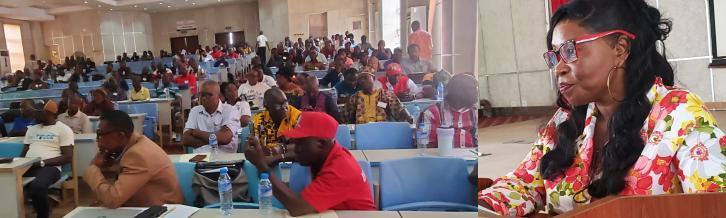
Delivering her farewell address at the ULFA General Assembly on Friday, March 27 at the Fendall Campus in Louisiana, Dr. Johnny urged members to back Dukuly and his slate, framing the vote as a choice to sustain ongoing gains within the faculty body.
Dr. Johnny said her administration confronted long-standing grievances captured in a 2021 Memorandum of Understanding (MoU) with the Government of Liberia(GoL) and the University of Liberia—issues ranging from salary disparities and unpaid benefits to poor working conditions and lack of institutional support.
“These outcomes were achieved, including eradication of disparity among faculty and payment of retroactive salary deductions for faculty, increment of salaries for all faculty at all levels of the University of Liberia, GoL, UL and NASSCORP signed a tripartite agreement to cover the debt of UL and restore NASSCORP Services,” she said, drawing applause from faculty members.
She added that medical insurance was restored, the Capitol Hill campus was renovated, and progress was made toward implementing promotion policies and developing a comprehensive human resource manual.
“Today, there is a competitive call for applications to fill vacancies, two buses have been procured to convey faculty members to Sinji, and adjunct faculty members were paid,” she noted.
Despite the reported progress, Dr. Johnny acknowledged that several issues remain unresolved, including high rental costs for faculty housing at Fendall, lack of scratch cards and gas slips for deans and chairpersons, and what she described as ongoing violations of the UL Charter.
She said some reforms were only partially implemented, stressing the need for continued advocacy and institutional commitment.
Beyond welfare issues, Dr. Johnny highlighted efforts to strengthen ULFA’s institutional capacity, including the establishment of the ULFA Lounge and the University of Liberia Credit Union (ULCU).
“We have established the ULFA LOUNGE and the University of Liberia Credit Union (ULCU) to not only ensure sustainability of ULFA, but to also showcase that we can also implement what we teach and that we can do it successfully,” she said.
She noted that the credit union is now addressing urgent financial needs of faculty and staff, while the ULFA Lounge has become a functional hub at the Capitol Hill campus.
“When there is no water or power on Capitol Hill, ULFA lounge is the rescue,” she added.
Her administration also set up an investment board, secured a loan facility with Ecobank of up to $12,000 for faculty members, and initiated financial and governance reforms, including the development of ULFA’s first annual budget and draft financial manual.
Dr. Johnny said ULFA expanded both local and international partnerships, including collaboration with the Liberia Institute for Policy Studies and Research (LIPSR) to host faculty training workshops, as well as engagement with the Chinese Embassy for capacity-building opportunities.
She added that ULFA participated in international platforms, including a continental conference on academic freedom in Accra, Ghana, while strengthening ties with other public universities and internal staff associations.
“We did not only advocate, but we also participated in enhancing change,” she said.
According to Dr. Johnny, her administration repositioned ULFA from a purely advocacy body to a key stakeholder in university governance, with representatives now serving on major institutional committees.
“We are no longer considered as just an advocacy group but as a pertinent member at the University of Liberia,” she said.
She also emphasized efforts to improve transparency and accountability, including restructuring ULFA’s governance framework and expanding its financial oversight mechanisms.
Turning to the upcoming elections, Dr. Johnny called for unity and responsibility among members, warning that internal divisions could undermine the association’s progress.
“As we approach elections, we must always remember that we all belong to an association that is bigger than each of us,” she urged. “But individually or collectively we can make or break the association.”
She endorsed Dr. Dukuly and his team—including J. Boima Kiazolu, Orando B. Yanquoi, Eric T. S. Patten, Smith Peters, Geetah S. Saydee, and Sammah O. B. Forkeyoh—describing them as capable of sustaining and advancing the reforms initiated under her leadership.
“Distinguished colleagues, you can now evaluate our leadership and deduce the answer from your earlier question… If you are pleased with your answer, please consider giving the people who had worked with me to achieve all these successes to build upon what we have started,” she said.
Dr. Johnny acknowledged that her administration was not without shortcomings but defended its overall record.
“On behalf of my team I have come to say thank you and say sorry in whatever way we might have offended you while in office,” she said.
Her remarks set the stage for what is expected to be a closely watched ULFA election, with members weighing continuity against calls for new leadership in shaping the future of faculty welfare and university governance.
For More News And Analysis About Liberia Follow Africa-Press