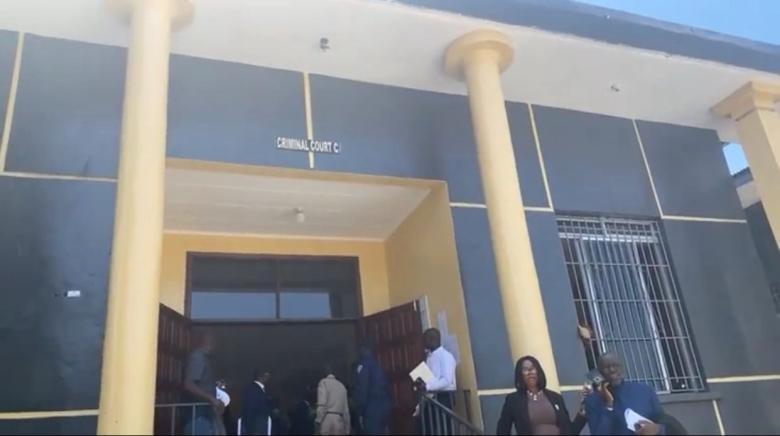
Africa-Press – Liberia. Monrovia-The high-stakes corruption trial involving former Finance Minister Samuel D. Tweah, Jr. and several national security officials took a dramatic and potentially defining turn Thursday, as the prosecution’s lead witness admitted under oath that investigators were “not interested in the operational details” of the controversial US$6 million now at the center of the case.
The revelation, extracted during cross-examination by defense lawyer Cllr. Arthur Johnson, has sent shockwaves through the courtroom and legal community, raising fundamental questions about the very foundation of the indictment.
“The investigation was not interested in the operational details of the US$6 million in question,” the witness, identified as Baba, told the court.
“We were investigating an act of corruption and when the defendants could not tell the investigators which national security institutions received what amount, we proceeded to indict them.”
A Case Built on Secrecy and Suspicion
The case stems from allegations that approximately US$6 million, reportedly allocated for national security purposes during the administration of former President George Weah, was mismanaged, diverted, or unlawfully expended.
Prosecutors alleged that the funds, drawn under opaque national security arrangements, were not properly accounted for, prompting a criminal investigation that ultimately led to the indictment of Tweah and other senior officials.
From the outset, the case has been complicated by national security confidentiality claims, with defendants maintaining that details surrounding the disbursement and use of the funds cannot be publicly disclosed without compromising state security.
Cross-Examination Exposes Cracks
But under sustained questioning on Thursday, the prosecution’s case appeared to weaken. Pressed by the defense to provide evidence of personal enrichment or direct diversion of funds, the witness conceded that such evidence was not part of the investigative focus.
Legal analysts say this admission could prove devastating.
“In corruption cases of this magnitude, establishing personal benefit or unlawful diversion is critical,” one legal observer noted.
“If the investigators were not concerned with how the money was actually spent, it raises serious doubts about how they concluded it was stolen.”
The contradiction became even more pronounced when the witness simultaneously insisted that the accused failed to explain which institutions received portions of the funds, a detail the defense argues falls squarely within the “operational details” the witness claimed to have ignored.
Defense: “You Can’t Indict Without Knowing What Happened”
Defense lawyers are now seizing on what they describe as a fatal inconsistency.
“How do you indict individuals for misuse of funds when you cannot say specifically what happened to the money?” Defense Lawyer, Cllr. Arthur T. Johnson intoned.
According to the defense, the prosecution’s case appears to rely heavily on the defendants’ refusal to disclose classified national security expenditures, rather than on concrete evidence of wrongdoing.
“The accused are citing national security grounds,” the defense maintains, “yet the prosecution is treating that silence as proof of guilt.”
FIA Controversy Deepens Legal Battle
The trial also veered into a technical but crucial dispute over the status of the Financial Intelligence Agency (FIA) within Liberia’s national security architecture.
The prosecution’s witness claimed that the FIA’s role in joint security operations was based on a letter from former National Security Advisor Jefferson Kanmoh, suggesting that the agency’s inclusion required formal authorization.
However, the defense quickly countered with a legal argument rooted in the National Security Act of 2011, which they say already defines the composition of Liberia’s security framework.
“The law is clear,” the defense argued.
“All security institutions existing at the time of the Act, and those subsequently established, are part of the national security architecture.”
They further noted that the FIA’s predecessor, the Financial Intelligence Unit, was established in 2012 under former President Ellen Johnson Sirleaf, and has long functioned as part of the joint security community.
“The code 800 referenced by the witness was merely for communication purposes,” the defense contended.
“It was not an instrument of admission into joint security.”
Courtroom Tension Mounts
As proceedings unfolded, observers noted visible signs of strain from the prosecution’s lead witness, who reportedly showed signs of extreme stress and near collapse during the intense cross-examination.
Courtroom watchers also pointed to what they described as shifting body language and uncertainty within the prosecution’s ranks, developments that could influence public perception of the case.
“This is only day two of the defense’s cross-examination,” one observer remarked.
“If this trajectory continues, the prosecution may face serious challenges sustaining its case.”
With the trial set to resume Friday, attention is expected to focus squarely on one central question, that if investigators were “not interested in the details,” how did they determine that the US$6 million was misused or stolen?
That question, legal analysts say, could define the outcome of the case.
For now, what began as a major anti-corruption prosecution is increasingly evolving into a test of investigative rigor, legal standards, and the limits of national security secrecy in Liberia’s justice system.
As the courtroom battle intensifies, one thing is certain; the credibility of the prosecution’s case is now under unprecedented scrutiny.
For More News And Analysis About Liberia Follow Africa-Press