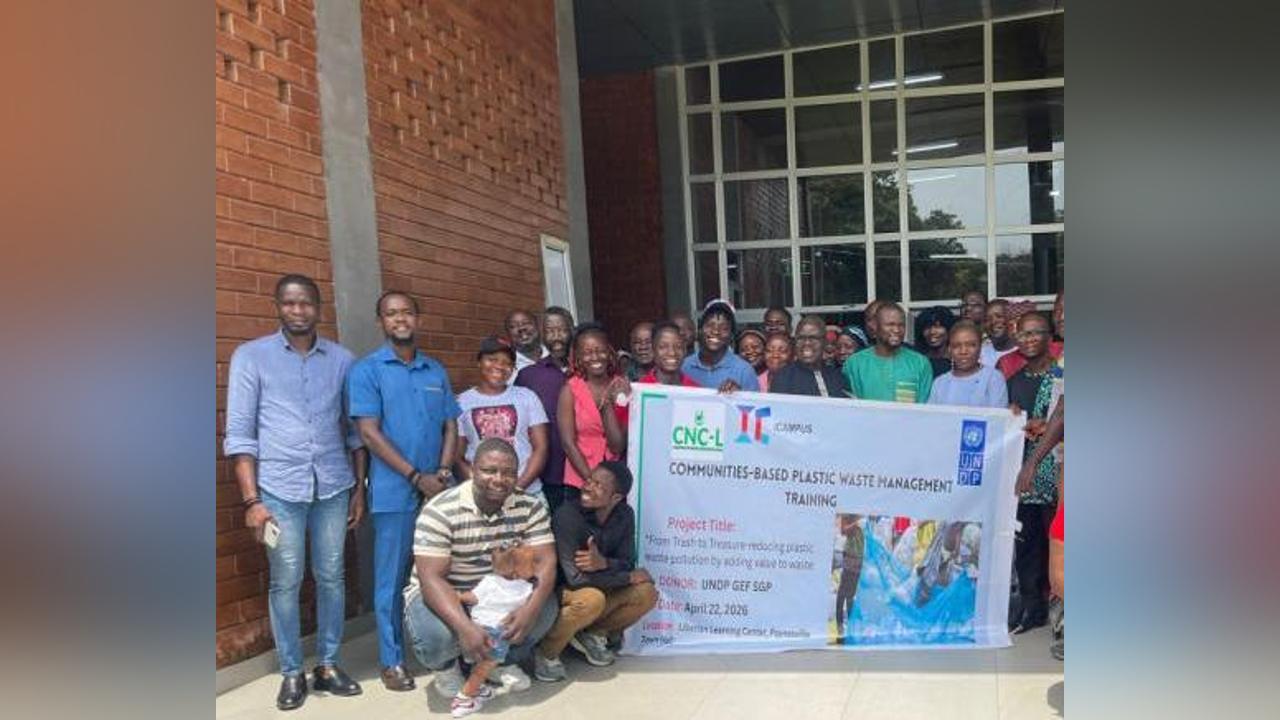
Africa-Press – Liberia. The Champion for Nature Conservation Liberia (CNCL), in collaboration with iCampus and support from the United Nations Development Programme (UNDP), has officially launched an onboarding and training session for community stakeholders and volunteers in Paynesville City, outside Monrovia.
The project, titled: “From Trash to Treasure: Reducing Plastic Waste Pollution by Adding Value to Plastic,” was formally introduced on Wednesday, April 22 during a one-day onboarding and training workshop held at the Liberian Learning Center.
The initiative is designed to revolutionize urban waste management by introducing community-based waste segregation and incentivized collection.
According to CNCL Executive Director, Moses A. Massah, the project targets eight specific communities—many of which are situated near critical wetlands that have historically served as “food baskets” for the region.
The eight benefiting communities include: Duport Road, ELWA, VOA (RIA Highway), GSA Road, A.B. Tolbert Road, Jacob Town, Fendell and Police Academy.
“Our wetlands and water bodies are suffering,” Mr. Massah lamented during the opening.
“For those who have lived in Monrovia for a long time, we remember when these swamps provided us with food—crabs, crawfish and fish. Today, they are spoiled by plastic. Our hope is that by working with these 65 participants, we can begin to restore these vital ecosystems.”
To ensure the project’s sustainability, CNCL has introduced a financial incentive model. Community members will be compensated $0.35 USD (approximately 65 LRD) for every kilogram of plastic gathered.
Mr. Massah explained that the core logic is to move waste segregation into individual homes. By separating organic waste from plastics, residents can earn a livelihood from recyclables while potentially using organic remains as natural fertilizer for “kitchen gardens.”
However, Mr. Massah issued a stern call for accountability: “It is a small project for now, but if we do it well, we will attract more donors. If we don’t perform, we risk being placed on a ‘blackbook’ by international partners. We must do what we say we are going to do.”
The Paynesville City Corporation (PCC), represented by the Director of Commercial Solid Waste, Romeo T. Coker, welcomed the initiative with open arms.
Mr. Coker revealed that plastic currently accounts for approximately 14% of the city’s total waste. “When you go to the market with $10, you come back with 10 to 15 plastic bags,” Mr. Coker observed.
“We have been overwhelmed in the past. This project’s approach of community-by-community segregation is the right way to go.”
Representing the UNDP, Programme Analyst T. Michael Vawau described the launch as “timely and necessary,” noting that plastic pollution remains a significant barrier to Liberia’s sustainable development goals.
“This project reflects UNDP’s commitment to innovative, community-driven solutions,” Mr. Vawau said. “We are turning plastic into an opportunity for inclusive growth, especially for women and young people.”
The Environmental Protection Agency (EPA), represented by Madison Dahn, also expressed strong support for the initiative, noting that the collaboration between CSOs, the government, and international partners is critical for long-term environmental impact.
Speaking on behalf of the selected communities, Jacob Town Community chairperson, Samukai Kamara, lauded CNCL and partners for the initiative gear towards mitigating waste in Liberia.
For More News And Analysis About Liberia Follow Africa-Press