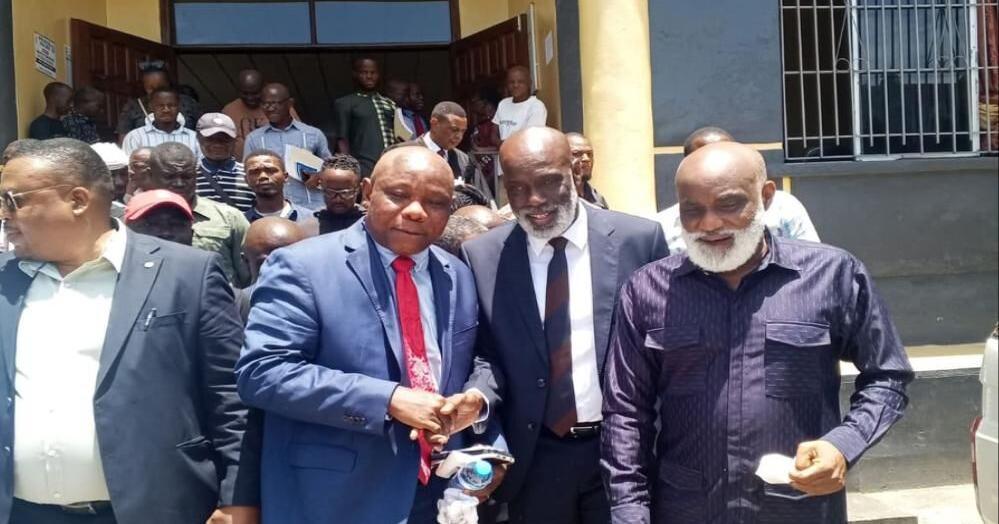
Africa-Press – Liberia. Liberia is once again at a critical institutional crossroads, as proceedings in Criminal Court “C” evolve beyond a routine corruption case into a broader national test of accountability, governance, and the integrity of public financial management. At the center of the controversy is former Finance and Development Planning Minister Samuel Tweah, whose alleged role in a disputed US$6.2 million transaction has triggered legal, political, and ethical debates across the country.
What initially appeared to be a technical matter involving public expenditure has now taken on deeper constitutional and moral dimensions—raising fundamental questions about whether the rule of law can withstand pressure when powerful actors are implicated.
The case pivots on a troubling inconsistency: senior officials responsible for national security and financial oversight have reportedly denied knowledge of the US$6.2 million said to have been disbursed for “security purposes.”
This contradiction strikes at the heart of the government’s justification for the transaction. In systems governed by law, security-related expenditures—though sometimes confidential—still require authorization, documentation, and traceability within established frameworks.
“If the institutions tasked with national security neither requested nor received the funds, then the legitimacy of the entire transaction becomes questionable,” a legal analyst familiar with the proceedings noted. “It raises the unavoidable question: whose security was this meant to serve?”
The testimony of Deputy Minister Tanneh G. Brunson has further intensified scrutiny. According to court accounts, she indicated that the transaction bypassed standard budgetary channels—an allegation that, if substantiated, suggests a breach of Liberia’s public financial governance architecture.
Public financial management systems are designed to ensure transparency, accountability, and control over the use of state resources. These systems rely on strict adherence to procedures—budget approvals, expenditure tracking, and institutional oversight.
“When funds move outside these systems, it is not just a procedural lapse—it is a systemic failure,” a Monrovia-based economist explained. “It undermines confidence in the entire governance framework.”
The defense has reportedly leaned on the argument that there is no evidence of personal enrichment by Samuel Tweah. While this may resonate in public discourse, legal experts caution that such a defense may be too narrow in scope.
“The absence of personal gain does not automatically absolve a public official,” said a senior legal practitioner. “The law also addresses abuse of process. If procedures were knowingly bypassed, that alone can constitute a violation.”
This distinction is critical. Modern anti-corruption frameworks do not solely focus on theft, but also on the misuse of authority, circumvention of controls, and actions that weaken institutional safeguards.
Another point of contention lies in what observers describe as inconsistencies in Tweah’s defense. While invoking the Public Financial Management Law to justify the transaction, his explanations regarding procedural requirements have reportedly shifted under scrutiny.
Such contradictions, analysts say, could weaken the credibility of the defense and reinforce the prosecution’s argument that established rules were not followed.
“The law is not flexible in the way political arguments often are,” one legal scholar noted. “It requires consistency, documentation, and compliance—not retrospective justification.”
Beyond the courtroom, the implications of the case are far-reaching. At stake is not only the fate of one official, but the precedent the case could set for future governance in Liberia.
If the court were to excuse procedural violations on the basis of intent or circumstance, critics warn it could open the door to a dangerous normalization of off-budget transactions—particularly those justified under vague or unverifiable claims of national security.
“What happens here will define how future officials interpret the limits of their authority,” said a governance expert. “It will either reinforce discipline or erode it.”
For many Liberians, the case represents a broader struggle over accountability and equality before the law. The perception—whether accurate or not—that powerful individuals can evade consequences has long undermined public trust in institutions.
“Accountability must not be selective,” a civil society advocate emphasized. “If the rules apply only to some and not others, then the system itself loses legitimacy.”
This sentiment reflects a growing demand for transparency and fairness in public administration, particularly in a country still rebuilding its institutions after years of conflict and economic instability.
As the proceedings continue, Liberia faces a stark choice between reinforcing the rule of law or risking further erosion of institutional credibility.
One path leads toward stronger governance—where laws are applied consistently, and public officials are held accountable regardless of status. The other risks entrenching a culture of impunity, where procedures can be bypassed without consequence.
Legal observers say the judiciary now carries a heavy responsibility.
“This is more than a legal case—it is a test of institutional courage,” lawyer noted. “The court must decide whether the law is a guiding principle or a negotiable instrument.”
The Samuel Tweah case has become a mirror reflecting Liberia’s governance challenges—exposing gaps in financial oversight, testing the resilience of legal institutions, and forcing a national conversation about accountability.
As the country watches closely, the outcome will likely shape not only legal precedent but also public confidence in the state’s ability to govern fairly and transparently.
In the end, the central question remains, will the law stand firm, or will it bend under pressure?
For More News And Analysis About Liberia Follow Africa-Press