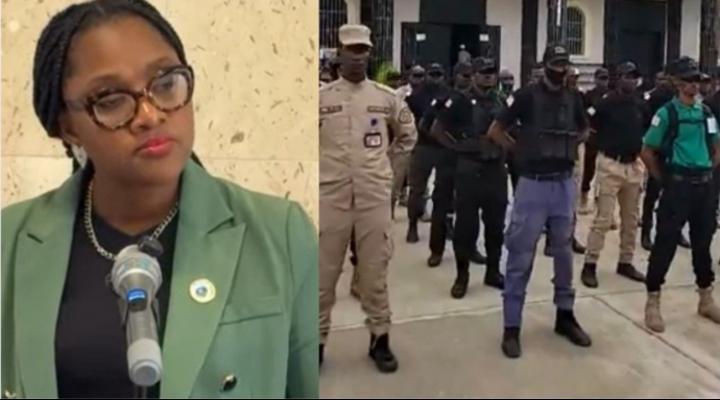
Africa-Press – Liberia. Following the Ministry of Justice’s order for the immediate cessation of activities linked to the National Fula Security of Liberia (NFSL), which it branded unauthorized and warned poses “serious national security concerns,” President Joseph Boakai’s Press Secretary, Kula Fofana, has mounted a rare public defense of the group, calling for its reform and regulation rather than an outright ban.
Ministry’s Crackdown
On Monday, February 16, the Ministry issued a statement citing “alarming reports, images, and public communications” circulating on social media about the group’s recruitment activities.
The Ministry stressed that no authorization, permit, registration, or operational approval had been granted for NFSL. “Under the laws of Liberia, the establishment, organization, recruitment, or operation of any security body, paramilitary structure, auxiliary force, or organized enforcement entity requires prior authorization from the Government through the Ministry of Justice’s Division of Public Safety,” the statement declared.
The Ministry confirmed that NFSL organizers had not undergone vetting, assessment, or security review. Accordingly, the Ministry ordered the immediate cessation of all recruitment, mobilization, promotional, and operational activities. The warning was blunt, any continuation would be deemed a violation of Liberian law and would “attract the full weight of criminal and administrative sanctions.”
President Boakai’s Presidential Press Secretary Pushes Back
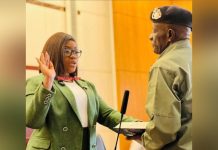
Despite this uncompromising stance, Fofana has come to the group’s defense. Her argument is rooted in pragmatism. “Calling for immediate disbandment without engagement risks alienating young people who are already contributing to orderliness. Guidance is better than rejection.”
She urged authorities to treat the situation as a teaching moment rather than a confrontation. “Providing legal framework, oversight, training, and integration into community policing initiatives can transform uncertainty into cooperation,” she said.
Ramadan and Public Safety
Her defense is not abstract. Ramadan, with its late-night prayers, crowded congregations, and heavy pedestrian movement, presents unique challenges for public safety. Police manpower is limited. Fofana argued: “Structured volunteer support under supervision enhances safety rather than undermines it.”
Proceeding With Caution
She acknowledged the risks of perception and politics. “Community gatekeepers must resist pressure to condemn entirely simply to satisfy public outrage, while the group itself must accept reform, legality, and accountability. Wisdom lies in calibration rather than extremes.”
Her final reflection was pointed: “The question should not merely be whether they should exist, but how they should exist lawfully.”
What We Actually Know
The NFSL is not a new phenomenon. Community Fofana says it has existed for years, primarily operating during major Islamic gatherings such as Ramadan prayers and Eid celebrations.
She explained that in 2018, when clerics Mufti Menk and Sheikh Mohammed Awal visited Liberia, turnout exceeded expectations. The group coordinated with the police to prevent chaos. Again, in November 2024, during another visit by Mufti Menk, a near-stampede was averted when the group restored order, allowing the program to proceed.
Is There Evidence of Militarism?
Accordingly, there is no documented record of armed activity, rebel affiliation, or political violence linked to NFSL. Members are described as ordinary young people, students, traders, and workers who volunteer during religious events.
A Useful Comparison
Fofana drew parallels with Christian gatherings, where ushers and marshals often manage crowds, parking, and altar access. “They may wear uniforms or reflective vests and coordinate movement, not as armed forces but as organized volunteers filling a gap where police presence is insufficient,” she explained.
The Muslim community faces similar realities during Ramadan night prayers and Eid congregations. The difference lies less in function than in perception.
The Real Issue: Structure and Perception
The controversy, Fofana suggested, lies less in what the group does and more in how it appears. Uniforms and coordination can create the perception of a paramilitary force.
Her prescription is straightforward. “Proper registration under national law, clear operational guidelines, coordination with state security agencies, training in non-violent crowd management, and possibly a name that reflects community service rather than force would address many fears.”
Preserving Peace Above All
Fofana was careful to stress limits. “I do not support any military or paramilitary organization whose purpose is to cause violence, intimidation, or destabilization in any form. The preservation of peace, national unity, and lawful order must remain paramount.”
Public Backlash
Fofana’s public defense of the controversial group has also received backlash on social media from government officials, civil society leaders, and ordinary citizens.
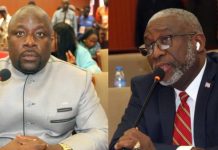
Assistant Minister for Technical Services at the Ministry of Information, J. Rufus Paul, publicly challenged Fofana’s defense, insisting that the issue is not one of perception but of legitimacy.
“In Liberia, the authority to organize and operate security structures rests solely with the state through institutions such as the Ministry of Justice,” Paul said. He warned that when groups adopt names like “National Fulani Security,” wear uniforms, and operate in coordinated formations, they risk creating parallel security arrangements that threaten Liberia’s fragile peace.
Paul dismissed Fofana’s comparison to church ushers as “not equivalent,” noting that ushers are informal volunteers serving within congregations, not organized ethnic-based units.
Commentator Dominic Jayjay Musa accused Fofana of siding with “terrorist Fulani people,” claiming that her defense betrayed Liberia’s national security interests. “It’s better for me to be called a xenophobic person today for defending my country and its people than for my entire generation to be wiped out,” Musa said, demanding Fofana’s resignation and questioning her loyalty to the government.
Cyrus Sneh Manneh, another commentator, cautioned against conflating the Fulani group with Liberia’s Muslim community. “The nomenclature of the group didn’t say anything regarding the National Muslim Security of Liberia, but rather the Fulani National Security of Liberia, which is wrong,” Manneh said.
Manneh argued that allowing ethnic-based security organizations would set a dangerous precedent. “Should every ethnicity in Liberia establish its own national security organization outside the right authorities?” he asked. “We are not strangers to our ugly past as citizens of this country.”
Alieu Swaray, a commentator familiar with mosque traditions, acknowledged the long-standing practice of volunteers assisting during prayers and Ramadan by arranging slippers, managing parking, and maintaining order. “That has never been the issue,” Swaray said. “The concern arises when such a group is formalized, given a name like ‘National Fula Security of Liberia,’ and even wears military-style uniforms.”
Swaray argued that formalizing mosque volunteers under a national ethnic security banner was unnecessary and potentially destabilizing. “For years, volunteers have served faithfully without titles, without controversy, and without division,” he said.
He rejected attempts to frame the debate as an attack on Islam. “Islam is not under attack in Liberia, and this should not be framed as a tribal confrontation,” he said. “Security is the responsibility of the state, and the Liberia National Police has the constitutional obligation to provide security at masjids during Ramadan and at all times.”
For More News And Analysis About Liberia Follow Africa-Press