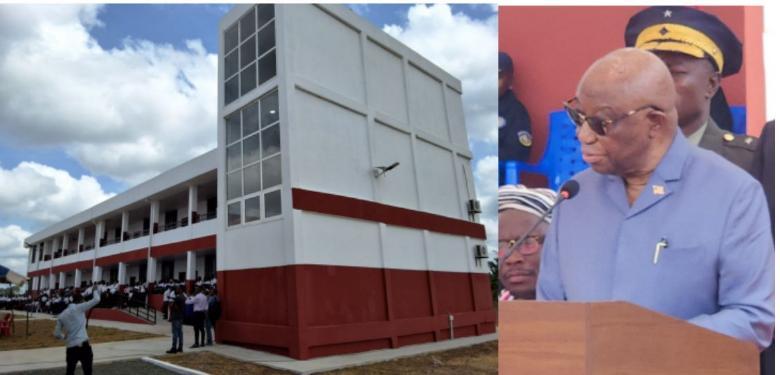
Africa-Press – Liberia. President Joseph Nyuma Boakai has officially commissioned the Kakata Senior Secondary Model School, a state-of-the-art facility described by authorities as a transformative step toward improving the quality of education across Liberia.
Speaking at the ceremony on March 19, 2026, Education Minister Jarso Maley Jallah said the new institution represents more than just infrastructure, but a “center of excellence” designed to bridge the long-standing gap between access to education and learning outcomes.
“This is not merely a structure of brick and mortar,” Dr. Jallah declared. “It is a strategic intervention intended to elevate the quality of minds in our classrooms and reposition Liberia’s education system for the future.”
The newly commissioned school, built through a partnership between the Government of Liberia and the World Bank, can accommodate up to 1,000 students. It features 15 classrooms, modern science laboratories for physics, chemistry and biology, an information and communications technology (ICT) lab, and fully equipped administrative and staff facilities.
The campus also includes solar-powered electricity, a reliable water system, and sports facilities such as football, basketball and volleyball courts—components officials say are essential to fostering both academic and extracurricular development.
Dr. Jallah emphasized that the project had faced significant setbacks prior to the current administration, including poor contractor performance that led to the termination and reassignment of the contract. She credited what she termed “decisive leadership and strengthened supervision” for bringing the project to completion.
“This was a failing project when we assumed office,” she noted. “Today, we are celebrating not just completion, but the restoration of confidence in our ability to deliver quality public infrastructure.”
According to the Minister, the Kakata Model School aligns with Pillar Six of the government’s national development agenda, which focuses on improving education infrastructure and outcomes. She stressed that the initiative marks a shift from merely expanding school access to ensuring effective teaching and learning.
“A model school sets the standard,” she said. “Laboratories must be used for discovery, teaching must be consistent, and leadership must be accountable. This school was built to work—and it must work.”
The Kakata facility follows similar model schools already operational in Gbarnga and Ganta, forming part of a broader strategy to reform Liberia’s secondary education system.
Dr. Jallah assured stakeholders that the school would be closely monitored to ensure it meets its intended goals, warning against the common challenge of underutilized facilities.
“We have seen too often that investments do not translate into learning when systems are weak,” she said. “This institution must be different.”
She also praised development partners, particularly the World Bank, legislators, and local authorities for their support, while urging teachers, students, and the community to take ownership of the facility.
“To the students, your excellence is the only acceptable return on investment,” she said. “To the community, this is your fortress of knowledge—protect it.”
President Boakai’s administration has placed education at the center of its governance agenda, with officials stressing that national development depends on human capital.
“A nation’s strength is not measured by the wealth in its ground, but by the wealth in the minds of its people,” Dr. Jallah concluded.
The commissioning ceremony drew senior government officials, lawmakers, international partners, educators, and residents of Margibi County, marking what many described as a significant milestone in Liberia’s education sector.
For More News And Analysis About Liberia Follow Africa-Press