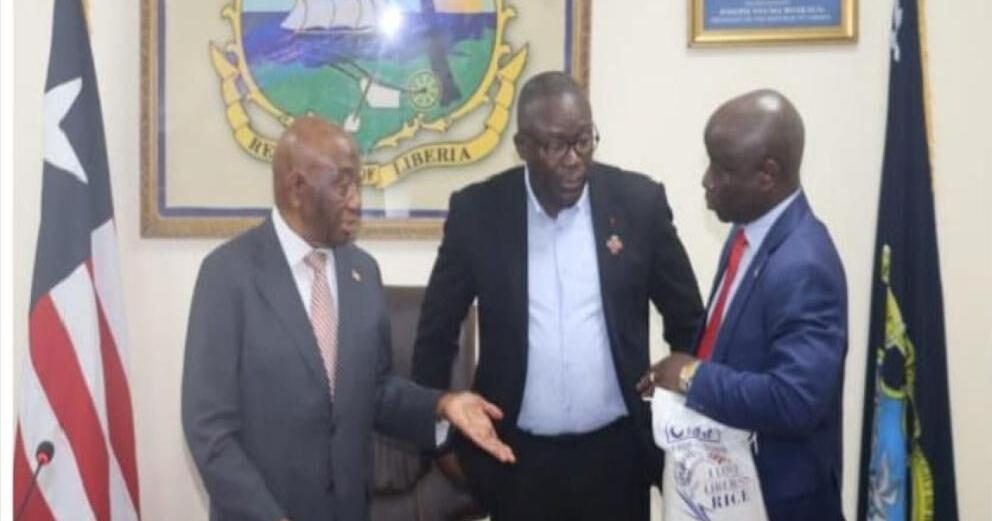
Africa-Press – Liberia. In a renewed push to confront the country’s long-standing dependence on imported rice, President Joseph Nyuma Boakai and Vice President Jeremiah Koung have pledged support to a growing national campaign aimed at boosting domestic rice production and restoring confidence in locally grown food.
The commitment came during high-level discussions at the Executive Mansion with Bishop Robert Bimba, Chief Executive Officer of the Community of Hope Agriculture Project (CHAP), who is spearheading the “I Love Liberian Rice” initiative—a campaign designed to reposition local rice as both a symbol of national pride and a pillar of economic resilience.
At the heart of the meeting was a shared recognition that the country’s heavy reliance on imported rice—its staple food—poses significant economic and strategic risks. For decades, the country has spent millions of dollars annually importing rice, placing sustained pressure on scarce foreign exchange reserves while exposing the population to global price shocks.
President Boakai, whose administration has consistently emphasized agriculture as a cornerstone of national development, described the initiative as timely and essential.
“This is not just about food,” the President noted. “It is about national pride, economic independence, and empowering our own people to feed the nation.”
He praised the quality and packaging of locally produced rice under the CHAP initiative, signaling a shift in perception that locally grown rice can compete with imported brands in both presentation and taste.
Liberians’ dependence on imported rice has deep historical roots, dating back to pre-war economic structures that favored importation over domestic production. Over time, this reliance has created a structural imbalance in the economy.
The implications are far-reaching, especially draining foreign exchange, vulnerability to global market and neglect of local agriculture. Millions of U.S. dollars are spent annually on rice imports, weakening Liberia’s currency position, while fluctuations in international rice prices directly impact local affordability. Domestic farmers struggle to compete with imported, often subsidized rice.
This dynamic has not only limited rural economic growth but has also contributed to persistent poverty among farming communities.
CHAP’s Model: Scaling Local Production
Bishop Robert Bimba outlined a practical pathway to reversing this trend through CHAP’s expansion strategy, anchored on the System of Rice Intensification (SRI)—an innovative farming method that increases yield while reducing water usage and input costs.
“Our goal is to demonstrate that Liberia can produce enough to feed itself,” Bishop Bimba said. “But we need the right support—land, infrastructure, and policy backing.”
Central to his appeal was a request for the government to allocate swamp lands in Zubah Town and other agricultural zones, which are critical for large-scale rice cultivation.
He also called for a deliberate policy shift to promote local rice consumption at official events and within government institutions.
“If we want Liberians to believe in Liberian rice, the government must lead by example,” he emphasized.
Vice President Koung has been tasked with working closely with CHAP to address land access challenges—an issue that has long constrained agricultural expansion in Liberia.
The move signals a broader policy alignment within the Boakai administration toward land accessibility for farmers, investment in modern farming techniques and promotion of local value chains.
Observers say such coordination is critical if Liberia is to transition from subsistence farming to commercially viable agriculture.
The initiative has also attracted support from international development partners, including Concern Worldwide and Welthungerhilfe, both of which have played key roles in supporting CHAP’s operations.
Their involvement underscores growing international confidence in Liberia’s agricultural potential—particularly in rice production, which remains central to food security strategies across West Africa.
Experts argue that sustained investment in local rice production could yield multiple benefits such as reduced import bill, job creation, rural development and currency stability. It would help lower dependence on foreign rice markets, lead to expansion of farming, processing, and distribution chains, increased incomes for farmers and improved livelihoods, and reduced pressure on foreign exchange reserves
More importantly, it would reposition agriculture as a viable economic driver rather than a subsistence activity.
Despite these opportunities, challenges remain. Imported rice continues to dominate urban markets due to perceptions around quality, availability, and consistency. Overcoming this bias will require not just production increases, but also improved processing and packaging, strong marketing campaigns, and policy incentives favoring local products.
The “I Love Liberian Rice” initiative seeks to address this gap by combining production with branding—turning local rice into a product of national identity.
For many observers, the government’s endorsement of the initiative represents more than symbolic support—it signals a potential shift in Liberia’s development trajectory.
If effectively implemented, the collaboration between government, local producers, and international partners could mark a decisive step toward food sovereignty.
“This is about reclaiming our capacity,” a senior agriculture official noted. “Liberia has the land, the water, and the people. What we need now is the commitment—and that is beginning to take shape.”
As Liberia grapples with economic pressures and global uncertainties, the success of initiatives like CHAP may well determine whether the country continues to import its staple—or finally produces enough to feed itself.
For More News And Analysis About Liberia Follow Africa-Press