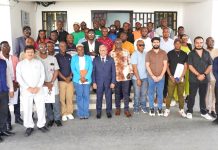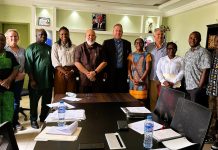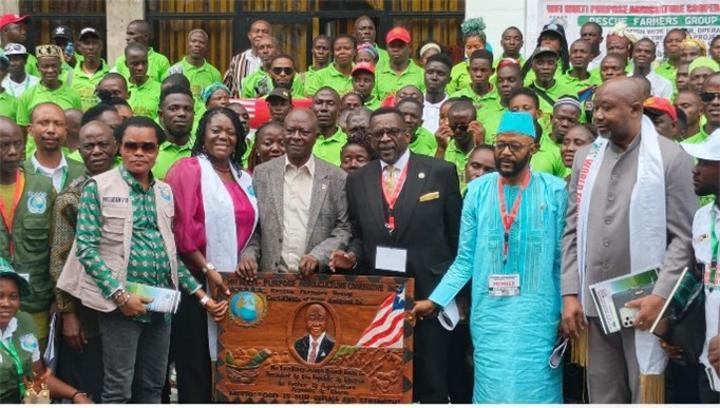
Africa-Press – Liberia. Liberia took a decisive step toward food self-sufficiency on Friday, February 6, as government officials, farmers, development partners, and youth leaders gathered at Monrovia City Hall for the official launch of Operation Feed the Nation, a nationwide agriculture initiative spearheaded by the World Foundation International (WFI) Multipurpose Agriculture Cooperative Inc.
The packed ceremony, held under the theme of transforming agriculture from subsistence to a national enterprise, highlighted the Boakai administration’s growing focus on local food production, youth employment, and economic independence as pillars of national development.
President Joseph Nyuma Boakai, Sr., who officially launched the initiative, delivered a keynote address that framed agriculture as a cornerstone of Liberia’s inclusive growth agenda and a pathway to long-term stability.
“Liberians must produce what we eat and eat what we produce,” the Liberian leader declared, drawing applause from farmers who had travelled from across the country’s fifteen counties. He stressed that “agricultural cooperatives remain one of the strongest vehicles for boosting production, improving processing, strengthening markets, and achieving food security.”
Speaking on behalf of President Boakai, Deputy Minister for Public Affairs at the Ministry of State, Anthony V. Kesselly, praised the resilience of Liberian farmers, noting years of struggle caused by limited access to inputs, infrastructure, and reliable markets.
Kesselly described the launch of WFI’s cooperative as a timely intervention aligned with government priorities, including increased production of rice, cassava, cocoa, and vegetables. “This is not just another project,” he said. “It is a national mission,” adding pointedly, “The Farmers Are Ready. The Logistics Are Not.”
Also addressing the gathering, Mr. Lincoln Z. Cooper, President and Chief Executive Officer of WFI-MAC, delivered a frank assessment of Liberia’s agricultural reality, contrasting the country’s natural wealth with its heavy dependence on imported food.
“Liberia is rich in fertile land and hardworking people,” Cooper said. “Yet we continue to depend on imported food, not because our farmers are unwilling or incapable, but because the systems and logistics to support them remain weak.” He added, “The land is available. The will is strong. But the logistics remain weak.”
Cooper explained that WFI-MAC is a farmer-centered institution designed to organize producers into strong cooperatives, reduce post-harvest losses, and transform smallholder farming into a viable national business. “Every bag of rice produced locally saves foreign exchange,” he noted. “Every farmer empowered reduces poverty. Every Liberian community fed with Liberian-grown food strengthens our sovereignty.”
Reinforcing the economic case, National Investment Commission Chairman Jeff Blibo urged Liberians, particularly young people, to rethink their perception of agriculture. “Agriculture is not a small business,” Blibo said. “Agriculture is Liberia’s business,” describing the sector as one of the country’s most investable due to its links to land, labor, value chains, and exports.
Earlier, Dr. John Wulu, Chairman of WFI’s Board, described Operation Feed the Nation as more than a program, calling it a commitment to rural dignity and survival. He disclosed that WFI has begun cataloguing more than 50,000 farmers into a centralized data system to link them with markets, inputs, and opportunities nationwide. “Our vision is simple,” Dr. Wulu said. “To empower farmers and vulnerable rural populations to live dignified lives through self-sufficiency and economic independence.”
From Lofa to Grand Kru, Cape Mount to Nimba, farmers filled the hall, many wearing cooperative colors and holding placards reading Feed the Nation. As Liberia grapples with rising food import bills and youth unemployment, the initiative places farmers at the center of a renewed national conversation. As one farmer from Bong County quietly remarked after the ceremony, “All we need is the chance. We can do the rest”, and on Friday in Monrovia, that chance appeared to take root.
For More News And Analysis About Liberia Follow Africa-Press