Africa-Press – Liberia. PM Kishida’s promises of funding and support for African causes during his four-nation tour recall past glories before ‘lost decade’
Observers said China’s growing influence in the continent is one reason for the visit, but also pointed to historic Japanese support for Africa
Japan is seeking to restore some of its economic and diplomatic glory in Africa, promising to mobilise public and private finance for multibillion-dollar infrastructure projects as part of its vision for a free and open Indo-Pacific.
Tokyo also wants a bigger role in brokering peace for the continent’s hotspots, such as the ongoing military battle in Sudan. In addition to US$500 million to “promote peace and stability”, Japan is sending a special envoy to the Horn of Africa.
Before China became a major player in Africa, Tokyo for decades pumped billions of dollars into the building of roads, power plants and ports on the continent. But Japan’s economic slowdown of the 1990s – its “lost decade” – forced a cut in overseas development investments.
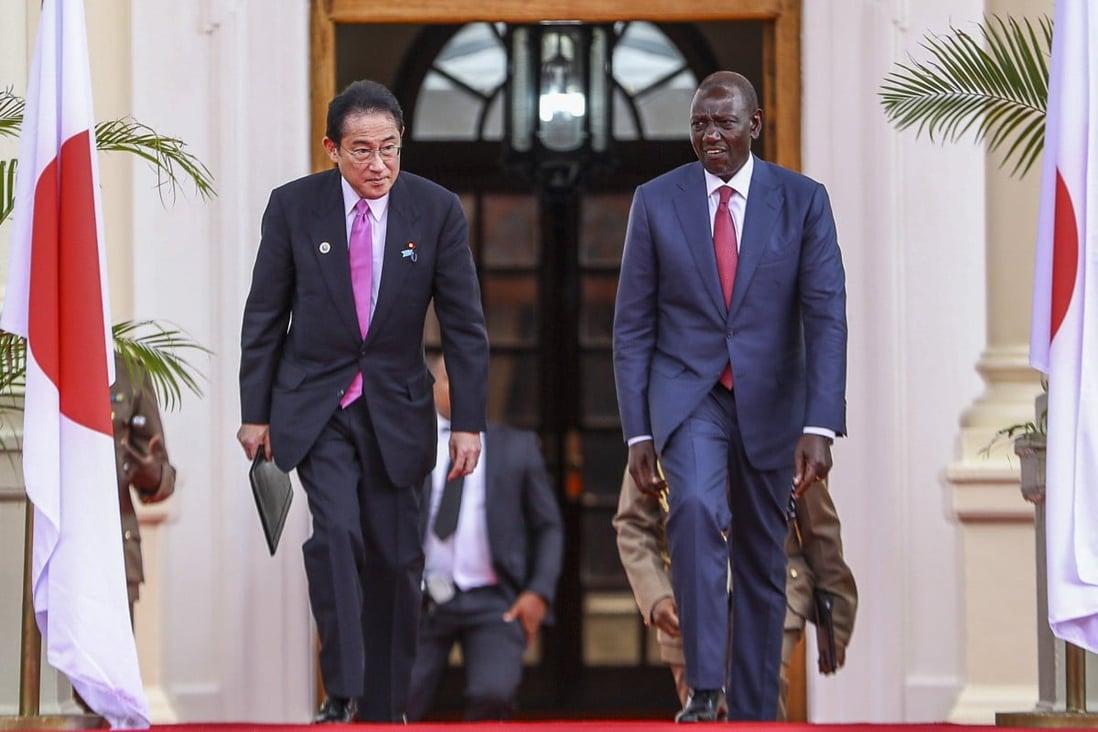
With China now Africa’s largest trading partner and lender, and with growing competition from the US and Europe, Japanese Prime Minister Fumio Kishida renewed Tokyo’s vows to the continent last week in Nairobi, during his four-nation tour that included Egypt, Mozambique and Ghana.
In an apparent swipe at China’s transcontinental Belt and Road Initiative, Kishida said Tokyo offers “transparent and fair” financing. Japan and other Group of 7 members – especially the United States – have criticised Chinese lending as burdening countries with “debt traps”.
China denies the debt trap allegation, and “has long been following the principle of transparency and openness and expanding new areas … in light of Africa’s needs”, according to a foreign ministry statement.
Seifudein Adem, an Ethiopian global affairs professor at Doshisha University in Japan, said a relevant context for Kishida’s visit is China’s growing and greater influence in Africa compared with Japan.
One way Japan tries to highlight the distinctiveness of its approach to Africa’s development is by stressing its “transparent and fair” approach to financing, Adem said. “No wonder therefore, that he had to mention this in Ghana and in Kenya.”
China-Africa expert Paul Nantulya, from the Africa Centre for Strategic Studies at Washington’s National Defence University, said Japan’s approach to infrastructure financing in Africa had historically been built around debt sustainability and accountability.
“While many have argued that this approach was developed as a counter to China’s Belt and Road Initiative – which they claim is lacking – the fact is, this approach has been part of Japan’s support for African infrastructure from the very beginning of its engagements with African countries since their independence,” he said.
Nantulya pointed out that Japan’s investments have always been framed within three requirements – jinminshoyū, ataisuru and ringi-sho – partnership, individual merit, and “bottom-up” development.
Japan was also the first foreign power to work with African countries to establish a permanent mechanism for cooperation, the Tokyo International Conference on African Development (TICAD), he said.
All other cooperation frameworks – like China’s Forum for China Africa Cooperation (FOCAC) were modelled on TICAD, which has met at summit level since 1993, at first every five years and now every three years.
On his first trip to Africa since taking office, Kishida brought promises of ports, power plants and railways aimed at improving Asia-Africa “connectivity” under Japan’s Indo-Pacific strategy.
In Egypt, he pledged 100 billion Japanese yen (US$733 million) for the third tranche of financing for Cairo’s fourth metro line. The project aims to cure worsening traffic congestion with a subway system in the city’s southwestern metropolitan area.
Japanese companies are funding and building a US$14 billion liquefied natural gas project in Mozambique, with loans from the Japan Bank for International Cooperation (JBIC).
In Maputo last week, Kishida said the project is not only important for Mozambique’s stability and growth, but also for the stable supply of LNG to Japan and the rest of the world.
But China is not out of the picture in the Mozambique gas boom. China National Petroleum Corporation and its partner ExxonMobil are developing a gas facility, which exported its first LNG from Mozambique in November last year.
At each stop of his African tour, Kishida promised to address Africa’s pressing issues – especially the escalating war in Sudan – at the next G7 summit in Hiroshima, which Japan is hosting.
Doshisha University’s Adem said the most significant aspect of Kishida’s visit was its timing, less than three weeks before the Hiroshima summit. “Africa is likely to come up,” he said.
Kishida’s Africa tour is basically a continuation of Japan’s foreign policy, in the context of Tokyo’s economic and diplomatic interests in the continent and the G7 meeting, Adem said.
“But there is no substantive difference between his policy toward Africa and that of his predecessor, Shinzo Abe,” said Adem, adding that any differences in policy arising from a change in leadership are comparatively negligible.
Kishida’s visit also took place against the backdrop of the eighth TICAD conference, held last year in Tunisia – “the first and only conference that was not attended by a Japanese prime minister” since its creation 30 years ago, Adem observed.
But the commitments undertaken at TICAD-8 – including US$30 billion for African development and peace initiatives – dwarf the US$10 billion put on the table by China at FOCAC in 2021, Nantulya said.
A plan to train 300,000 African professionals in Japan over the next three to four years “makes Japan the most important partner for African human resource development as it overtakes FOCAC, which reduced its commitment to train 150,000 Africans every three years to just 10,000, mainly due to Covid-19,” he said.
Nantulya said Kishida was also very keen to reconnect with African political, private sector, and development leaders and assure them of Japanese solidarity after the death of his predecessor Abe, who was assassinated last year.
Abe, Japan’s longest-serving prime minister, is lionised across Africa as an iconic champion of the continent and a great friend and brother to African countries, because of all he did to advance the African agenda, both in and out of office.
For More News And Analysis About Liberia Follow Africa-Press