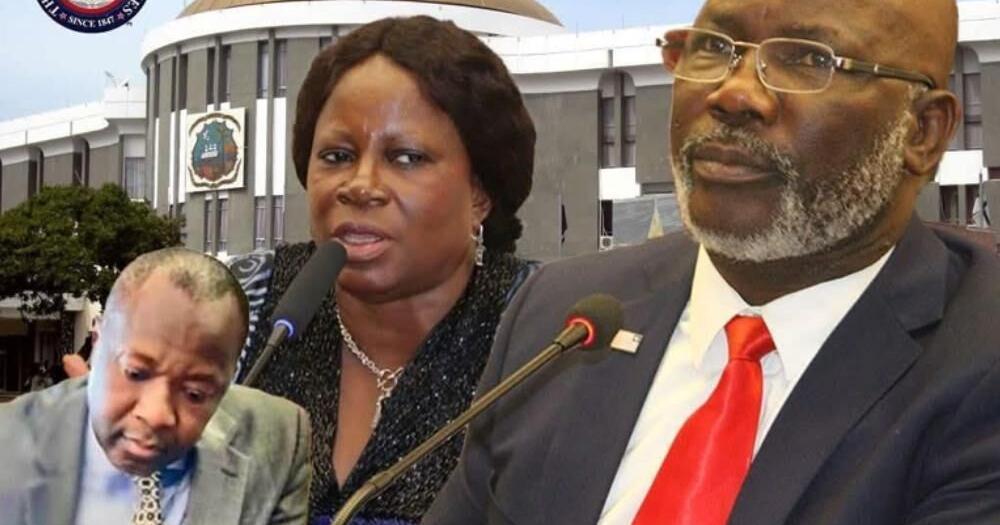
Africa-Press – Liberia. The Legislature is facing what appears to be renewed internal strain after the House of Representatives formally complained against Gbarpolu County Senator Amara Konneh, accusing him of undermining its authority over the controversial expulsion of Montserrado County District #10 Representative Yekeh Y. Kolubah.
At stake is more than a dispute over words. The episode has opened a broader debate about legislative independence, inter-chamber relations, and the fragile balance between accountability and institutional cohesion within one of the country’s most critical democratic bodies.
The House’s complaint stems from a public commentary by Senator Konneh, in which he questioned both the timing and rationale behind Kolubah’s removal.
“Important issues… got overshadowed by the Yekeh Kolubah debate,” Konneh wrote, referring to key legislative actions during the special session, including the supplementary budget and currency policy discussions.
He went further, casting doubt on whether the expulsion addressed any substantive national concern.
“Now that he is gone, does that resolve the border crisis with Guinea?” he asked, linking Kolubah’s earlier remarks to tensions along the country’s northern frontier.
In stronger language, Konneh described the situation as “theater” that could “grind the whole system of government to a halt,” adding pointedly: “This is not politics, it is madness.”
For House leadership, those remarks crossed a line.
In its communication to the Senate, the House argued that Konneh’s statements were “disparaging” and risked eroding the credibility of the Legislature.
Lawmakers insist that Kolubah’s expulsion was carried out in line with Article 38 of the Constitution, which grants each chamber the authority to discipline its members, including expulsion with a two-thirds majority.
“The integrity of this institution must be protected,” a senior House member said privately. “When a sitting senator publicly delegitimizes a constitutional action of the House, it creates confusion and weakens public confidence.”
The House’s reaction reflects a deeper concern—that internal criticism—especially when aired publicly—can undermine institutional authority in a political environment already marked by public skepticism.
While the House has framed the issue as one of institutional respect, Konneh’s critique appears rooted in a different concern—prioritization and political intent.
His argument suggests that the Kolubah saga may have distracted from more pressing national issues, including economic decisions and governance reforms.
More significantly, his comments about “party bosses” and political loyalty hint at a broader critique of legislative behavior.
“If your political enemies were chosen for you by your party bosses… are you really fighting your own war, or theirs?” he asked.
This line of reasoning touches on a long-standing issue in Liberian politics—the tension between party discipline and individual legislative independence.
By invoking this, Konneh positions himself not just as a critic of a single decision, but of a wider political culture that may prioritize alignment over deliberation.
Tensions between the two legislative chambers are not unprecedented, but they have typically remained behind closed doors.
Historically, disagreements between the House and Senate have emerged over budget allocations, confirmations, and legislative priorities. However, public confrontations—especially those involving accusations of institutional undermining—are less common and more consequential.
The Kolubah case itself has already been contentious, involving allegations of due process violations, a Supreme Court stay order, and questions about whether the House met the constitutional threshold for expulsion.
In that context, Konneh’s remarks can also be interpreted as part of a broader national debate about legality, fairness, and political motivation.
The Senate has responded cautiously, acknowledging the House’s complaint while emphasizing “legislative comity and inter-chamber cooperation.”
According to its communication, Senator Konneh has been “engaged and advised” internally—an indication that the Senate is seeking to contain the issue without escalating tensions.
A Senate insider described the approach as “measured and deliberate.”
“The goal is to avoid turning this into a full-blown institutional conflict,” the source said. “There are mechanisms within the Legislature to address differences without destabilizing the system.”
If not carefully managed, the dispute could have broader implications for governance such as legislative gridlock—a breakdown in relations between the House and Senate could slow down the passage of critical legislation, including budgetary measures and policy reforms.
It could also weakened oversight—inter-chamber conflict may reduce the effectiveness of legislative oversight, particularly if cooperation between committees is affected, while there could also be public confidence erosion. At a time when public trust in institutions is already fragile, visible divisions within the Legislature could reinforce perceptions of dysfunction.
Others believe that if lawmakers increasingly resort to public confrontation, it could normalize adversarial politics within the Legislature, making consensus-building more difficult.
An outspoken member of the House told the Daily Observer yesterday, “When lawmakers begin to openly question each other’s legitimacy, the institution itself becomes the casualty. The public stops seeing a unified Legislature and starts seeing competing factions.”
At the heart of the controversy is a fundamental tension—the right of lawmakers to express dissent versus the responsibility to preserve institutional integrity.
Konneh’s defenders argue that his comments reflect legitimate oversight and freedom of expression.
“Legislators are not robots,” one supporter posted on social media. “They are elected to think, question, and speak—even if it is uncomfortable.”
But critics counter that public statements must be measured, particularly when they concern sensitive institutional decisions.
“There is a difference between critique and condemnation,” another observer noted. “When language becomes inflammatory, it can damage the very institution you are trying to improve.”
Ultimately, the dispute over Konneh’s remarks cannot be separated from the controversy surrounding Kolubah’s expulsion itself.
That episode has already raised critical questions, was due process fully observed? Did the House meet the constitutional threshold? And did political considerations influence the outcome?
Konneh’s intervention, rather than creating the debate, may have amplified concerns already present in the public domain.
Both chambers are currently signaling a willingness to maintain cooperation. But the situation serves as a reminder of how quickly internal disagreements can evolve into institutional tensions.
The challenge for the Legislature will be to strike a balance—allowing room for critical debate while preserving the unity necessary for effective governance.
As one senior legislator put it, “We can disagree, even strongly. But we must never forget that we are part of one system. If that system breaks, we all lose.”
In a political climate already marked by controversy and public scrutiny, how the Legislature resolves this problem may well shape not just its internal dynamics, but its credibility in the eyes of the Liberian people.
For More News And Analysis About Liberia Follow Africa-Press