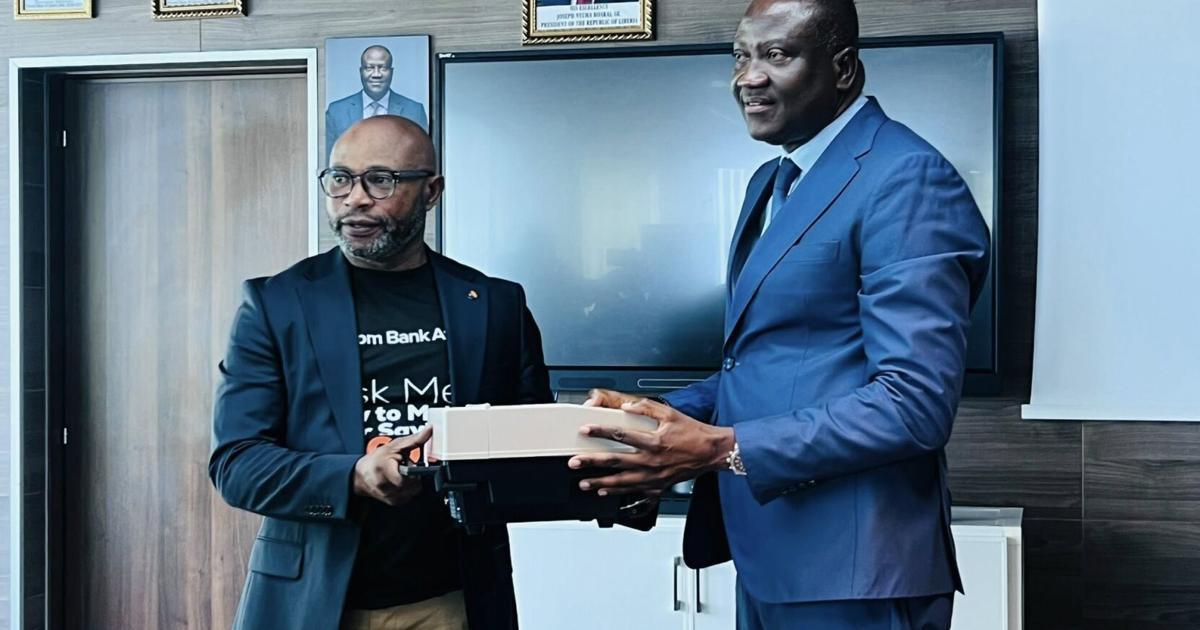
Africa-Press – Liberia. The Central Bank of Liberia (CBL) has intensified efforts to increase the circulation of Liberian coins across the economy by donating additional coin sorting machines to commercial banks, while urging citizens and businesses to accept coins as legal tender in all transactions.
Speaking on Thursday, April 9, 2026, during a meeting with the Liberia Bankers Association (LBA), CBL Executive Governor Henry F. Saamoi said the decision comes in response to the persistent problem of low coin circulation within the Liberian economy.
“One of the critical issues that we’ve been considering is the low circulation of coins in the Liberian economy, which has gained our attention, as well as the attention of the Liberia Bankers Association,” Saamoi said.
According to the governor, the lack of coins in circulation has been a concern for both the Central Bank and commercial banks, despite coins being an official component of Liberia’s legal tender.
“They’ve also had issues with the circulation of coins, which is part of our legal tender in the country,” Saamoi added.
He emphasized that coins must be accepted for all transactions nationwide, warning that rejecting them is unlawful.
“The coins are supposed to be accepted for each and every transaction in the country. The rejection of coins is a violation of the Constitution,” Saamoi said. “So just as bills are accepted, coins are supposed to be accepted by all businesses, all citizens for transaction purposes.”
To address logistical challenges associated with handling coins, the Central Bank has provided additional equipment to commercial banks to improve their ability to receive, sort, and redistribute coins.
“So today we’ve met with the commercial banks. What we are doing today is to facilitate the acceptance and usage of coins in the economy,” Saamoi explained.
He announced that the Central Bank has increased its support to commercial banks by donating more coin sorting machines.
“We are making an additional donation to the commercial banks of two additional coin sorting machines,” Saamoi disclosed. “Previously we had donated one each to all of the nine commercial banks. Today we are increasing that donation by two.”
With the latest donation, Saamoi said each commercial bank will now be equipped with three machines to handle coin transactions.
“So each commercial bank will now have three coin sorting machines. Our hope is that with that addition, the commercial banks will be able to accept coins for deposit and also pay out coins for transaction purposes,” he said.
Beyond the donation, the Central Bank and the Liberia Bankers Association have also agreed on a new policy aimed at ensuring coins are actively circulated within the economy.
“In fact, as a result of this meeting, we’ve agreed jointly with the LBA that for every withdrawal in Liberian dollars over the counter at each bank, one percent of that withdrawal will be paid in coins,” Saamoi announced.
He explained that the policy will take effect immediately beginning Monday.
“Meaning if you walk into a commercial bank effective Monday to withdraw five thousand Liberian dollars, one percent of that five thousand will be paid to you in coins,” the governor said.
Saamoi used the occasion to appeal to the public and government officials to support the initiative by willingly accepting coins during financial transactions.
“So at this presentation, we want to appeal to the general public, to appeal to our colleagues in government because as government we should be leading by example,” he said.
He specifically urged government officials not to reject coins when they receive them from banks.
“If you’re a government official and you walk into a commercial bank to withdraw, please, please, please accept from the commercial banks one percent of your withdrawal in Liberian dollars in coins,” Saamoi emphasized.
The CBL governor stressed that coins were never intended to remain in bank vaults but to facilitate everyday transactions across the country.
“The coins have to circulate in the economy. The coins were not meant to be kept in the vault of the Central Bank or in the vault of the commercial banks,” he stated.
According to him, coins play a critical role in facilitating small-scale transactions and trade, particularly among low-income earners and small businesses.
“The coins are intended to facilitate transactions. They are intended to facilitate trade, especially at the lower-tier level,” he said.
Saamoi also warned that rejecting coins could lead to legal consequences.
“There will be messages that will be broadcast because there are penalties for rejecting coins which is similar to rejecting bills,” he said. “So if you reject coins, you are actually rejecting Liberian dollars which is a violation of the Liberian Constitution and there are penalties for doing that.”
The governor made it clear that the Central Bank will not intervene on behalf of any official who refuses to accept coins.
“If you’re a government official, please do not call the Central Bank. This is Liberian currency and it’s supposed to be accepted for transaction purposes,” Saamoi said firmly.
“I don’t want to get a call from any government official to say a commercial bank has decided to pay me in coins and I cannot take coins. I will not intervene as governor of the Central Bank of Liberia,” he added.
Saamoi said the success of the initiative will depend on cooperation from both the public and government officials.
“Our appeal is to all of us who are in high government positions to please assist the Central Bank so that the coins will go into circulation so that the intended population can benefit from coins,” he noted.
He also thanked members of the media for attending the event and helping to raise awareness about the initiative.
“I want to thank you as members of the press for coming to witness this presentation that has been made today to the Liberia Bankers Association,” he said.
Responding on behalf of the Liberia Bankers Association, its President Lekan Balogun welcomed the Central Bank’s support and said the additional machines will significantly strengthen the banking sector’s ability to process coins.
“On behalf of the Liberia Bankers Association, we want to thank the Central Bank for providing us these tools to assist us in being able to accept coins from our customers,” Balogun said.
He noted that commercial banks previously received one coin sorting machine each but have now been provided two more.
“So before now, one was given to the banks and now we have additional two,” he explained.
Balogun said the machines will help banks properly handle and count coins deposited by customers.
“What this will do is to enable us to be able to accept coins now and be able to count,” he said.
He stressed that coins are legitimate national currency and must be accepted just like paper money.
“The coins are legal tender and we expect everybody to accept it. The way you accept the notes are the same way you accept the coins,” Balogun stated.
Balogun also highlighted the economic benefits of using coins, noting that they are more durable than paper currency.
“There is an overriding benefit accepting the coins because the cost alone of printing notes in this economy is actually a lot,” he said.
“Coins are durable, they are legal tender and they should be accepted,” he added.
Balogun assured the public that commercial banks across Liberia are ready to receive coins from customers as part of their regular banking operations.
“And if you walk into any bank today in Liberia, we will accept the coins from you because they are legal tenders of the country,” he said.
For More News And Analysis About Liberia Follow Africa-Press