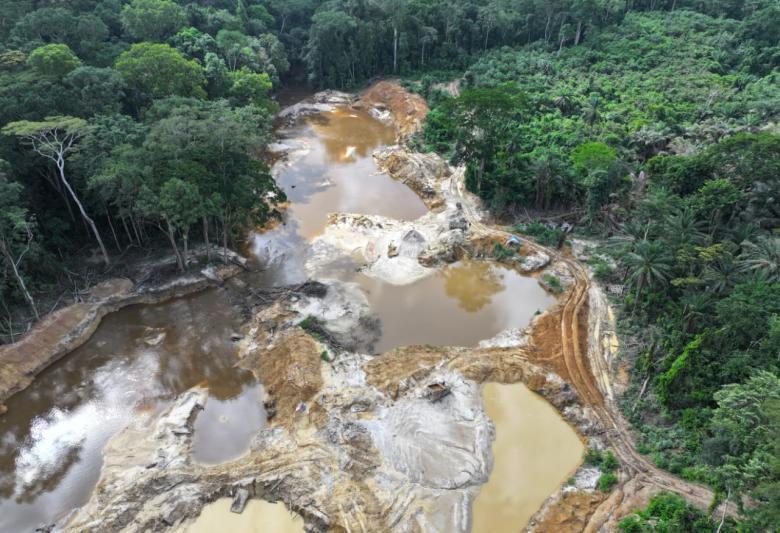
Africa-Press – Liberia. Insufficient budgetary support to conservation efforts is said to be impeding the effective protection of national parks and protected areas in Liberia. The situation has reportedly led to surge in illicit mining and hunting in the Gola and Sapo national parks, Liberia’s primary parks located in Sinoe and Gbarpolu Counties, southeast and north west, Liberia. Both parks are homes to Liberia’s rich biodiversity, chimpanzees, hippopotamuses, and elephants as well as variety of plant species.
However, the lack of sufficient budgetary funding has limited the ability of relevant agencies including the Forestry Development Authority (FDA), Environmental Protection Agency (EPA) and the ministry of Mines and Energy to hire and train sufficient forest rangers and inspectors as well as provide required livelihood support to residents of nearby forest communities. The situation has reportedly fueled weak law enforcement thus posing a significant threat to the country’s wildlife and biodiversity.
The Forestry Development Authority (FDA) and the Environmental Protection Agency (EPA) are tasked with ensuring sustainable management of the forest land, conservation of forest resources, protecting the environment and preserving biodiversity while the ministry of Mines and Energy is clothed with the authority of regulating the mining sector.
The FDA has over the years requested 150 to 180 forest rangers to protect the Sapo National Park alone which covers 1804 square kilometers, but the request has not been approved as only 40 rangers are currently visible at the Sapo National Park. The Gola National Park and other protected areas also faced similar challenge.
In the 2025 National Budget, the FDA, EPA and the ministry of Mines and Energy were allocated a combined budget of over US$10 million. The EPA was allotted US$2,414,466, while the FDA and Ministry of Mines and Energy US$4,184,144 and US$4,004,111, respectively. However, the EPA says it needs US$20 million annually, twice the total budget of the three entities, to fully execute its mandates. This funding according to the EPA would cover logistics, salaries, training, and hiring more than 438 inspectors to monitor environmental crimes nationwide.
The 2026 Draft National Budget submitted to the Legislature on November 7, 2025 by the Executive branch of government shows the allotment of US$3, 165, 524 to the Forestry Development Authority as compared to the US$4,184,144 allotted in the 2025 approved national budget. The EPA and Ministry of Mines and Energy have also been allotted US$2,914,466 and US$6,163,997 respectively in the 2026 draft national budget.
The FDA 2026 draft budget items include basic salary, domestic travel-Daily Subsistence Allowance, electricity, office building rental and lease, fuel and lubricants – vehicles, fuel and lubricants – generator, repair and maintenance, machinery, equipment, stationery and public sector investment plan (PSIP). Under the FDA budget, there is no direct line-item for conservation, so it is unclear if funding for conservation is placed in any of the budget items and doubts arise when FDA officers declare that conservation efforts are only supported by donor funding.
With recent budget hearings at the Liberian Legislature, the three entities may have experienced increase or decrease in their respective budget following legislative appropriations.
FDA Managing Director, Rudoph Merab, told the Liberian Senate on June 24, 2025 on Capitol Hill in Monrovia that the FDA lacks adequate funding and sufficient rangers to effectively manage the parks. He further stated “All of what we are saying here can be curtailed if we have the people in place to help prevent it – I have been given a job, but I need to be empowered to do that job.”
The international community is emphasizing the need to increase financing in Liberia’s biodiversity conservation. The Liberia Sustainable Forest Economy Project (P508345), a project concept by World Bank, outlines Liberia’s capacity constraints in the form of insufficient environmental and social staffing and training, as well as limited technological and financial resources. The UNDP also urges Liberia to prioritize strengthening policies and governance related to biodiversity financing and calls on civil society organizations to advocate for biodiversity financing budgets. It does is on its recent publication “Liberia’s Biodiversity: A Future to Invest”
This call also requires that lead entities protecting conservation, environment and the forests such as the Forestry Development Authority, (FDA) become financially independent
Since its establishment in 1976 by an Act of the Legislature, the FDA remains a semi-public autonomous corporation limiting its financial capability to fully execute its mandates. Over the years, authorities at the
FDA have called for the review of the Act to upgrade the entity to autonomous agency to be financially independent. However, the request is yet to meet legislative approval.
The FDA semi-autonomous status has made it almost impossible to fully carryout its mandates for conservation purposes as fees collected are sent to the government’s consolidated account.
Nora Bowier, FDA Deputy Managing Director for Community, Conservation and Carbon, estimates that $1.2 million to $1.5 million would be needed to manage the Sapo Park alone. She says the FDA relies heavily on grants and international partners to fund conservation efforts. Bowier said “Sapo should have up to 150 to 180 rangers – unfortunately we do not have the resources to ensure that we hire sufficient people to mind the park.”
Insufficient financing for conservation does not only affect biodiversity but also local communities. Although the law mandates FDA to work in collaboration with local communities, non-governmental organizations, and interested international organizations to provide alternative livelihoods for communities adversely affected by the establishment or maintenance of Protected Forest Areas (Chapter 9.10 c of the Forestry Reform Law 2006), lack of funding has impeded the FDA to provide sufficient livelihoods alternatives to communities. As expressed by FDA Deputy Managing Director, “we are making some efforts with that, but the efforts we are making are not too sufficient.”
Bowier says, if challenges confronting the sector are not addressed adequately and promptly, the country’s forests would be depleted including its opportunities for generating income and revenue. The country’s rich biodiversity portfolio and international recognition would also be at risk due to severe illicit mining and hunting.
The ministry of Mines and Energy has since denied issuing licenses to any miners or companies to mine in protected areas across the country.
The Director of Communications at the Ministry of Mines and Energy, Richard Manubah, says the mining law clearly outlines who can be a miner, how to obtain mineral rights, and where mining activities are designated to take place. Manubah emphasized that mining activities are prohibited in protected forests and national parks. He says the management of national parks relies solely on the Forestry Development Authority (FDA).
However, the ministry faces challenges due to low budgetary support, limiting its ability to hire more inspectors and increase visibility. He disclosed that discussions concerning increased budgetary support are ongoing with the ministry of Finance and the National Legislature.
Manubah added that eradicating illegal activities in rural communities needs the coordinated efforts of ministries and agencies of government as well as local communities. He urged community dwellers to discourage illegal mining activities in their areas by saying no to illicit miners.
The ministry of Mines and Energy from January 2024 up to present has canceled twenty-seven Class B licenses, reviewing thirty-eight while thirteen pending. The ministry says the move is part of efforts to crackdown on illicit mining activities which pose significant threats to the environment and the country’s biodiversity.
The lack of sufficient budgetary support and limited manpower remain common across other relevant agencies with the Environmental Protection Agency (EPA) being no exception.
The Environmental Protection Agency, which is the government, lead environmental watchdog also confirmed environmental damages including land degradation and water pollution caused by ongoing illegal mining activities, but emphasized the need for more resources to effectively and efficiently curtail menace.
Photo by the Environmental Protection Agency
The Executive Direcor of EPA, Dr. Emmanuel Urey Yarkpawolo says the EPA baseline studies revealed concerning results about the state of Liberia’s water systems, highlighting the need for further action to mitigate environmental damage. He says the EPA is significantly challenged with low budgetary support due to national priorities which often limit its funding. Dr. Yarkpawolo disclosed that the total of US$20 million is needed annually to sufficiently mitigate environmental crimes.
VIOLATION OF ENVIRONMENTAL AND CONSERVATION LAWS
Ongoing illicit mining and hunting activities in national parks and protected areas blatantly violate the laws including, chapter 10.1 of the New Minerals and Mining Law and Chapter 9 section 9.10 b (ii) of the National Forestry Reform Law Of 2006.
The above-mentioned laws prohibit activities such mining, farming and hunting inside national parks and protected areas. Specially chapter 10.1 of the New Minerals And Mining Law.
Chapter 9 section 9.10 b (ii) of The National Forestry Reform Law Of 2006 also states that “No one shall in a National Park, Nature Reserve, or Game Reserve, prospect, mine, farm, hunt, fish, extract Timber or non-timber Forest Products, or take any other action except those for management or non-consumptive uses, such as tourism, recreation, and research.”
Chapter 10 section 10.1 of the New Minerals and Mining Law states that “Mineral Rights shall not be granted with respect to any lands located within the boundaries of any cities commonwealth districts, municipal districts, cemeteries, transported or communication facilities, aqueducts, military base, port, Poro or Sande grounds, and other grounds reserved for public purposes, except with the consent of the public officials authorized to administer or control the affairs of such entities, and subject to such special terms and reasonable conditions as may be prescribed for the protection of surface users.”
Despite robust laws governing conservation, the environment and mining, illicit activities are still rampant in Liberia’s national parks and protected areas due to insufficient budgetary support to adequately enforce these legislations. This surge in visible illegal mining, farming, and hunting has prompted citizens and conservation groups to sound the alarm over the weak enforcement of Liberia’s conservation law.
CALL TO ENFORCE EXISTING LAWS
The continuous damage to the environment, national parks and other protected areas has triggered calls from citizens, local and international organizations to enhance the enforcement of existing environmental, conservation and mining laws.
One of those calling for concerted efforts to protecting the forests comes from the former Development Superintendent of Wacaba Statutory District, in Sinoe County A. Caine Tarwho. He called for incarcerating lead illegal miners and regular joint security patrols in and around the parks to discourage such activities. Tarwho stated “If you arrest an illegal miner and they resurface the next day; there will be no fear – the Sapo park will continue to be destroyed.”
He believes that the laws governing the forest, environment and mining sectors should fully be enforced to ensure the protection of the parks to preserve the heritage of the country. The former local official pleaded with government to allocate more funding to conservation activities in the national budget instead of depending solely on donor funding.
Tarwho’s plead for more budgetary to the FDA, EPA and the Ministry of Mines and Energy to fully execute their mandates is being buttressed by the Chairman of the Movement for Citizens Action in Sinoe County, Mayson Brown. He advocates for the government to make provision for the hiring of the required rangers to mind protected areas including national parks.
With huge benefits expected through the preservation of the forests, Brown, also wants citizens to take ownership of the forests by ensuring that illegal miners are not allowed to carry out any forms of mining. “If we want to benefit from the park, we should not destroy it – while it is true that there is no job, you cannot destroy the parks for short time benefits,” he said.
The Commissioner of Kongba District, Gbarpolu County, a community hosting the Gola National Park, (GNP) Lawrence Sherbro, has joined numerous calls to protecting national parks and protected areas across the country. He heighted the insufficient presence of rangers in the GNP, emphasizing the need for more recruits to protect the forest.
The widespread illicit mining, farming and hunting have claimed the attention of conservation groups including the Society for the Conservation of Nature of Liberia (SCNL) and the Wild Chimpanzees Foundation (WCF). The two conservation groups believe that though efforts are being made, the implementation of the laws is on a slow pace and need to be tightened.
SCNL head of Strategic Pillar on Biodiversity and Conservation Science, Dickarmien Alvis Deemie, says the weak enforcement of the laws has contributed to slight decline in the population of species in the Gola National Park as the destruction of their habitat continues. Research conducted by SCNL through the deployment of camera traps showed low imageries of chimps as compared to past years.
The SCNL in 2024, supported the FDA through training of rangers to increase law enforcement patrols along with the Joint security. During patrols, the SCNL says, hunters were still seen with dead chimpanzees, clearly demonstrating the need for increased rangers.
Photo of single barrel guns seized in the Gola National Forest. Photo by SCNL
“So, when people are arrested in these acts, there is a need for further investigation, but again our law enforcement is still very weak – it is contributing to the conservation status of chimpanzees and other high conservation value species in Gola [Gola National Park].”
Deemie further said “Hunting is still an issue in Gola and other parks – it has not reduced – it is still continuing. It is a big challenge for us, because these programs are supported by donors – we expect some level of reduction in illegal activities affecting the park.”
Data shows ongoing illegal activities still high in the Gola National Park as shown below.
The above chart clearly showed that 1,187 illegal hunting activities were recorded in 2025 as compared to 848 hunting activities recorded in 2024. Farming and mining account for 81 in 2025 as compared to 2024 which recorded 28 in the Gola National Park. This clearly indicates increase illicit activities in the parks.
The Country Director of the Wild Chimpanzee Foundation, Dr. Annika Hillers, acknowledged challenges confronting the sector and called on authorities to raise awareness with the local population to create ownership in the protection of Liberia’s biodiversity. Dr. Hillers said Liberia hosts some of the world’s most endangered species that cannot be found anywhere, as such, the destruction of their habitats could lead to their extinction.
Dr. Hillers noted that though efforts have been made, there has been resistance for law enforcement due to limited manpower, and no fear for unarmed officers in the parks. She noted that Liberia is currently in the process of losing opportunity due to the destruction of the its biodiversity and ecosystem services by prioritizing short term personal interests over long term sustainable development.
“Liberia has the potential to benefit very much from the existing forests. We talk about the potential to generate income from carbon trade projects and ecotourism, but the reality is at the moment the short-term priority goes extractive industries such as to mining, and logging. So, my question here is where do you expect the tourists to go if the forest is gone? What do you expect the tourists to see if wildlife is gone?
She believes that the implementation of the National Wildlife Conservation Management Areas Law is still challenged and more needs to be done to educate every Liberian about the consequences of the law. “The law is being implemented to some extent through the National Wildlife Taskforce, but I agreed that still more education is needed to ensure that every Liberian is aware of the law.”
She says the Wild Chimpanzee Foundation is providing logistics, infrastructure, training and livelihood support to the government through the FDA with funding from the European Union, Rain Forest Trust among others.
Partners including SCNL, WCF and other major players supporting Liberia’s conservation efforts do not hire or provide salary for rangers, but only support forest rangers training program and logistics.
ONGOING EFFORTS TO CURBING ILLICIT ACTIVITIES
Despite of the low budgetary support, in September 2025, a joint operation conducted by the Forestry Development Authority, Ministry of Mines and Energy, Environmental Protection Agency, and the Armed Forces of Liberia resulted in the removal of illegal occupants from the Sapo National Park. This effort aimed to curb illicit activities in the area. This wasn’t the first time authorities have taken action against illegal mining in the parks. In 2005, a similar operation removed over 2,000 illegal occupants, although they returned three months later due to insufficient rangers.
The FDA and partners have also made some efforts to training staff, create awareness on bushmeat trading and arrest some violators of the forest and biodiversity conservation laws of Liberia amidst low budgetary support.
The Ministry of Mines and Energy has also been working to address the issue, shutting down several illicit mining sites across.
Liberia’s Environmental Law of 2003 stipulates that discharging hazardous substances into the environment is an offense, punishable by a fine of up to US$50,000- or 20-years imprisonment.
In 2024, the EPA imposed fines totaling approximately $1.2 million. However, only about $200,000 was collected, with some companies, including steel giant, Arcelor Mittal being fined this year. The EPA has impounded trucks dumping dirt and is working to bring companies into compliance. The country’s chief environmentalist, Dr. Yarkpawolo, emphasized that these activities are unsustainable and harm local communities.
“We need additional support to get where we want to be, but I don’t want to underestimate our efforts about what we have done in Liberia for both climate change and biodiversity conservation,” Dr. Yarkpawolo said.
Right group says, the country stands at risk of losing billion to illicit mining if nothing is done to address illegal mining and illegal hunting activities.
The Chairman of the House of Representatives Committee on Agriculture, Forestry, and Fishery, Alfred Hezekiah Flomo, acknowledged damages caused by illicit miners and hunters in the Sapo National Park and protected areas. He emphasized that the need for increased budgetary support to the Forestry Development Authority (FDA) to effectively maintain national parks and forests cannot be overemphasized. He says, the FDA requires more resources to protect the forests and ensure the presence of rangers in National Parks and other protected areas.
“The Legislature will review the FDA’s allotment on forestry to make an informed decision, and the Managing Director will be required to provide detailed information on previous budget utilization and future needs,” he said.
INTERNATIONAL SUPPORT NEEDED
In Liberia, the EPA, FDA and local communities are also making tremendous efforts to curb the situation, but they are challenged by poverty, alternative livelihood, climate change – sea erosion which is taking away coastal communities as well as crops failure.
However, Dr. Yarkpawolo blamed the situation on bigger countries and companies that are emitting greenhouse gases, adding that their action is affecting smaller countries like Liberia as compared to them.
He wants countries and organizations emitting greenhouse gases to take responsibility to finance to help clean up some of the problems being created. He said “We are not getting enough support – what we get is like a drop in the bucket.”
Liberia has signed several international agreements focused on environmental protection, including the Paris Climate Agreement, the Convention on Biological Diversity, the United Nations Convention to Combat Desertification and the Convention on International Trade in Endangered Species of Wild Fauna and Flora among others.
At the 80th session of the UN General Assembly, President Joseph Nyuma Boakai emphasized the need for full implementation of the Paris Climate Agreement and increased investment in climate adaptation and mitigation.
Liberia’s 2035 Nationally Determined Contribution (NDC 3.0), launched in September 2025, outlines the country’s climate action plan including reducing greenhouse gas emissions by 64%. The country will develop a costing and cost-benefit analysis, along with an investment plan, to support its NDC targets. However, Liberia’s 2021 NDC estimated a total of $490.59 million through 2025 as the necessary funding to achieve its mitigation and adaptation targets.
In 2022, 2400 African delegates met to discuss on Protected Areas, (PAs) which represent 14.4% of the total African land. The group concluded that the major challenge is about funding, with 90% of the PAs severely underfunded. They issued the Kigali Call for Action calling for a new paradigm in funding PAs, basically moving to a scenario with many actors, many funding mechanism and broader goals. Despite the Kigali Call to Action, insufficient funding remains a major challenge in more African countries.
For More News And Analysis About Liberia Follow Africa-Press