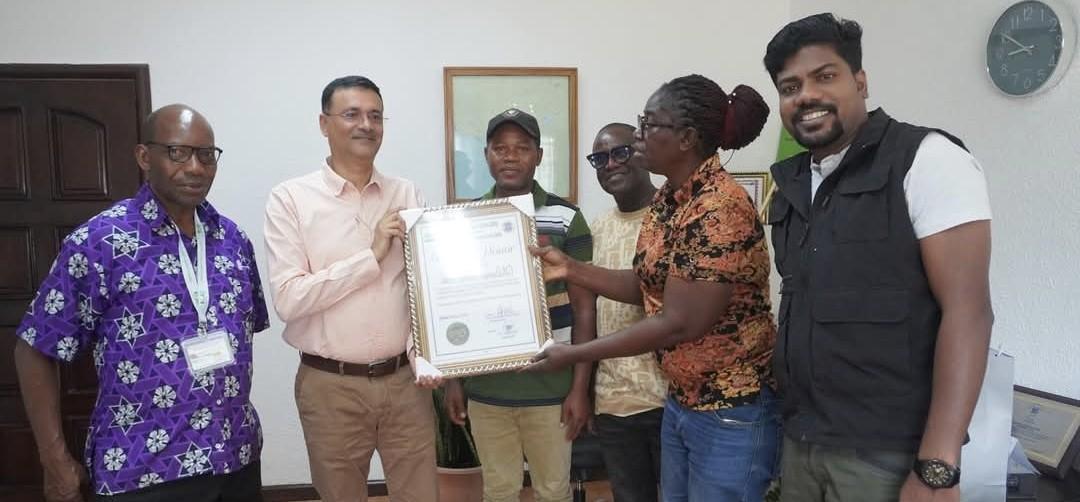
Africa-Press – Liberia. The Liberian Agricultural Company, LAC, operating in Grand Bassa County, has received a prestigious Certificate of Honor from the Rubber Planters Association of Liberia and the Rubber Development Fund Incorporated, recognizing its outstanding contributions to the growth, innovation, and sustainability of Liberia’s rubber sector.
The award ceremony, held on Tuesday, March 25, at the Rubber Planter Association of Liberia Office in Cooper’s Farm near Kakata, brought together key stakeholders from across the agricultural value chain.
LAC was praised for its consistent support to smallholder farmers through technical training, provision of high-quality planting materials, and capacity-building programs that continue to enhance productivity and improve rural livelihoods.
Agriculture Minister Dr. J. Alexander Nuetah, lauded LAC’s efforts, describing the company’s collaboration with government as a strong example of an effective public–private partnership driving national agricultural development.
Also delivering remarks were Margibi County Superintendent Ojay Godfavor Morris, RPAL President Wilhelmina G. Mulbah-Siaway, and RDFI Chairman Tokpah J. Mulbah.
Each commended LAC’s resilience and leadership, particularly its unwavering support to farmers during and after the COVID-19 pandemic.
Receiving the honor on behalf of LAC, Local Rubber Purchase Manager Deepak Divakaran expressed appreciation for the recognition and reaffirmed the company’s commitment to sustainable rubber production.
He emphasized that proper agronomic practices, including planting distance, tree density, and quality control, are essential for long-term success in the sector.
Mr. Divakaran disclosed that LAC trained over 300 tappers in 2025 to strengthen local capacity, and since 2009 has supplied more than one million rubber stumps to smallholder farmers.
As of 2026, the company has prepared 140,000 nursery plants, with 110,000 to be distributed through RPAL to ensure a steady and sustainable supply chain.
In addition, LAC, in collaboration with Rubber Development Fund Incorporated, has supported key infrastructure projects, including road and bridge rehabilitation in several rural communities, significantly improving access for farmers and boosting economic activity.
Farmers Praise LAC’s Lasting Impact
Farmers and local leaders across beneficiary communities have hailed LAC’s interventions as transformative, citing improvements in training, farm management, road access, and income opportunities.
Smallholder technical advisors, Mr. Abraham Siokar and Mr. Henry Gibson, highlighted LAC’s strong field presence and monitoring system.
“We don’t just train and leave,” one advisor explained.
“We move around the communities, monitor farmers, ensure sustainable practices, and even conduct internal audits. If agents are not treating farmers fairly, action is taken. This is about building a long-term relationship.”
They noted that LAC deploys 20 extensionists who track farm performance, train and create awareness, Internal audits, enforce sustainability standards, and ensure transparency in payments, helping to build trust between farmers and the company.
Farmers also praised LAC’s pricing system, which aligns with the national framework set by the Liberia National Rubber Pricing Committee. Beyond the government-set price, LAC provides additional incentives for farmers who meet sustainability standards, including environmental protection, proper labor practices, and use of safety equipment.
In Weesah Town, Grand Bassa County, Town Chief Josiah G. Jacobs described LAC’s impact as life-changing.
“Before LAC intervention, vehicles could not reach our town,” he said.
“Today, roads are open, and movement is easy. The training has helped us understand the true value of our farms. We were damaging our trees before, but now we know how to manage and protect them for the future.”
Another farmer, Oreath Jones, emphasized the importance of the training provided.
“This training made us understand proper tapping and the importance of the rubber tree. We are grateful to LAC and hope they continue to support us,” she said.
Farmers further explained how LAC’s training has introduced modern techniques such as proper panel opening, equipping trees, and preparing farms for productive tapping cycles.
Several farmers who spoke with FrontPageAfrica over the weekend noted that although they are currently in the early stages of production, they expect improved yields in the coming months due to the knowledge gained.
Despite the progress, farmers appealed for additional support, particularly in accessing essential tools such as tapping knives, cups, wires, and other equipment needed to fully operationalize their farms.
They also called for more training opportunities, as some farmers were unable to participate in earlier sessions.
In response, LAC has indicated willingness to provide materials through structured systems, including credit arrangements tied to production, and plans to expand training programs, especially in specialized areas like budding and nursery development.
Driving Sustainable Agriculture
Guided by its commitment to responsible tropical agriculture, LAC continues to uphold international standards in environmental protection, labor rights, and sustainable land use.
With its rubber exports destined for European markets, the company has maintained strict compliance with global requirements on deforestation, human rights, and environmental stewardship.
Through its extension programs, LAC actively monitors farming communities to ensure adherence to these standards, reinforcing its role as a responsible and forward-looking industry leader.
As conveyed on behalf of LAC General Manager Naveen Madan, the company said it remained committed to strengthening partnerships that empower rural communities, enhance agricultural productivity, and contribute meaningfully to Liberia’s economic growth.
With continued collaboration between government, stakeholders, and farming communities, the Liberian Agricultural Company is poised to remain a key driver of transformation in Liberia’s rubber sector.
For More News And Analysis About Liberia Follow Africa-Press