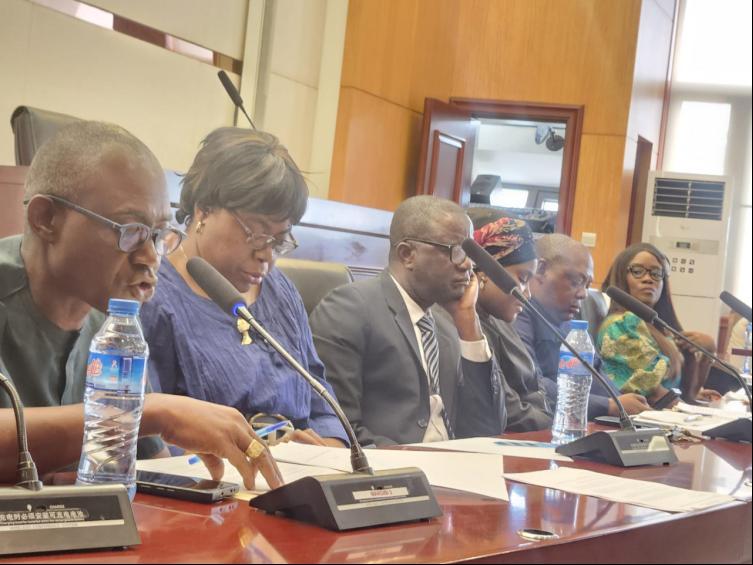
Africa-Press – Liberia. A stern legal battle ensued on Wednesday, February 25, 2026 between the Liberia Anti-Corruption Commission (LACC) and the Law Reform Commission (LRC) during public hearing into the proposed act to amend the Anti-Corruption Law.
During the hearing conducted by the Liberian Senate, the LACC openly expressed serious disagreement with most parts of the proposed law on grounds that it violates most parts of the Liberian Constitution.
What’s In The Proposed Amendment
The proposal seeks to implement illicit enrichment laws in Liberia to align with the United Nations Convention Against Corruption. The proposal, which is drafted by the LRC, in parts also aims to shift the burden of proof from the accuser to the accused.
LRC Defense
Cllr Bornor Varmah, Chairperson of the Law Reform Commission, pointed out that these legal reforms aim to hold public officials accountable by requiring them to justify significant wealth that exceeds their legal earnings.
By shifting the burden of proof to the accused once a discrepancy is identified, he said the government hopes to deter bribery and enhance judicial credibility.
Furthermore, Cllr. Varmah told members of the Senate Standing Committee on Judiciary, Human Rights, Claims and Petition that these measures will bolster foreign investment and improve the nation’s standing with international financial institutions.
Notably, he furthers that the proposal seeks to recover stolen assets and redirect public funds toward essential services like healthcare and education. This legislative shift is presented as a vital step toward fostering transparency and strengthening the democratic governance of the country.
Specifically, Cllr. Varmah states that the proposal advocates for Liberia to adopt illicit enrichment laws is in accordance with the United Nations Convention Against Corruption (UNCAC), requiring public officials to justify wealth that exceeds their legal earnings.
By establishing a paradigm shift in the burden of proof, he explained that the law would require the state to demonstrate a financial disparity, after which the accused must provide a reasonable explanation for their assets.
“Implementing these measures aims to deter systemic abuse of office and restore public trust while simultaneously positioning Liberia as a transparent destination for foreign direct investment,” Cllr. Varmah informed the Liberian Senate, emphasizing that such reforms will bolster the rule of law by reducing impunity for high-ranking officials and allowing the government to recover stolen funds for essential public services.
Among other things, Cllr. Varmah is convinced that this law will provide the basis of unhindered prosecution of criminal related offenses wherein the state will be armed to run after state criminal perpetually.
The proposed amendment also provides means for the removal of LACC for a cause such as incapacity to perform, corruption and others, but only that such must be done through due process of the law.
In the current law, the statute of limitation for criminal related offenses is five years and three years for misdemeanor.
LACC Raises Concerns Over Constitutional Violation
For its part, the Liberia Anti-Corruption Commission (LACC) raised serious legal concerns and official stance regarding proposed legislative amendments.
Cllr. Alexandra K. Zoe, Chairperson of the LACC, said while the Commission endorses new laws designed to combat illicit enrichment, it frowns against shifting the burden of proof violates constitutional protections against self-incrimination.
She specifically cited Articles 20(A), and 21(b) of the Liberian Constitution as articles that would be completely violated if said proposition is enacted.
She argued that if these statutes contradict the constitution, the Supreme Court could eventually dismiss their criminal cases.
Cllr. Zoe wants a balance that ensures speedy trials and protects the rights of the accused as enshrined in the organic law of the state.
The Commission urges the Legislature to refine these bills so they provide stronger enforcement powers without compromising fundamental human rights or legal certainty.
“While the Commission welcomes the removal of statutes of limitations and the criminalization of illicit enrichment, we want to express our concern that shifting the burden of proof to the defendant may violate constitutional protections against self-incrimination. The primary objective of this testimony is to advocate for a balance between aggressive anti-corruption measures and the constitutional rights of the accused, such as the right to a speedy trial,” argued the LACC head.
She warns that unless these laws are carefully aligned with the 1986 Constitution, they may be undermining the very fight against corruption they intend to support.
Also, when it comes to the removal of removals of officials of the LACC, Cllr. Zoe contends that it will weaken the robustness of members of the Commission.
“This, in my mine, will weaken the fight against corruption. We can be investigating the executive and the same executive at the top has the power to remove us at will in the name of a cause. The process of due process as mentioned herein does not suffice in the first place.”
Law Reform Commission’s Defiance
Alarmingly, the LACCC boss revealed to Senators how she pointed out those ills during the drafting process, but the Law Reform Commission still insisted to defiantly insert those ugly clauses.
“We saw those bad parts of the law and we raised the necessary alarms, but Honorable Senators, the Law Reform Commission still maintained them there. We worked together during the drafting process, but again, they are the main crafter and dictated what to remain there,” added Cllr. Zoe of the LACC.
Following hours of testimonies and cross examination of the witnesses by Senators, the process was concluded with members promising to work along with the integrity institutions involved as they move on with the review process.
Also attendance at the hearing was the Office of the Ombudsman and the Governance Commission, but the latter was sent out of the hearing on grounds that its Chairperson has not been officially confirmed by the Liberian Senate.
For More News And Analysis About Liberia Follow Africa-Press