Africa-Press – Liberia. The World Bank Country Manager for Liberia, Dr. Khwima Nthara, says corruption remains a major enemy to development in the world and in Liberia in particular, and it needs to change.
Nthara said the World Bank considers corruption a major challenge to its twin goals of ending extreme poverty by 2030 and boosting shared prosperity for the poorest 40 percent of people in developing countries.
“One of the reasons why it’s a major challenge to development is because it does not occur like a flood, hurricane, or earthquake, whose form we can see with our eyes and whose damage can be seen within a geographical location and at a particular point in time,” he said.
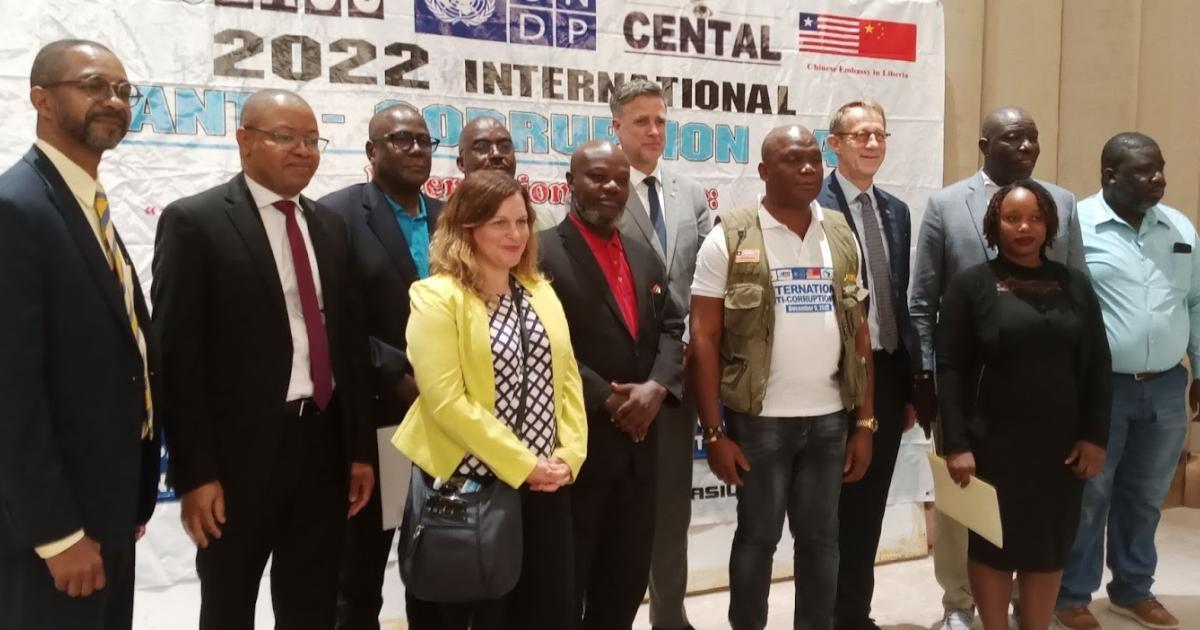
Nthara made the remarks on Friday, December 9 during this year’s observance of International Anti-Corruption Day held at the Ellen Johnson Sirleaf Ministerial Complex under the national theme: “Promoting Integrity and Accountability for Increased Citizens Participation in the Fight against Corruption.”
Nthara further said it is a major enemy because it is usually invisible, a silent killer, and yet has such a devastating impact on an economy, and on people’s livelihoods.
Nthara said the amendment to the anti-corruption law that gives the Liberia Anti-Corruption Commission prosecutorial powers sends a clear signal that the government is serious about the fight against corruption, while lauding the leadership of the three branches of government for the reforms.
He said this must now be complemented by ensuring that the LACC and judiciary are well resourced to do their jobs, stating that “this means ensuring that they have enough and qualified people, and they have adequate budgetary resources for their operation.”
Nthara said that given the high cost of corruption, the economic and social returns to investment in institutions of integrity and accountability would be even higher than the returns to investing in visible projects such as infrastructure.
“Given that we know about the cost of corruption, citizens must take it upon themselves to fight corruption in all its forms. They must not only say no to corruption but must demand accountability and action from their leaders. This requires a mindset change, because in most of our societies in Africa, corruption has become normal culture,” he said.
According to him, in monetary terms, the total cost of corruption globally is estimated at $3.6 trillion annually, and in contrast, the total cost of natural disasters in 2021 was $258 billion, which is huge but so much less compared to the cost of corruption.
Nthara said corruption is a major challenge to development and has a disproportionate impact on the poor and the most vulnerable, stating that “it increases costs and reduces access to services, including health, education, and justice.”
The Chairperson of the Liberia Anti-Corruption Commission (LACC), Cllr. Edwin Kla Martin, said that as Liberia joins other countries in celebrating International Anti-Corruption Day, it is extremely important for Liberians to strengthen all sectors of society in order to collectively declare a massive war against corruption.
Martin said he has realized that fighting corruption in Liberia requires extraordinary energy and courage.
Martin said Liberia must rise to the task in this contemporary era of ensuring that corruption is not entertained, encouraged, practiced, or maintained at any level of the country’s political governance.
“I still believe in the solemn pledge that we can all work to reduce incidents of corruption and to establish an atmosphere where all Liberians can equally benefit from the resources of this country,” Martin said.
He said the commission has encountered and is still encountering a series of challenges that are all attempts to distract them from their goals and weaken the war declared against corruption.
“The LACC under my leadership is deeply concerned about Liberia and its future—a future where corruption will no longer be the way of life and where our citizens can enjoy public assets and goods irrespective of political affiliations and creed. It’s our responsibility to have a national movement that tackles corruption from all angles of our society,” he said.
Martin calls on the Legislature to enact and pass a new law establishing a specialized court for the prosecution of corrupt public officials and private persons held liable for corruption offenses.
For More News And Analysis About Liberia Follow Africa-Press