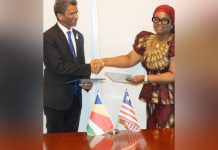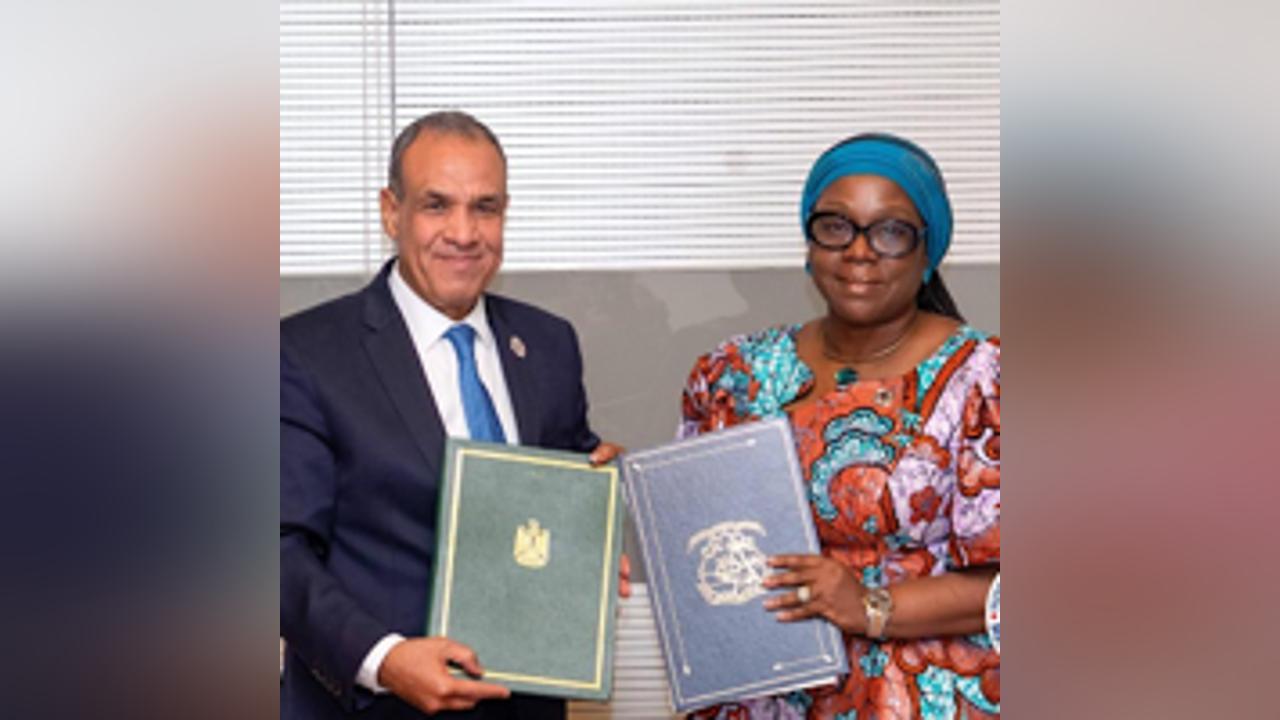
Africa-Press – Liberia. On the margins of the African Union Summit that began in Addis Ababa, Ethiopia, last week, Liberia and Egypt signed a Memorandum of Understanding (MoU) aimed at deepening cooperation in diplomatic training and academic exchange—an agreement many believe could significantly reshape Liberia’s foreign policy capacity at a critical moment in its international engagement.
The MoU was signed by the Minister of Foreign Affairs, Sara Beysolow Nyanti, and her Egyptian counterpart, Badr Abdelatty. The agreement establishes collaboration between the Gabriel L. Dennis Foreign Service Institute of Liberia and Egypt’s Institute of Diplomatic Studies, focusing on training programs, academic exchanges, joint research, and professional cooperation.
The signing comes just months after Liberia assumed a non-permanent seat on the United Nations Security Council (UNSC), a development that elevates the country’s diplomatic responsibilities and visibility on the global stage. During the ceremony, Dr. Abdelatty conveyed greetings from President Abdel Fattah el-Sisi to President Joseph Nyuma Boakai and congratulated Liberia on its UNSC election, expressing confidence in Monrovia’s ability to advance Africa’s interests.
For Liberia, the timing of the MoU is particularly strategic. As Chair of the Africa Group in New York this month, Liberia has been tasked with coordinating continental positions at the United Nations—an assignment that demands seasoned diplomacy, policy coherence, and technical expertise.
Minister Nyanti underscored this broader vision in a Facebook post, praising President Boakai’s leadership and highlighting Liberia’s expanded diplomatic engagements, including a breakfast meeting in Addis attended by nearly 25 countries and the opening of diplomatic relations with the Seychelles.
For Egypt, the agreement reinforces Cairo’s longstanding ambition to serve as a diplomatic anchor in Africa. By offering training opportunities and institutional partnerships, Egypt strengthens its soft power and deepens ties with a West African nation poised to play a larger role in global governance.
For Liberia, however, the benefits may be even more transformative.
First, the partnership seeks to address a longstanding institutional gap–the need to professionalize and modernize the country’s foreign service. The commitment by Egypt to sponsor five Liberians for diplomatic training represents an immediate and tangible gain. Over time, structured academic exchanges and joint research initiatives could help institutionalize best practices in negotiation, multilateral diplomacy, and strategic communications.
Second, the MoU complements broader discussions between the two countries on military, police, and intelligence cooperation, as well as energy and food security. Diplomacy, in this sense, becomes both a tool and a multiplier—strengthening Liberia’s ability to negotiate investments, coordinate security partnerships, and advance economic priorities.
Third, enhanced coordination on African positions at the United Nations could amplify Liberia’s voice. Egypt, a seasoned diplomatic actor with decades of multilateral experience, offers institutional memory and strategic depth that Liberia can leverage during its UNSC tenure.
At the heart of the agreement lies Liberia’s Gabriel L. Dennis Foreign Service Institute—a body that has historically faced resource and capacity constraints. The MoU effectively internationalizes the Institute’s mandate, linking it to a more established diplomatic training institution in Egypt.
A strengthened Foreign Service Institute could have far-reaching implications, Professionalization of Diplomacy—structured training ensures that Liberian diplomats are better equipped in international law, economic diplomacy, and conflict mediation; Policy Continuity—institutional knowledge reduces dependence on ad hoc appointments and enhances long-term strategic planning; Global Credibility—a well-trained diplomatic corps enhances Liberia’s image as a serious and competent international actor, and Economic Leverage—skilled diplomats are better positioned to negotiate trade, investment, and development agreements that align with Liberia’s national interests.
In a region where diplomacy increasingly intersects with security and economic competition, the development of a robust diplomatic academy becomes a strategic asset.
Beyond Training, Expanding Bilateral Horizons
Minister Nyanti welcomed Egypt’s proposals and suggested convening a Liberia–Egypt Business Forum, alongside a potential State Visit by President Boakai to Cairo in August. The Egyptian side welcomed the idea, signaling that the MoU may serve as a foundation for broader economic engagement.
Egypt has also invited Liberia to sign a Joint Commission Agreement in April, which could formalize cooperation across multiple sectors.
Political observers believe that such engagements align with President Boakai’s broader foreign policy strategy—leveraging Liberia’s UNSC seat and continental leadership roles to attract partnerships that strengthen domestic development goals.
The MoU is part of a flurry of diplomatic activity by Liberia during the AU Summit. Minister Nyanti highlighted bilateral talks between President Boakai and the Ethiopian Prime Minister, as well as Liberia’s participation in high-level discussions among African leaders and senior UN officials, including Deputy Secretary-General Amina Mohammed.
In many ways, the Liberia–Egypt agreement reflects a recalibration of Liberia’s foreign policy posture—from reactive diplomacy to proactive engagement.
While the immediate impact will be measured by the five sponsored trainees and upcoming exchanges, the long-term success of the MoU will depend on sustained implementation, funding, and institutional reforms within Liberia’s Foreign Service Institute.
If effectively executed, the partnership could serve as a cornerstone for a more assertive and technically proficient Liberian diplomacy—one capable of translating multilateral visibility into tangible national gains.
The MoU, for Liberia, is more than a training agreement, it is a strategic investment in the architecture of its foreign policy at a time when the country’s voice on the world stage has never been more consequential.
For More News And Analysis About Liberia Follow Africa-Press