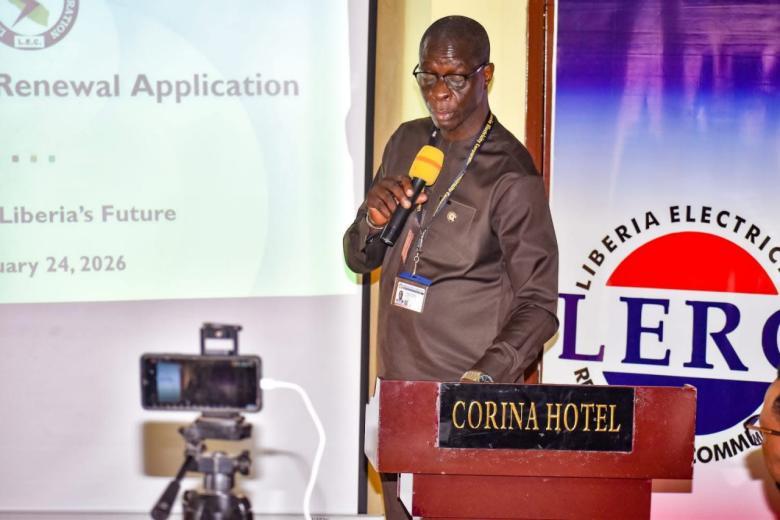
Africa-Press – Liberia. The Liberia Electricity Regulatory Commission (LERC) has conducted a public hearing on the renewal of the import license of the Liberia Electricity Corporation (LEC), bringing together public officials, development partners, private sector actors, and members of the general public.
The hearing, held at a hotel in Sinkor, forms part of the regulatory process required under Liberia’s electricity laws, which mandate public consultation before the renewal of utility licenses.
Presiding over the hearing, LERC Board Chairman, laude J. Katta, emphasized that the session was in line with statutory requirements governing the electricity sector.
He noted that public hearings ensure transparency and accountability in the regulation of utilities.
Chairman Katta officially called the hearing to order at 10:33 a.m., outlining ground rules to ensure orderly participation. He encouraged stakeholders to raise concerns during the session or submit written comments for consideration by the Commission.
The import license under review was originally issued to LEC in January 2021 for a five-year term and has now expired, prompting the renewal process.
Presenting on behalf of LEC’s management, Deputy Managing Director for Operations, Thomas Gonkerwon, explained that the import license is critical to addressing Liberia’s growing electricity demand.
He disclosed that LEC currently imports electricity primarily from Côte d’Ivoire and Guinea through regional power arrangements, noting that regional electricity trade within West Africa is expanding.
According to him, the full launch of the regional electricity market in 2026 is expected to enhance access to cross-border power supply.
Mr. Gonkerwon highlighted that electricity imports help bridge seasonal supply gaps, particularly during the dry season when hydroelectric generation declines.
He outlined LEC’s projected demand growth through 2028, pointing to an annual growth rate of approximately 11 percent. He further detailed ongoing and planned interventions aimed at strengthening domestic generation capacity, including: Expansion of hydro generation at Mount Coffee, Development of additional solar plants, Plans for new thermal generation projects, Introduction of 100,000 smart meters in 2026 to reduce technical and commercial losses.
According to LEC, these initiatives are aligned with Liberia’s electrification targets, including commitments to significantly increase access rates nationwide.
LEC also announced plans to pursue a 100-megawatt thermal plant expected to come online by 2027, contingent upon government approval.
The utility argued that early action is required given global energy market pressures and rising electricity demand driven by industrial growth and emerging technologies.
Officials emphasized that future thermal installations would comply with environmental standards and utilize cleaner technologies.
A representative of the House Committee on Mines, Energy, Natural Resources and Environment commended the Commission for subjecting LEC to public scrutiny, describing it as a demonstration of regulatory independence.
The lawmaker stressed that limited access to reliable and affordable electricity remains a major national challenge, particularly in rural communities.
He urged accelerated efforts to expand access, noting that energy plays a critical role in agriculture, mining, and job creation. The Assistant Minister for Energy also delivered remarks, reaffirming government’s commitment to improving electricity access and supporting sector reforms.
During stakeholder interventions, concerns were raised regarding the exclusivity of LEC’s role in electricity importation and wholesale supply. A representative from the Rural and Renewable Energy Agency (RREA) referenced provisions within the national grid code and regional electricity protocols, calling for the development of a market operational guideline that would promote competitive and open participation in electricity importation and procurement.
Private sector representatives similarly sought clarity on opportunities for public-private partnerships, particularly in power generation, distribution, and importation.
They emphasized that reliable and affordable electricity remains essential for economic expansion and business growth in Liberia.
The LERC indicated that it will review submissions and stakeholder feedback before reaching a determination on the renewal of LEC’s import license.
For More News And Analysis About Liberia Follow Africa-Press