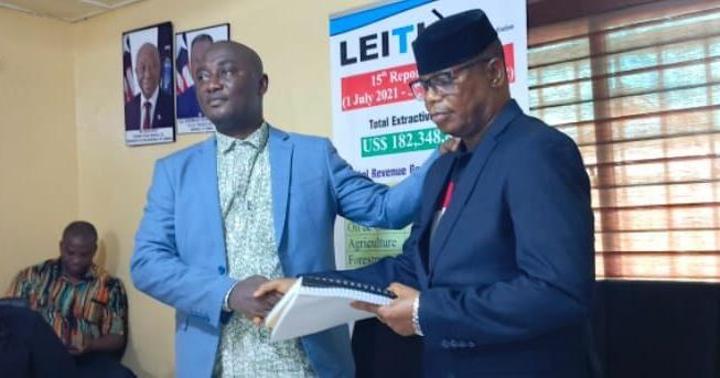
Africa-Press – Liberia. Liberia has taken another decisive step toward deepening transparency and accountability in the management of its natural resources with the official launch of the 16th Country Report of the Liberia Extractive Industries Transparency Initiative (LEITI), alongside a newly developed LEITI Data Portal and an Updated Simplified Contract Matrix.
The public release of the report followed a unanimous decision by members of the Multi-Stakeholder Group (MSG) at its fourth sector meeting, in keeping with the LEITI Act and the EITI 2023 Standard.
The launch ceremony was held on Friday in Monrovia and presided over by the Chairman of the MSG and Minister of Mines and Energy, R. Matenokay Tingban, who described the report as a landmark achievement in Liberia’s transparency journey.
“The 16th LEITI Country Report marks another important milestone in Liberia’s efforts to strengthen transparency and accountability in the management of our natural resources,” Minister Tingban declared. “Today, we are officially launching Liberia’s 16th EITI Report, the LEITI Data Portal, and the Updated Simplified Contract Matrix in line with the Act that created LEITI and the EITI 2023 Standard.”
Minister Tingban emphasized that the launch comes at a critical time as Liberia prepares for its next EITI Validation, scheduled to begin on January 1, 2026. He described the validation exercise as a top priority for the MSG, noting that the group is working to ensure Liberia achieves a strong outcome.
“The Multi-Stakeholder Group is fully aware of the validation process ahead and is ensuring that all the bits and pieces are put together so that when Liberia goes for validation next year, we come up with a very strong mark,” he said. He explained that under the EITI framework, countries are required not only to produce comprehensive reports but also to ensure open access to data and full disclosure of extractive contracts.
A major highlight of the event was the presentation and live demonstration of the LEITI Data Portal by the Head of Secretariat, Jeffrey Yates, who said the platform was designed to make extractive sector data simple, accessible, and understandable to ordinary citizens.
“When you’re looking for key data from the extractive sector, you can go to the report, but you can also just come here,” Yates explained. “The portal gives you summarized data that is easy to understand.”
He noted that the portal provides sector-by-sector overviews of mining, forestry, agriculture, and oil and gas, showing their contributions to Liberia’s economy and GDP from 2007 to 2022, when EITI implementation began in the country.
“You don’t need to be flipping books. You just click on the dots for a particular year, and it tells you the contribution of each sector to the economy and GDP,” he said.
According to Yates, the portal meets all key EITI disclosure requirements, including revenues, production volumes and values, exports, employment figures, and ownership information. Employment data are disaggregated by gender, while beneficial and legal ownership information allows users to search company ownership across the mining, oil and gas, forestry, and agriculture sectors.
“We didn’t just leave it vague,” Yates said. “We made it sectorial and very easy for people to assess. You search the company name, and you get the beneficial ownership information.”
The portal also enables users to compare what government institutions report as revenue received with what companies report as payments made, allowing discrepancies to be easily identified. It further discloses active mining licenses by class, including Class A, B, and C, as well as exploration and prospecting licenses.
Yates added that extractive contracts are now directly linked through the portal to the LEITI Contract Library, while all approved LEITI reports, special studies, post-award reviews, and mainstreaming reports are also hosted on the platform.
Reading from the official press statement, Minister Tingban disclosed that the Government of Liberia received a total of US$152.46 million in extractive sector revenue between January 1 and December 31, 2023. The mining sector contributed the largest share, followed by agriculture, forestry, and oil and gas.
The report further revealed that US$1.352 billion worth of extractive commodities were exported during the reporting period, dominated by gold, iron ore, rubber, crude palm oil, and diamonds. Company-level disclosures showed that Bea Mountain Mining Company, Western Cluster, and ArcelorMittal Liberia accounted for the bulk of export values during the year.
On employment, the extractive sector employed 19,345 people, comprising 16,602 males and 2,743 females. The report also noted that Bea Mountain alone employed 1,110 permanent foreign workers during the reporting period.
In a major governance disclosure, Minister Tingban announced that the MSG had identified suspicious transactions involving the Liberia Petroleum Regulatory Authority, ArcelorMittal Liberia, and the Liberia Revenue Authority. He disclosed that the MSG has mandated the LEITI Secretariat to forward the matter to the Liberia Anti-Corruption Commission for further investigation following the launch of the report.
Minister Tingban said the report will now be disseminated nationwide to engage citizens, solicit feedback, and strengthen extractive sector governance. He also disclosed plans for an MSG retreat in Grand Bassa County to review and approve validation templates ahead of Liberia’s 2026 EITI Validation.
He expressed appreciation to development partners, stakeholders, and the Government of Liberia, while commending the LEITI Secretariat for working under difficult conditions.
“Let me assure all stakeholders, especially our development partners, that LEITI will continue to play its role in ensuring that Liberians benefit from their extractive resources,” he said.
However, the Minister issued a stern warning to institutions that failed to cooperate during the reporting process, stressing that compliance with LEITI is a legal obligation.
“The LEITI process is backed by law through an Act of the National Legislature, and as such, the law will apply to anyone who refuses to cooperate with the process, going forward,” he cautioned.
For More News And Analysis About Liberia Follow Africa-Press