CLAUDIUS T. GREENE JR.
Africa-Press – Liberia. Imagine walking around Montserrado County and seeing people living in houses made of plastic bottles.
The concept might appear rather bizarre, but, for the YMCA, it could be a breakthrough solution for Liberia on multiple levels.
“Our country is facing a dual challenge: inadequate housing for many of our citizens and the disastrous impact of plastic pollution,” says Ebenezer Saah Davies, YMCA National Youth Council President. “The project we are about to embark on is to pioneer a solution that addresses both issues simultaneously.”
The ingenious idea involves repurposing plastic bottles, an often overlooked and abundant waste material, as a substitute for traditional building materials.
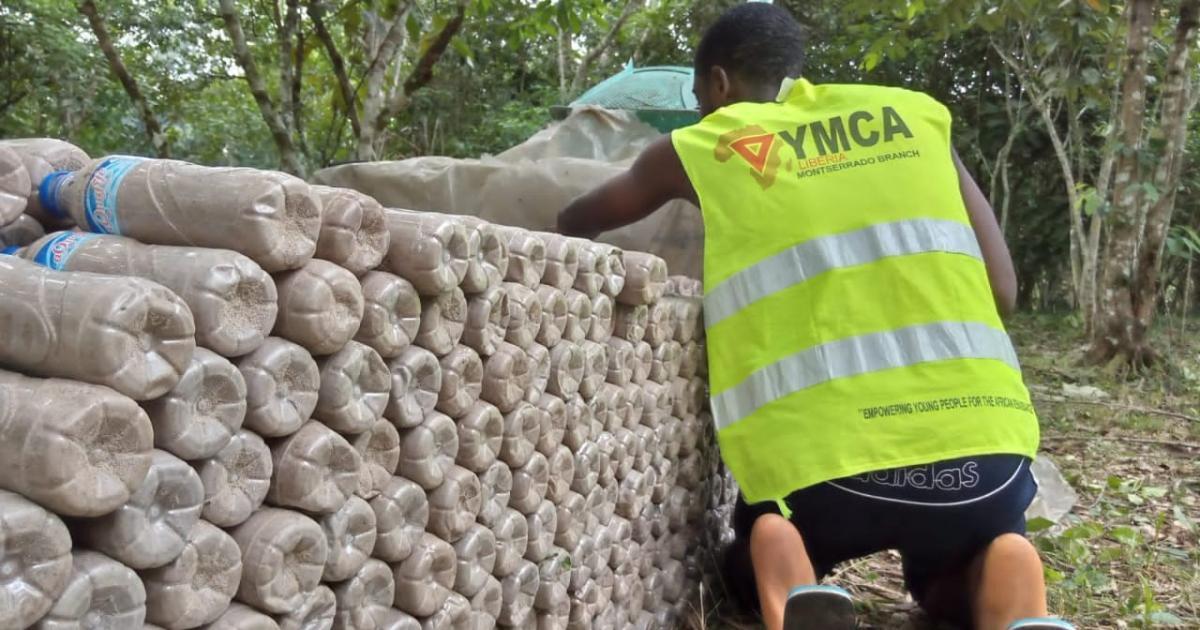
Understanding the potential of these discarded bottles, the YMCA, a Christian-led organization committed to social development, has begun collecting thousands of plastic bottles to be meticulously cleaned and sorted according to size — effectively transforming them into a resource rather than a pollutant.
The target, according to Davies, is 50,000 bottles. So far, nearly half have been collected, and are being packed with sand, which would then be turned into eco-bricks.
They would be laid horizontally, one on top of the other, and bound together to create a solid building unit that possesses excellent insulating properties.
These eco-friendly “bottle bricks” would be secured together with mud or cement, assisting in creating sturdy walls that can withstand the elements.
“One of the primary objectives of the initiative is to showcase the economic and environmental benefits of utilizing plastic waste in construction.
“Traditional building materials contribute significantly to carbon emissions and resource depletion. The ambitious project to shine a light on sustainable living and provide a blueprint for a cleaner, greener future while combat Liberia’s ever-growing environmental crisis head-on,” Davies says.
Plastic pollution has become a global crisis, with devastating impacts on ecosystems, and Liberia, like many other countries, faces significant challenges in managing plastic waste.
With limited recycling infrastructure and limited public awareness, the issue continues to escalate, posing severe threats to the environment and public health.
But the concept of using discarded plastic bottles to build homes as a means of tackling plastic pollution was first introduced by the pioneering work of Andreas Froese, a German environmental activist.
Motivated by the desire to address both the housing shortage and plastic pollution, he developed this innovative solution to transform waste into livable spaces.
The idea however took off in India, and South and Central America and had been applied since to provide a cost-effective, environmentally-friendly alternative to conventional building bricks.
And in 2011, a Nigerian named Yahaya Ahmed of the Nigeria Development Association for Renewable Energies built West Africa’s first “plastic bottle house” in the village of Yelwa, Kaduna State, which went on to become a tourist attraction.
Ahmed, according to the BBC, estimated that a bottle house cost one-third of what a similar house made of concrete and bricks would cost and it is also more durable.
The three-room house, which contained a toilet and a kitchen, needed more than 10K sand-filled plastic bottles to be built.
And for Liberia, the YMCA, which believes that a compacted sand bottle house is stronger than bricks, is intended to construct the country’s first-of-its-kind house in Camp Todee, Todee District, rural Montserrado.
The house, which is expected to be a two-bedroom and contains a palaver hut, will help YMCA overcome limited lodging facilities at its rural camp for activities.
“Bottle houses are also ideally suited to Liberia because of the hot weather as the sand insulates them from the sun’s heat, helping to keep room temperatures low,” says Davies. “And because of the compact sand, they are bullet-proof — which may also prove even more attractive in more insecure parts of the north.”
However, the proposed house, whose environmental benefit is immense, still needs a concrete foundation laid to ensure that the structure is firm and stable.
According to experts, to build with plastic bottles, sand needs to be sieved to remove the stones otherwise it will not be nice and it would not be able to pass through the mouth of the bottle.
“Beyond the environmental benefits, bottle houses offer numerous advantages,” Davies argued. “It ensures affordability, creating an accessible housing solution for the economically disadvantaged.
“And the insulation improves indoor temperatures, alleviating the need for excessive cooling or heating, thereby reducing energy consumption,” he added.
While Liberia generates a significant amount of plastic bottle waste annually, even though most water in Liberia is sold in small plastic bags, the YMCA’s ambitious project has been met with curiosity and skepticism, though experts assert that the ideal has been proven to be realistic.
One of the primary challenges the project faces is the need to ensure the plastic’s quality and strength in constructing the house.
The YMCA, according to Davies, is mindful of this and would work with experienced engineers and architects, and environmental experts to guarantee a safe, secure, and sustainable structure.
“The YMCA’s plastic house project seeks to provide a sustainable and cost-effective solution that can be replicated and scaled up to address the country’s housing challenges. Liberia, like many developing nations, faces a shortage of adequate housing, particularly for low-income communities.
“The house’s design will incorporate innovative techniques, demonstrating the feasibility of plastic-based construction while raising awareness about the benefits of recycling and responsible waste management,” Davies noted.
For More News And Analysis About Liberia Follow Africa-Press