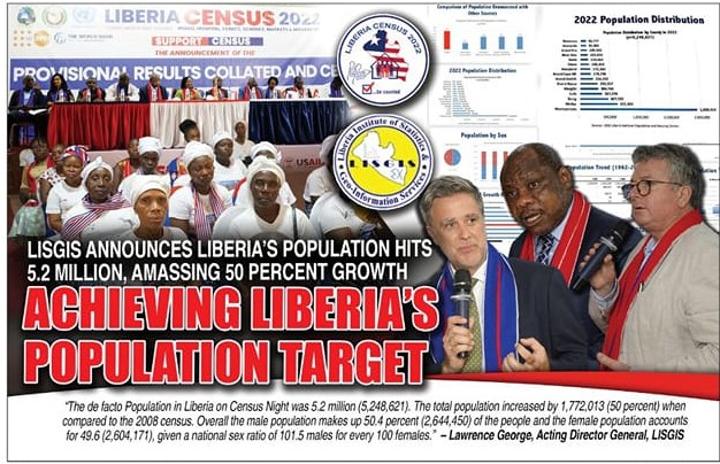
Africa-Press – Liberia. Liberia Institute of Statistics and Geo-Information Services (LISGIS) has announced that Liberia’s population is now 5,248,621, an increase of 50 percent in the last 15 years.
Announcing the provisional results of Liberia’s first digital census on Wednesday, LISGIS’ Acting Director General, Lawrence summed the provisional results up when he said, “The de facto Population in Liberia on Census Night was 5.2 million (5,248,621). The total population increased by 1,772,013 (50 percent) when compared to the 2008 census. Overall the male population makes up 50.4 percent (2,644,450) of the people and the female population accounts for 49.6 (2,604,171), given a national sex ration of 101.5 males for every 100 females.”
If the population trend continues, Liberia’s population is expected to double in the next 23 years, Mr. George said.
He said a total 1,187,388 households were enumerated with an average national household size of 4.4 persons, while the national population density is 140 persons pers square mile.
The 2022 LNHPC was marred by a plethora of problems, ranging from chaotic recruitment exercise and administrative lapses that led President Weah to sack two of LISGIS’ senior administrators while on his foreign trip.
In the President’s absence, Vice President Taylor joined LISGIS’ Board of Directors to rally Liberians to support the census.
Speaking at the announcement of the provisional results at the Monrovia City Hall, VP Taylor thanked Liberia’s development partners including the United Nations system in Liberia, United States, Sweden, Ireland, EU and Ghana for supporting the census.
She said the success of Liberia’s first digital census has paved the way to integrate digital system in all sectors. She called for the setting up of a postal system.
Speaking earlier, the Chairman of LISGIS Board of Directors, Finance and Development Planning Minister Samuel Tweah thanked President George Weah for his “exemplary” leadership role in guarding the census to a successful conclusion. The data, Tweah said, will be used in Liberia’s development drive and thanked the partners for their unflinching support to the process.
The event was also attended by Liberia’s development partners. Leading the One UN System, the new UN Resident Coordinator, Christine N. Umutoni hailed Liberia’s the conduct of the second National Population and Housing Census during the peace era by Liberia as a significant milestone.
The release of the provisional results, Madam Umutoni said, means that Liberia now has reliable new and multisectoral data that the government and its partners can all use immediately and going forward.
With the analysis of the Census data based on the various thematic areas, she noted that there will be updated demographic, social, and economic data to support Liberia’s development activities and for tracking the implementation of development goals.
“It means that the Census will provide updated data to aid policies to reduce inequality across various sections of society; and decision-making for future government services based on specific population needs and location and distribution,” she said.
World Bank Country Manager Khwima Nthara said now that the data has been collected, it is now time to use it in the country’s development drive. He pledged the Bank’s continued support to Liberia.
More statistics
The provisional results of the 2022 National Population and Housing Census (LNHPC) as announced so far, almost bear similar pattern with the 2008 census results.
Montserrado County with 1.9 million people, accounts for 37 percent of the total population enumerated, followed by Nimba County, with a population of 621,841 (12% of the population). Bong sits third with 467,502 (9%) and Lofa followed with 367,502 population (7%). These four counties accounts for 65% of the total population, according to LISGIS.
The four least populated counties including Rivercess – 90,777 (1.7), Gbarpolu – 95,995 (1.8%), Grand Kru -109,342 (2.1%) and River Gee – 124,653 (2.4) account for less than 4% of the total national population.
The other counties’ population include Bomi: 133,668; Sinoe: 150,358; Maryland: 172,202; Grand Cape Mount: 178,798; Grand Gedeh: 216,692; Grand Bassa: 293,557 and Margibi: 304,946.
High population growth rate
As announced by LISGIS, Liberia’s population growth rate of 3 percent is among the highest in the Mano River Union (MRU) region. Only Sierra Leone tops Liberia with a growth rate of 3.2. Guinea and Cote D’ivoire lag behind with 2.4 and 2.5 growth rates respectively.
About the 2022 LNPHC
The 2022 National Population and Housing Census is Liberia’s first complete digital census in 5th in its 175-year history. The last census, conducted in 2008 put Liberia’s population at 3.4 million people.
According to LISGIS, it used state-of-the-art geo-spatial, census monitoring dashboard and Computer Aided Personal Interview (CAPI) technology in all aspects of its implementation. It furthered that as a comprehensive digital census, it leveraged the available technology to improve operational efficiency and enhance the quality of the data collected.
Amid complaint that some households were not reached, LISGIS said about 16,562 Census Enumerators and Supervisors visited households nationwide, counted and collected detailed information on nearly all persons that spent the Census Night (November 10, 2022) in their respective households.
The actual Census enumeration was conducted from 14th November to 20th December 2022, with a mop-up exercise from 27th December 2022 to 7th January 2023.
The data presented will be used as provisional figures until the final results are released by the end of May 2023, LISGIS said; adding that the completeness of the 2022 LNPHC is ranked at 97 percent, which is an internationally acceptable achievement. LISGIS had targeted a population of 5.3 million.
The next step
The data presented will be used as provisional figures until the final results are released by the end of May 2023, LISGIS said; adding that the completeness of the 2022 LNPHC is ranked at 97 percent, which is an internationally acceptable achievement. LISGIS, he said, had targeted a population of 5.3 million.
The next step, according to LISGIS, is to present the provisional census results to the Legislature, recruit specialists to analyze the census data and produce report on the thematic areas covering population size and composition, housing condition and characteristics, fertility, mortality, nuptiality, migration and population redistribution.
Other thematic areas include poverty dimension, labor force and employment, disability and special population, education and literacy, gender dimension, agriculture, population projection, health and sanitation, youth and adolescent.
In addition, LISGIS will conduct post enumeration survey (PES) to determine the census completeness, coverage and content errors produce the final census reports and disseminate by May, 2023.
For More News And Analysis About Liberia Follow Africa-Press