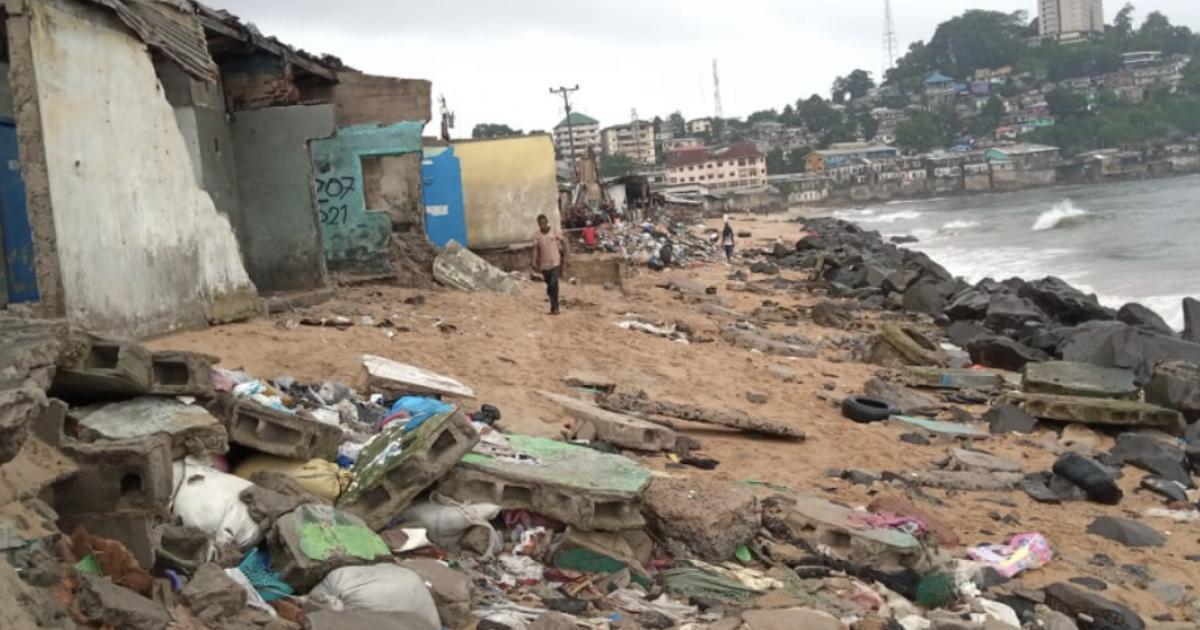
Africa-Press – Liberia. The City Government of Monrovia has launched the Monrovia Grow Green (MonGrow Green) project with the aim of addressing climate change-related crises, including flooding and sea erosion.
The project will also seek to transform Monrovia into a safer, cleaner, greener, and more inclusive city through participatory climate change mitigation and adaptation interventions.
In implementing the project, the Monrovia City Corporation (MCC) will work with migrants and displaced communities to plant 20,000 mangrove and coconut trees to establish green corridors along the former Somalia Drive, now the Japanese Freeway; West Point and New Kru Town coast lines; and along the Mesurado River.
These trees will serve four main purposes: balance the soil, provide a green and shady environment for residents, absorb excess soil and groundwater, and absorb carbon emissions emitted by human activities.
Most importantly, the project aims to provide livelihoods to climate migrants and internally displaced persons (IDPs) and provide public awareness and sensitization on climate mitigation and adaptation mechanisms.
The project shall directly impact 150 climate migrants and IDPs between the ages of 18 and 35, and the second group will be 36 years of age and above, comprising only women, through livelihood training and business support.
The MonGrow Green project is supported by the Mayors’ Migration Council (MMC) through the Global Cities Fund for Migrants and Refugees, the MMC’s response to the unmet needs of cities as they support migrants, refugees, and internally displaced people (IDPs) in the face of pressing challenges, from global pandemics to the climate crisis.
By directly funding cities to implement inclusive programs of their own design, the GCF builds precedents for fiscal feasibility in city governments that are often disregarded by donors with low risk tolerance.
The GCF is led by the MMC in partnership with six key strategic partners: the C40 Cities Climate Leadership Group (C40 Cities), Metropolis, the UN Migration Agency (IOM), United Cities and Local Governments (UCLG), the United Nations Human Settlements Programme (UN-Habitat), and the UN Refugee Agency (UNHCR).
Giving an overview of the project, the Field and Safeguard Officer of the project, Fayiah Yonda, indicated that the project will do everything to ensure that the right people, who are actual victims, benefit, as demonstrated by the due diligence mechanism carried out by the project team after the selection of internally displaced persons was done in collaboration with the community leaders.
He stressed that Mayor Jefferson Koijee’s commitment to empower women aligned with the project’s objectives to recruit more women and young people, who are considered more vulnerable to the adverse effects of climate and pandemic-related circumstances.
According to Yonda, the skills training and business stimulus aspects of the projects will be implemented with utmost seriousness and periodic follow-ups so that those who receive the opportunities can help themselves.
“We don’t want you to mismanage the money that will be given for business.” So, we will train you on how to manage business funds. We will do follow-ups to ensure that you are actually doing the business the project empowers you to do. The same will be true for skill training for young people under the age of 35.”We will identify the schools and make sure those selected attend,” he emphasized.
Speaking at the official launching program in proxy on behalf of Mayor Jefferson Tamba Koijee, Monrovia City Corporation (MCC) Director General for Internal Operations, Cain Prince Andrews, encouraged the selected communities, especially the 150 beneficiaries, to take ownership of the project, stressing that the extension of the project depends on the positive response.
“There are three things I want you all to consider as you embark on this journey; we want you to protect the environment, be careful on how to protect the environment, stop building in the waterways, and take maximum precaution.”
“Secondly, protect the trees because there are people who do not want to see these things happen.” We, ourselves, can do this through local ownership. “The trees do a lot of things.”
“And finally, let’s work together with the city government as my able boss, the lord Mayor Jefferson Tamba Koijee, believes in inclusion,” Andrews stressed.
For More News And Analysis About Liberia Follow Africa-Press